

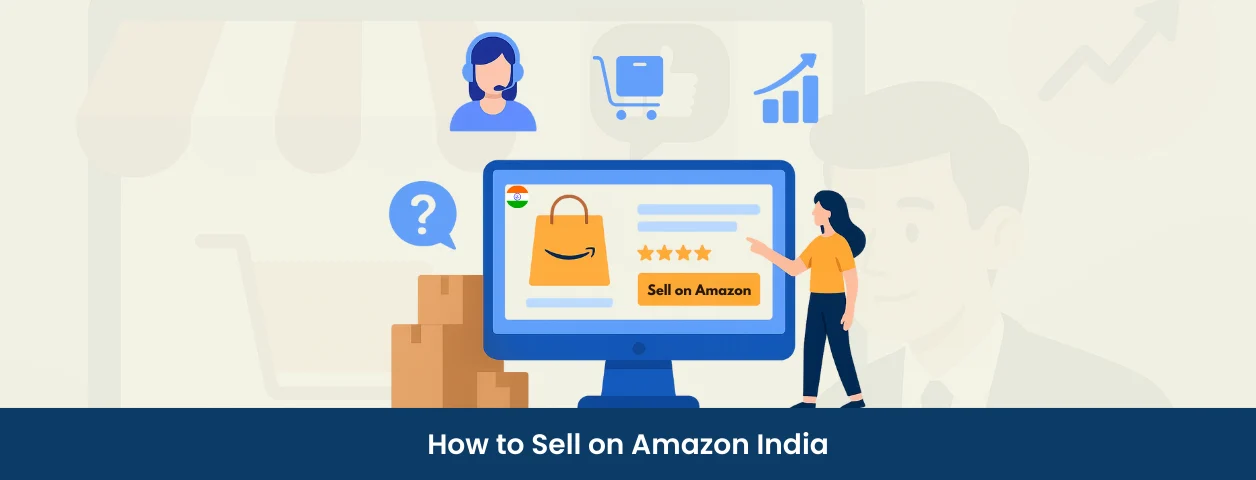
Amazon India has become one of the most trustworthy eCommerce platforms in this rapidly growing online market. With over 300 million registered users, Amazon India offers an opportunity for its sellers to reach customers across and beyond the country.
Even if you are a beginner or an experienced seller, understanding how to sell on Amazon India is a must to be known. From choosing the right products, managing inventory, fulfilment, and marketing, every step determines your profit and success in this field.
This comprehensive guide walks you through the top-selling products on Amazon India, market trends, practical business models, step-by-step instructions, and the cost and profit breakdown of a basic seller on the Amazon platform.
Key Takeaways:
- Amazon India continues to grow successfully, supported by government policies, and the rise of internet usage makes it a perfect platform for online sellers.
- To sell on Amazon, it require some essential documents and bank details, but the entry barriers are relatively low compared to other platforms.
- Effective product sourcing and choosing the right business model can enhance your margins and customer satisfaction.
- Leveraging Amazon’s seller tools and advertising options can boost your visibility and rank your product for more sales.
- With the right strategy and approach, sellers on Amazon India can make it a viable business or even a profitable side income source.
What is Amazon India?

Amazon India is one of the largest online marketplaces in the country, connecting sellers with customers across every major city and town. It offers a ready-to-use selling platform where individuals and businesses can list their products, manage orders, and grow their brand without even building their own website or logistics system.
Insigghts India’s report reveals that India’s overall eCommerce market is projected to reach ₹17.7 trillion ($211.6 billion) in 2025. This represents a year-over-year growth rate of around 12.5%, with forecasts suggesting the market will reach ₹27.3 trillion ($326.7 billion) by 2029. This growth is accelerated by factors such as:
- Rise of the internet and smartphone adoption, especially in rural areas.
- Normalised digital payment methods like UPI and credit cards.
- Increased trust in online shopping among Indian consumers.
Amazon India acts as a bridge platform between sellers and buyers. Once you list your products, Amazon adds them to its platform store and showcases them to its millions of users every day. Amazon also supports their sellers through tools for marketing, pricing, inventory analytics, and customer service.
Why Should You Sell on Amazon India?
Amazon India offers a vast customer base with firm trust and an easy-to-start business model, where anyone can start selling their products within a few hours. The platform provides its sellers with lots of advantages, and some of them are:
- Massive customer traffic and broader reach.
- Easy registration or onboarding and product listing.
- Reliable payment gateways and customer support.
The sellers also benefited from Amazon’s logistics network, professional delivery services, and built-in marketing options like Sponsored Products and Lightning Deals.
Is Selling on Amazon Profitable in India?
Selling on Amazon India can be profitable, especially if you choose the right products and understand how Amazon’s cost fee structure works. Many sellers earn consistent income because the platform already has massive traffic and strong customer trust.
Profitability mainly depends on product research and competitive pricing. Profit can drop if you choose common product categories or spend too much on ads. There are also chances of high return rates, poor reviews, and stockouts, which can affect visibility and reduce your total profit margin.
Consistent optimisation and managing replacements effectively are the keys to increasing and maintaining reasonable profits. Print on demand model usually offers higher margins because it provides branding and product value control. The retail and wholesale models have a quicker turnover but provide lower profits.
Overall, Amazon India is a profitable business for sellers who implement data-driven decisions, focus on quality, and build an attractive product dashboard. With the perfect strategy, your online store on Amazon can become a long-term business.
What to Sell on Amazon India?

You can sell almost any consumer product on Amazon, as long as it meets their guidelines. The marketplace supports multiple product categories, allowing sellers to start small and expand after scaling the growth of their business.
Yet, choosing the right product category helps you build a profitable business sooner. Based on current market data and consumer trends, here are some of the most profitable and high-demand categories on Amazon India:
- Electronics: Top-selling items include smartphones, smartwatches, power banks, Bluetooth headphones, smart home devices, and wireless chargers.
- Fashion and Apparel: Indian consumers prefer casual clothing and affordable options over luxury brands. This includes T-shirts, sarees, footwear, and jewellery.
- Home and Kitchen: Everyday essentials such as air fryers, microwave ovens, kitchen gadgets, and home decor products are performing well in the online sales platform.
- Beauty and Personal Care: Because of the increased self-care awareness, items like skincare products, soaps, shower gels, and body lotions are in huge demand.
- Baby Products: Online marketplaces are also being supported with the sale of baby products like diapers, baby shampoo, wet wipes, feeding bottles, and baby clothing.
- Grocery and Foods: Items like organic food, spices, nuts, tea, coffee, and packaged snacks are selling great on platforms like Amazon, especially during festivals.
- Pet Supplies: Pet food, grooming supplies, toys, and customised pet products like pet tags and pet t-shirts are gaining popularity among pet lovers.
- Health and Fitness: People are aiming to be diet and health-conscious and are attracted to fitness products like vitamins, supplements, immunity boosters, gym equipment, yoga mats, dumbbells, and other related products.
Additionally, utilising Print on Demand products like printed books and any other handmade products sourced directly from Indian manufacturers, or choosing any product category depending on the situation, helps you grow your business steadily.

How to Sell Products on Amazon India?
Amazon provides various tools, logistics and other support that make your entire online selling process smooth, even if you have no eCommerce experience. To sell on Amazon India professionally, a structured approach is required, which is explained in a step-by-step process below:
Step 1: Choose Your Business Model
Before you create an Amazon Seller account, you must understand what are the business models suitable for Amazon, because the model you choose impacts your investment, profit margin, and daily operations. Amazon India supports multiple models; some of the primary choices are:
a. Retail Model
The retail model is the simplest entry point into the eCommerce business, where you simply source products locally at lower prices and resell them on Amazon at your markup price. This approach requires a minimal initial investment, but it allows you to test the market quickly.
It also has some challenges, like lower profit margins, high competition in popular items, and the risk of unsold inventory, which makes it mainly suited for local business owners seeking online expansion, beginners who are ready to invest only a little, and sellers with existing inventory.
b. Wholesale model
This model answers the question of where to buy products to sell on Amazon India. You can purchase a bulk of goods directly from authorised brands or distributors at wholesale prices, then sell the products online. It offers stable margins and repeat orders but requires brand authorisation and a higher upfront investment.
Sellers with existing storage and those who are ready to spend higher capital, targeting established product categories, and also having a relationship with authorised brands, can make use of this business model in their Amazon selling journey.
c. Dropshipping Model
Dropshipping is the most efficient model, where you never need an inventory. Instead, when a customer orders on Amazon, you forward the order to your dropshipper, who handles packing and shipping directly to your customer.
Partner with the best dropshipping suppliers or manufacturers, list their products on your Amazon store with an added price as your profit, order the product from your supplier, and the marked price difference from the supplier price is your profit.
Sellers with limited capital, who want to test new niches without financial risk, and entrepreneurs seeking to scale the business quickly without logistics hassles, dropshipping stands out as the first and best option.
d. Print On Demand (POD) Model
The print on demand business model allows you to sell custom-printed products without manufacturing or holding any inventory. After you find a reliable print on demand provider, you only focus on designing the products, and your POD partner handles production and shipping.
You can design products using templates or custom artwork, list them on your Amazon store with your own branding, and collect orders from the store, forward them to your POD service provider, where they will print and ship your product to customers.
India’s best print on demand fulfilment platform, Qikink, offers its sellers many advantages and options that make their online selling business in India efficient and scalable. Qikink, being the top considered platform, offers both print on demand and dropshipping services and gains its name and popularity among the Indian online sellers.
e. Amazon Merch on Demand

Amazon Merch on Demand is Amazon’s own print-on-demand service exclusively for the US market. This service is not available directly in India, yet some Indian sellers use their US bank account and other details to sell on Amazon’s Merch on demand.
Best suited for designers, content creators with existing audiences, and people seeking passive income ideas, despite lower earnings per sale. It also has some limitations, like the strict approval process and high competition from established designers.
Similar to the print on demand model, sellers upload their designs to the platform, and Amazon handles the production, shipping, and customer service, where as a seller, you can earn royalties from each sale of your product.
Step 2: Create an Amazon Seller account

Ensure all documents are clear, legible, and not blurry. Then navigate to the Amazon Seller Central page, click the ‘Start Selling’ button and begin registering your Amazon Seller account. You can choose from any of the two account type options: 1) Individual Account, or 2) Professional Account, with respect to your limitations.
Before registering, ensure you have all the necessary document requirements for selling on Amazon India.
Requirements of an Amazon Seller Account:
- PAN (Permanent Account Number) card,
- GSTIN (GST Registration Number),
- Bank Account details,
- Address proof,
- Other Identity proofs.
Following that, you have to fill in the details like,
- Your full name, as mentioned in the PAN card.
- Email address and proper mobile number, for OTP purposes.
- Business type: either Individual, Sole Proprietor, Private Limited Company, Partnership or LLP (Limited Liability Partnership).
- Your business store name, which should comply with the legal requirements for selling on Amazon India.
Once verified with your basic details, you will be moved to the next page to enter the GST and other tax information. Amazon will verify your GSTIN directly with the GST database after you upload your GSTIN certificate (with Annexures A and B) in Amazon’s required format.
GST approval takes approximately 48 to 72 hours, after which you will be required to fill in your bank details, with
- Registered name as the bank account holder’s name,
- Account number,
- IFSC code,
- Proofs for address and identification as required.
The address you register will be your pick-up address, so it must be in the same state as your GST registration. If you have multiple warehouses, you can also add additional addresses later in the Amazon Seller Central settings.
Step 3: List Your Products

After registration, the process leads to listing your products on your store dashboard. Product selection is the foundation of your profitable business. Choosing the right product reduces competition and increases the chance of steady sales.
In your seller dashboard’s inventory, you can add products individually or in bulk. For the first few products, add them individually to ensure quality. For each product, remember to provide,
- Clear, descriptive title with keywords used in both the product title and description, and select the relevant product category.
- Key features in bulletins, like the material made of, size, colour and compatibility, also add a unique product code to track your inventory sales.
- Upload 6 to 8 high-quality images showing the product from different angles, with the main image on a white background.
- The quantity of the product that is readily available and the price of the product are consistent with profit margins and GST calculated.
Before listing the products, choose the source or the business model you are going to trust, from which you will receive your products for your store. Compare cost, delivery time, quality, and packaging before selecting a supplier.
Start selling custom T-Shirts on Amazon using Print On Demand

Step 4: Manage Shipping, Fulfilment and Pricing
Define your shipping charges based on weight, destination, and fulfilment method. Amazon provides two fulfilment methods for its sellers in handling their shipping and delivery.
- Fulfilment by Merchant (FBM): You pack and ship products yourself using your choice-based courier. Slower process, but allows you to control quality and costs.
- Fulfilment by Amazon (FBA): The platform handles your product packing, shipping, returns, and customer service. Faster delivery, but Amazon charges a fee for fulfilment.
You can also choose your own courier, considering factors like courier rates, packaging weight, destination and delivery timeline. There are shipping calculators that help to estimate costs and give us a clear idea of selecting a seller and a courier partner.
While pricing, ensure your bank account is linked correctly. Amazon deposits seller payments every 7 days into this account. Check whether your online banking is active and that your bank supports digital fund transfers. Your profit will be determined by the smartness in the product pricing, for which you can implement some tips, such as
- Competitive pricing based on the market average.
- Occasional, seasonal and festival discount offers.
- Using Amazon’s Automated Pricing tool for real-time pricing adjustments.
Check competitors’ prices for similar products, and if your price is too high, your products won’t get visible on the top page. Also, if your price is lower, your margin of profit will also be lower. Always try to target competitive pricing while maintaining a profit, excluding the platform fee, GST and other fees.
Step 5: Scale Your Business

You have now successfully started your online selling business on the Amazon Seller Central platform, but just beginning to sell online does not complete the topic. Analysing and scaling your business brand is also included in this section.
Always check that the product name, title and descriptions are properly mentioned and follow the policies of Amazon, without any trademark or copyright infringements. After each sale, ensure you will mostly receive positive feedback, which can be gathered to display upfront. You can also follow some ethical strategies for improving the reviews, like
- Sending follow-up emails requesting honest reviews (Amazon allows this within 30 days of delivery).
- Offering excellent product quality and customer service to encourage more natural reviews.
- Responding positively to every negative review and try to build brand trust.
- Avoiding incentives for positive reviews, which could break the Amazon guidelines.
These are also indirect promotions to your store, as every product needs its own promotion to reach the required customer. Try using sponsored advertisements, deals, offers, discounts and targets to increase customer conversions.
After each sale, analyse the record of sales for each product category and revise pricing accordingly. Try to research the trends to move your product, according to the market, which will help you scale your business effectively.
Step 6: Handle Returns and Customer Service
While monitoring your sales records, there will be a stage of returns and refunds, where orders get cancelled in large numbers for no reason. Amazon always prioritises customer satisfaction, which should be handled professionally. So, managing the post-sales process and progress is also vital while starting to sell through the Amazon Seller Central dashboard.
Amazon customers can initiate returns within 30 days for most products. For FBM, you are allowed to decide the return policy and process, and for FBA, Amazon handles the returns or replacements automatically. Always take a little extra care to inspect the returned items and issue refunds properly.
Customer service at the Amazon platform should be legitimate, and as a professional seller, you should respond to your customers’ inquiries within 24 hours and solve their problems smoothly and quickly. There will be issues and complaints while selling products online, but learning and improving from the mistakes makes you stand out as a successful brand.
Cost of Selling on Amazon India

Selling on Amazon India does not require a heavy upfront investment, but understanding the different fees involved will be helpful in planning your seller subscriptions. The cost breakdown depicts how the fee or cost structure in Amazon will affect your final profit margin and helps you price your products correctly.
Amazon charges sellers based on the type of product, size, weight, and fulfilment method. The main fee structures include:
- A percentage of the total amount as a referral fee, charged by Amazon for every sale. It usually ranges up to 25%, depending on the different product categories.
- A closing fee, which is fixed per order based on the price slab of the product.
- A shipping fee is charged when using the Amazon Easy Ship option, which varies based on weight and delivery zone.
- A storage fee, along with the fulfilment charges, will be required when you choose the Fulfilment by Amazon (FBA) option.
These fees are automatically deducted later from your payout, so you do not need to pay anything upfront. Other than the primary fee costs, there will be packaging costs, advertising costs, promotions costs and other additional costs for designs or taxes.
The fee also differs by the account type. An Individual account limit of 40 orders per month with a basic pricing fee, where a Professional account requires its users to pay ₹499 monthly (with GST), which unlocks unlimited sales and ads, and allows for quick processing for anyone selling over 40 orders a month.
For instance, you are selling an oversized t-shirt at ₹599, where,
- Product cost: ₹249
- Fulfilment and shipping charge: ₹100
- GST or tax charge: ₹50
Subtracting these costs from your marked prices gives you a profit of ₹200 for each T-shirt, which is a 20% profit on your price. Estimating the exact cost of profit for selling 50 T-shirts (with a professional account subscription) per month gives you a profit of around ₹10,000.
Every product you sell in Amazon are applied with a referral fee differs by many product categories, which can be calculated as a percentage of the selling price of each product.
|
Product Category
|
Referral Fee Range
|
Fulfilment Charges
|
|---|---|---|
|
Apparel
|
Roughly 1% to 24% depending on sub‑category and selling price
|
Weight‑handling from about ₹29 per item and closing fee from ₹5 per order.
|
|
Electronics
|
Around 5% to 20%, where mobiles have lower fee and accessories has higher
|
Shipping from ₹29 and closing fee from ₹5, varying with weight.
|
|
Fashion
|
6% to 23% and more, based on product
|
Same shipping slab rates as for apparel category.
|
|
Grocery
|
1.5% to 11.5% depending on item, and other fee based on different products
|
Weight‑handling from ₹29 and closing fee from ₹5, sensitive to weight or region.
|
You can also use Amazon’s fee calculator in the Seller Central portal to preview exact costs before listing. Calculate the expenses before pricing each product, and also try testing lower fee product categories at the initial stages. This approach keeps your business profitable from day one on Amazon India.

Final Thoughts
Amazon India offers a golden opportunity for anyone who wants to succeed in India’s booming eCommerce market. The low barriers of entry, availability of proven business models like Print on Demand and Dropshipping, and the recent fee reductions make starting your seller journey at Amazon more profitable.
With the right product choices, quality product listing, and a clear understanding of Amazon’s fee structure and fulfillment options, anyone can turn their store into a profitable income source. Most successful sellers on Amazon began small but scaled through technical decisions and professional service.
Success depends on hard work and consistent improvements, such as SEO-optimising titles, positive reviews, adjusting prices, and understanding what customers actually search for. When your products deliver quality and clarity, the platform automatically gains trust, market traffic, and profit.
If you are exploring scalable models like print on demand or dropshipping, partnering with a reliable fulfilment provider makes a significant difference. Platforms like Qikink help you handle production and shipping smoothly, so you can focus entirely on designing, listing, and scaling your Amazon business to grow steadily and become a strong, long-term online brand.
Read More
- Amazon Dropshipping in India: Start, Scale & Succeed with Zero Inventory
- Amazon FBA vs Dropshipping: Which is Better for Your Online Business?
- Assessing Amazon Print On Demand Quality: A Comprehensive Review
- Start selling your Arts on Amazon using Print-On-Demand services
- Shopify vs Amazon: Which Platform is Best for Your Online Business?
Frequently Asked Questions
Can I sell on Amazon India?
Yes. Anyone in India with a GST number (for most categories), a bank account, and a valid phone number can register as an Amazon India seller. You can start with even one product and scale gradually.
How much does it cost to sell on Amazon India?
Costs include a monthly subscription fee, referral fees ranging from 2% to 25% per product category, fulfilment fees for FBA services, shipping costs for self-fulfilled orders, and advertising spend if you use Amazon PPC. Referral fees for items priced below ₹300 are waived in many categories. Use Amazon’s fee calculator for exact estimates.
What are the most selling products on Amazon India?
Top-selling categories are Electronics (smartphones, accessories), Fashion & Apparel (casual wear, footwear, jewellery), Home & Kitchen essentials, Beauty & Personal Care, Baby Products, Grocery & Food items, Pet Supplies, and Health & Fitness. Leveraging Print on Demand products also offers growing opportunities.
How to sell on Amazon USA from India?
Indian sellers can register on Amazon’s Global Selling program to export products to the US. You need an Import Export Code (IEC), GST compliance, and work with international logistics partners or FBA Export to manage deliveries. Register on the Amazon seller portal for the US marketplace and ensure compliance with US import and tax regulations.
How to become an Amazon Seller in India and increase profits?
Start by selecting a suitable business model (retail, wholesale, dropshipping, POD). Research profitable products with low competition, optimise listings with keywords, and maintain consistent stock levels.