

Artists can sell art on Amazon India by registering as a seller on Amazon, listing original paintings, prints, or artwork applied to products, and choosing how each order gets packed and shipped. They can use a regular Amazon seller account to list their products. Those selling genuinely handmade pieces can register through Amazon Karigar.
Amazon requires sellers to have a GSTIN from their first marketplace sale, with no turnover-based threshold exemption for marketplace selling. GST-exempt products are treated differently under the applicable tax rules. Fulfilment can be handled through Amazon’s FBA service, Easy Ship, Self-Ship, or a dropshipping partner for eligible products.
Amazon India revised its seller fees several times in 2026, including changes to referral, closing, and cancellation fees. Getting the account, listing, and pricing right from the start matters because Amazon’s fee changes can affect the margin on each order.
Key Takeaways:
- Amazon’s referral fee, closing fee, and cancellation fee all changed separately in 2026, so a price that worked last year may no longer cover Amazon’s cut.
- A seller account and the required GST registration need to be sorted before taxable products go live on Amazon; GST-exempt products are treated differently.
- Original paintings, printed reproductions, and artwork placed on merchandise are sold and fulfilled differently, so the right approach depends on what is actually being listed.
- FBA, Easy Ship, and Self-Ship split storage, packing, and shipping responsibility differently between the seller and Amazon, which changes both cost and control.
- Selling art without holding finished stock is possible through an Indian dropshipping partner that produces and ships eligible products after an order.
How Selling Art on Amazon India Works?
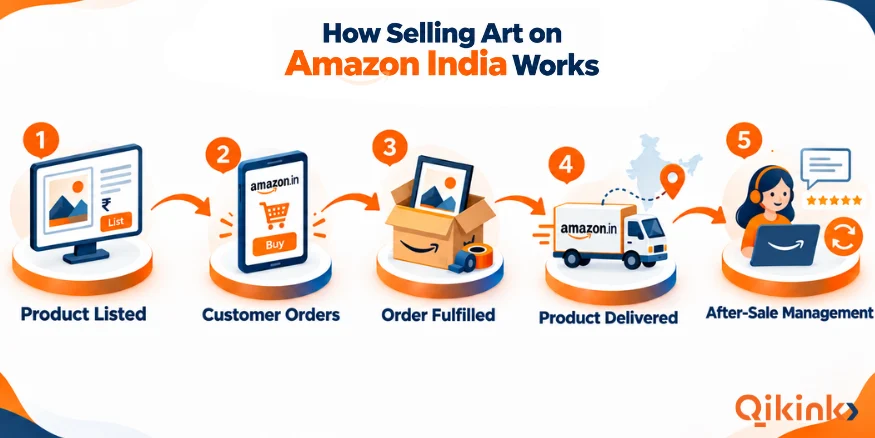
Selling art on Amazon India follows a marketplace model where the artist lists a product, customers discover and purchase it through Amazon, and the seller or fulfilment partner handles the order after the sale.
The basic workflow is:
- Product Listed: The artwork is added to Amazon with its product information, images, price, and other required details.
- Customer Orders: A buyer purchases the artwork through Amazon, and the order appears in the seller account.
- Order Fulfilled: The seller, Amazon, or a fulfilment partner handles packing and dispatch based on the selected fulfilment arrangement.
- Product Delivered: The order is shipped to the customer’s address through the applicable delivery network.
- After-Sale Management: The seller handles post-order requirements such as returns, refunds, customer feedback, and keeping the listing updated.
The seller’s profit margin depends on the selling price after accounting for product costs and applicable Amazon fees. Amazon India changed referral, closing, and cancellation fees at different points in 2026, so the current fee structure needs to be considered when calculating the margin on an art product.
Selling on Amazon India is Easy!
Understand how to build and scale a profitable Amazon store in India
How to Sell on Amazon India →
Selling Routes for Artists on Amazon India
Artists can sell on Amazon India through a regular Amazon seller account. Those selling genuinely handmade products can also use Amazon Karigar if their products meet its requirements.
Amazon Karigar for Handmade and Artisan Sellers

Amazon Karigar is designed for artisans and sellers who make authentic handmade products. Artists selling handmade paintings, traditional artwork, and other handcrafted pieces can use this route if their products meet Amazon’s requirements.
Karigar Eligibility and Benefits
Products sold through Amazon Karigar need to be genuinely handcrafted. Sellers also need to provide the business and tax details required by Amazon for seller registration.
The main benefits of Amazon Karigar include:
- Lower referral fee: The referral fee is capped at 8% or less, depending on the category.
- Training: Amazon provides training to help artisans understand the selling process.
- Account support: Eligible sellers receive support during the initial setup.
- Cataloguing support: Amazon provides assistance with product imaging and cataloguing for eligible sellers.
Sell Art on Amazon: Free Starter Tool
How to Sell Art on Amazon in India: 6 Steps
Selling art on Amazon India involves setting up the seller account, understanding the costs, creating the listing, and choosing how orders will be fulfilled. The following six steps cover the process from account setup to promoting the products after they go live.
Step 1: Set Up an Amazon Seller Account
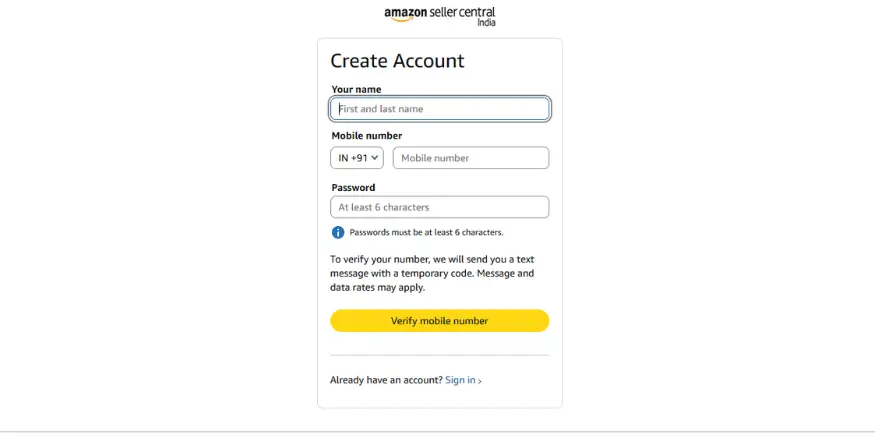
Source: Amazon
The first step to selling art on Amazon India is to register as a seller through Amazon Seller Central. The registration process collects the information Amazon needs to verify the seller, set up payments and arrange order fulfilment.
The main details to prepare include:
- Seller and business details: Provide the name and contact information required during seller registration.
- GST details: A GSTIN is required from the first sale, with no turnover exemption. Paintings, prints, and merchandise don’t qualify for Amazon’s small set of GST-exempt categories.
- Store name: Choose the name that will represent the seller’s products on Amazon.
- Pickup and shipping details: Add the address and shipping information required to fulfil orders.
- Bank account: Provide the bank details needed to receive payments from Amazon.
The full account-registration process, including GST details, store name, pickup address, shipping method and bank account setup, is covered in detail separately. Once the seller account is ready, the next step is to understand the Amazon fees that need to be included when pricing artwork.
Step 2: Understand Amazon Seller Fees in 2026

Amazon seller fees depend on the product category, selling price, and fulfilment method. For an artist, the main costs to consider are referral fees, closing fees, shipping or weight handling fees, cancellation fees, and other applicable charges.
The main charges are:
- Referral fee:
A percentage of the selling price that varies by product category. From March 16, 2026, Amazon expanded 0% referral fees to eligible products priced up to ₹1,000 across 1,800+ categories. Eligibility depends on the product category and applicable fee structure.
- Closing fee:
A fee that varies based on the product’s selling price and fulfilment channel. From September 7, 2026, closing fees increased by ₹1 for products priced up to ₹500 and by ₹3 for products priced above ₹500 across Fulfilment Centre (FC), Easy Ship and Seller Flex.
- Shipping or weight handling fee:
This covers applicable shipping and delivery charges and varies based on factors such as fulfilment method, product size, weight, and delivery distance. With Self-Ship, the seller instead pays the courier or shipping provider directly.
- Cancellation fee:
From August 17, 2026, Amazon calculates cancellation fees for eligible Easy Ship and Self Ship orders at 10% of order value below ₹10,000, 8% from ₹10,001 to ₹50,000, 5% from ₹50,001 to ₹1 lakh, and 2% above ₹1 lakh. An 18% GST applies to the cancellation fee. The charge applies when a seller cancels for reasons other than a buyer request, including certain auto-cancellations caused by failure to ship and confirm the order within the required time.
- Other applicable fees:
Additional charges may apply depending on the fulfilment method, programme, or optional services used by the seller.
The total cost of selling an artwork therefore depends on more than the Amazon referral fee. Before setting a price, the calculation should include the artwork or production cost, Amazon fees, packaging, shipping or courier costs, and the intended profit margin.
For example, a ₹900 art print and a ₹5,000 original painting can have very different fee and fulfilment costs. The selling price should be calculated after checking the current Amazon fee structure for the specific product category and fulfilment method.
Step 3: Create and Optimise Your Art Listing
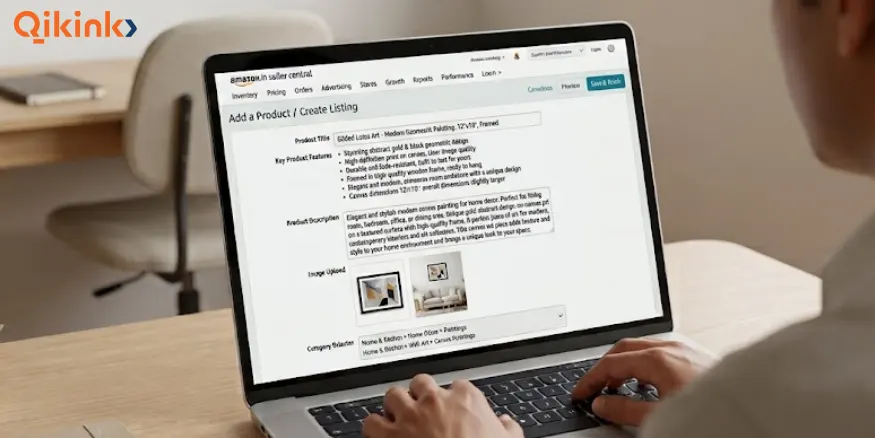
A clear and complete product listing helps customers understand the artwork and gives Amazon the information needed to display it correctly. For paintings, prints, and art merchandise, the listing should clearly describe the artwork, size, material, images, price, and other relevant product details.
If the artwork is already available on Amazon, the seller can add an offer to the existing product listing. If it is a new product, a new listing can be created through Seller Central.
ASIN stands for Amazon Standard Identification Number. It is a unique 10-character identifier Amazon uses to identify products in its catalogue. If an exact product already exists, the existing ASIN can be used to add an offer instead of creating a new product page. When a seller creates a new product that is not already in Amazon’s catalogue, Amazon generates an ASIN for that product.
Write a Clear Product Title
The title should identify the artwork and its important attributes without unnecessary keyword repetition. For a painting or canvas art print, useful details can include the artwork type, subject, style, material, size, and frame details where relevant.
For example:
“Abstract Canvas Wall Art, Modern Geometric Painting, 12 x 18 Inch, Framed”
The title should describe the actual product being sold. Avoid adding unrelated search terms or claims that the artwork cannot support.
Use High-Quality Product Images
Images are especially important when selling art online because customers cannot physically examine the artwork before purchasing it. Use clear images that show the complete artwork and, where useful, details such as texture, finish, frame, edges, and scale.
For original paintings, additional images can show close-up details and the artwork displayed in a room. For prints and merchandise, the images should clearly show the final product and its material.
Amazon requires images of at least 500 pixels on the longest side, with 1,000 pixels or larger recommended to allow customers to zoom in. Category-specific image requirements may also apply.
Add Accurate Product Information
Use bullet points to present important product information in a format that customers can scan quickly. For art products, useful details can include:
- Artwork type and style
- Dimensions and orientation
- Material or canvas type
- Frame or mounting details
- Printing method, where relevant
- What is included with the product
- Care or handling instructions, where applicable
Every detail should match the actual product. This is particularly important for paintings and prints because differences in size, framing, material, and finish affect what the customer receives.
Write a Detailed Product Description
The product description should provide more detail about the artwork than the title and bullet points. Include the subject, style, materials, dimensions, printing or production details, and relevant information about framing, installation, or care.
Use relevant search terms naturally instead of repeating the same keyword throughout the description. For example, an abstract canvas can naturally include terms such as abstract painting, canvas wall art, or modern wall art when they accurately describe the product.
Select the Correct Category and Product Attributes
Choose the Amazon category that most accurately matches the artwork and complete the relevant product attributes. Depending on the product, these can include size, colour, material, brand, style, and other category-specific fields.
If the same artwork is available in genuine variations, such as different sizes or colours, Amazon may allow those versions to be grouped under one listing. Different products should not be grouped together simply to increase keyword coverage or listing visibility.
Accurate product information, strong images, relevant keywords, and the correct Amazon catalogue entry help customers understand exactly what they are buying.
Step 4: Choose How to Fulfil Your Orders
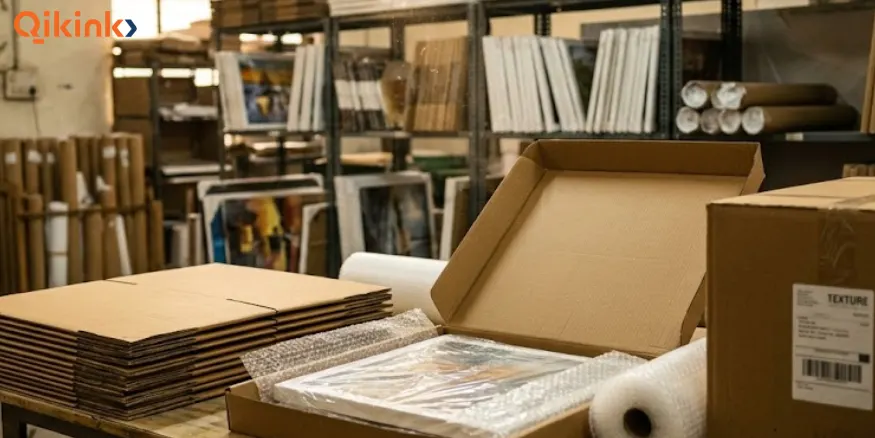
The fulfilment method determines who stores, packs, and delivers an art product after an Amazon order is placed. For sellers on Amazon India, the main options are Fulfilment by Amazon (FBA), Easy Ship, and Self-Ship.
The right option depends on factors such as the size and fragility of the artwork, available storage space, order volume, packaging requirements, and how much control the seller wants over fulfilment.
Fulfilment by Amazon (FBA)
With FBA, the seller sends inventory to an Amazon fulfilment centre before it is sold. Amazon stores the products and handles picking, packing, delivery, customer service, and returns for FBA orders.
FBA can suit artists who sell ready-made paintings, prints, or other artwork in quantities that can be stored safely at an Amazon fulfilment centre. For fragile or valuable artwork, the seller should also check Amazon’s applicable packaging and fulfilment requirements before sending inventory to a fulfilment centre.
Amazon Easy Ship
Easy Ship can suit artists who keep finished artwork at their own location and want Amazon to handle delivery. The seller retains control over inventory and packaging without sending the entire stock to an Amazon fulfilment centre.
Self-Ship
Self-Ship gives the seller responsibility for the complete fulfilment process after an order is received. The seller stores the product, packs it, and arranges delivery through a third-party courier or their own delivery network.
This option can give artists more control over how paintings and other fragile artwork are packed and which courier handles the shipment. The sellers should account for courier charges, packaging costs, and delivery timelines when setting the product price.
Self-Ship is a seller-fulfilled model, also referred to as Fulfilled by Merchant (FBM) in other Amazon marketplaces.
Choosing a Fulfilment Method for Art
For paintings and other art products, the choice should match how the artwork is stored, packed, and shipped. The fulfilment method can also affect the total cost and level of control over each order.
Ship Products in an Online Business!
Discover the process of shipping in ecommerce from order to delivery
Ecommerce Shipping →
Step 5: Price Your Art for Amazon
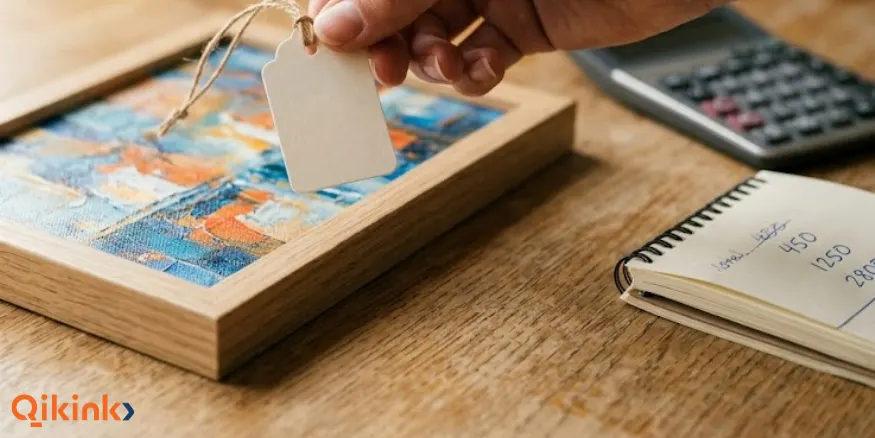
The selling price of an artwork on Amazon should cover the costs involved in producing, listing, fulfilling, and selling the product, while leaving the intended profit margin. The price and margin should be calculated before the listing goes live so that applicable Amazon charges and other selling costs do not reduce the expected margin.
When setting the price, account for:
- Product cost: Include materials, production, labour, framing, printing, or sourcing costs, depending on the type of artwork.
- Amazon fees: Include the applicable fees for the product category, selling price, and fulfilment method. The exact charges should be checked before finalising the price.
- Packaging and shipping: Include packaging materials and any shipping or courier costs that the seller is responsible for.
- Other selling costs: Allow for applicable costs such as advertising, discounts, returns, or damaged shipments where relevant.
- Target profit: Add the profit required after all applicable costs have been accounted for.
A workable selling price should be high enough to cover the product cost, Amazon fees, fulfilment expenses, and other selling costs while leaving the intended profit. Because some Amazon charges vary by product price and fulfilment method, the final price should be checked against the applicable fee structure before the listing goes live.
For example, if an art print costs ₹300 to produce and pack and the seller expects ₹200 as profit, the price cannot simply be set at ₹500. Applicable Amazon fees, shipping costs, advertising, discounts, and other selling expenses also need to be considered.If these additional selling costs come to ₹100, the seller would need to price the product above ₹600 to retain a ₹200 target profit, subject to the actual Amazon fee structure.
The price can also be compared with similar products on Amazon. Compare artworks with similar sizes, materials, framing, production quality, and product type rather than simply matching the lowest available price.
Step 6: Promote Your Art and Improve Sales

Promoting art on Amazon involves advertising eligible products, sharing listings through relevant channels, and improving the listings based on actual performance.
- Use Amazon Ads: Sponsored Products and other eligible Amazon advertising options can be used to promote art listings in Amazon search results and product pages.
- Share the listings: Share Amazon product links through Instagram, Facebook, Pinterest, or other relevant channels where the artwork can reach potential customers.
- Check performance: Monitor orders, product views, advertising results, and customer feedback in Seller Central.
- Improve the listing: If a product is not performing as expected, review its images, price, title, description, and product information and make relevant changes.
- Expand the catalogue: Add more original paintings, prints, or other suitable art products as production and fulfilment capacity allows.
Promotion should support a listing that already has accurate product information, clear images, and a workable price. Regularly reviewing performance helps identify what needs to be changed as the Amazon store grows.
What Art Can You Sell on Amazon?
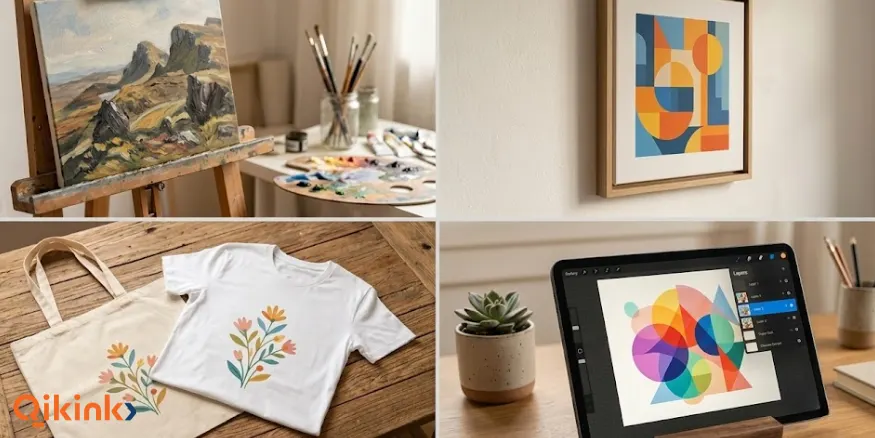
Amazon art can include original paintings, art prints, reproductions, and physical products featuring an artist’s designs. The main difference is how the artwork is produced and what the customer receives.
Original Paintings and Artwork
Original paintings are unique physical artworks created by the artist. They can include oil paintings, acrylic paintings, watercolour paintings, drawings, mixed-media artwork, and other original pieces.
The artwork itself is the product being sold, so each original piece represents a specific item of inventory.
Art Prints and Reproductions
Art prints are physical reproductions of an existing artwork. A painting, illustration, photograph, or digital artwork can be reproduced as a poster, canvas print, framed print, or another form of wall art.
Prints allow an artist to sell multiple physical copies of the same artwork while keeping the original as a separate product. The same artwork can therefore be offered in different sizes, materials, or formats.
Art Merchandise
Artwork can also be used as a design on physical merchandise. Products can include
and other items that support custom printing. In this model, the artwork becomes part of another physical product. The customer purchases the finished merchandise rather than the original artwork.
Print on demand is one way to produce art merchandise without purchasing large quantities of finished products in advance. The product is printed after an order is received and then prepared for delivery through the chosen fulfilment setup.
Digital Artwork Used for Physical Products
Digital artwork can be turned into physical products for sale on Amazon. Digital paintings, illustrations, patterns, typography, and other original designs can be prepared for products such as posters, canvas prints, apparel, mugs, and tote bags.
The artwork file should have sufficient resolution and suitable dimensions for the intended product. Colour, cropping, transparency, and placement may also need to be adjusted for different product formats.
This is different from selling a digital download. Production can be handled by the artist or a fulfilment provider. The physical product, rather than the digital artwork file itself, is what the customer receives.
Types of Paintings and Art Styles You Can Sell on Amazon
Artists can sell different types of paintings and art styles on Amazon India, provided the artwork meets Amazon’s product, listing, and applicable category requirements. The format can include original artwork, prints, reproductions, or designs used on physical products.
Common types of paintings and art styles that can be listed include:
- Abstract paintings
- Landscape paintings
- Nature and floral artwork
- Portrait paintings
- Traditional and Indian art
- Modern and contemporary art
- Minimalist artwork
- Geometric and decorative art
- Still-life paintings
- Typography and illustrative artwork
- Mixed-media artwork
These styles can be sold as original paintings, reproduced as prints, or adapted into designs for physical merchandise, depending on the artwork and the product being offered. Traditional and Indian art can include styles such as Kalamkari, Tanjore, Madhubani, Warli, and Rajasthani art.
The same artistic style can be offered in different product formats. For example, an abstract painting can be sold as an original canvas, reproduced as a print, or adapted into a design for products such as T-shirts, posters, and mugs.
For artists learning how to sell paintings on Amazon, the important factor is to describe the artwork accurately and choose the appropriate product category and attributes. The title, images, and product details should clearly represent the actual painting, its style, medium, size, and format.
Real Life Example: How Majikhan Mutva Took Lippan Art to Amazon

Majikhan Mutva, a Lippan artist from Siniyado village in Kutch, Gujarat, began learning Lippan art in 2013 and later used social media platforms like Facebook and YouTube to introduce his work to a wider audience. He started earning through the art and also experimented with nameplate art, which received a positive reception.
In 2017, when Amazon India launched its Karigar programme, he was initially rejected because of concerns about shipping his fragile mud-and-mirror artworks. Later, Amazon accepted his art into the programme after a recommendation. However, joining Amazon did not immediately translate into sales. Amazon assigned him a manager when he was receiving no orders and later shot his story in his village and featured the story and artwork in national marketing campaigns, which increased his visibility.
His products eventually became available on Amazon, Etsy and his own website (MajikhanMudArt), while he continued accepting customised orders. Amazon’s seller blog has also cited 2X quarter-on-quarter growth for his Mudwork business in its Karigar coverage. His experience also shows why selling art on Amazon involves more than creating a listing.
Fragile artwork needs suitable packaging and fulfilment, while visibility may require product content, social media and promotion beyond the marketplace itself. Mutva continued using YouTube and Instagram to showcase his work even after gaining visibility through Amazon.
How Qikink Helps Fulfil Art Products Sold on Amazon?
Qikink produces and fulfils physical products featuring an artist’s designs, including posters, canvas prints, mugs, tote bags and apparel, from a catalogue of 350+ customisable products.
Products are made only after an order is placed, so sellers do not need to hold finished inventory in advance. This makes Qikink relevant to art prints, reproductions, and art merchandise, not to original paintings, which already exist as a finished physical piece.
How Does an Amazon Order Reach Qikink?
Qikink does not integrate directly with Amazon. When a customer orders a product, the seller sees the order in Amazon Seller Central and manually places the same order in the dashboard.
- List the product on Amazon: The seller adds the artwork to a physical product on Amazon, with pricing and product details.
- Order received: A customer buys the product, and the order appears in Seller Central.
- Place the order in Qikink: The seller enters the Amazon order details in the Qikink Dashboard.
- Qikink produces and ships: Qikink produces the product and dispatches it to the customer.
- Update tracking: The seller copies the tracking number from Qikink into Amazon Seller Central.
Qikink recently discontinued Easy Ship support for Amazon orders, so sellers using Qikink for these orders now need to use Amazon Self-Ship. The seller remains responsible for managing the Amazon order and updating shipment status in Seller Central.
What the Artist Still Manages?
The artist manages the artwork, the Amazon listing, pricing, images, and advertising. Qikink handles production and dispatch once the order is placed, and the seller needs to keep the Amazon listing’s product details matched to what Qikink actually produces.
When This Model Makes Sense?
Print on demand suits artists who want to sell a design across several product formats, without buying stock for each one upfront. Original paintings need a fulfilment method such as FBA, Easy Ship, or Self-Ship, since the piece already exists and needs to be stored, packed, and shipped.
How Dropshipping Works?
Learn the process of how does dropshipping work: Step-by-step
Dropshipping in India →
Frequently Asked Questions
1. How to Sell Paintings Online on Amazon India?
2. Do You Need GST to Sell Art on Amazon India?
3. What is Amazon Karigar and Who Can Use It?
4. How Much Does it Cost to Sell Art on Amazon India?
5. Can You Sell Original Paintings on Amazon?
6. Is FBA or Self-Ship Better for Selling Art on Amazon?
7. Can You Sell Art on Amazon Without Holding Inventory?
Final Thoughts
Selling art on Amazon India comes down to a few decisions made early: the right seller account and GST setup, an accurate read of 2026’s fee changes, a listing that matches the actual product, and a fulfilment method suited to what is being sold.
Original paintings, printed reproductions, and merchandise carrying a design each need a different approach, and pricing has to account for Amazon’s charges rather than only the cost of making the artwork.
For artists who want to sell a design across prints or merchandise without holding finished stock, Qikink produces and ships these products after each order through its print on demand and dropshipping model.
Read more
- How to Sell on Amazon India: Products, Profit, Requirement Guide
- How to Sell T-Shirts on Amazon: Start Earning From 1st Month
- Amazon Dropshipping in India: Guide to Start, Scale and Succeed
- How to Get a GTIN Exemption from Amazon to Sell Products
Share the Article

