

The average dropshipping income in India varies widely because independent sellers do not receive a fixed monthly salary. Some beginners make little or no profit, while established stores may earn more depending on their completed orders, product costs, advertising and delivery expenses.
In dropshipping, your business income is not the total amount customers spend. For example, a store with ₹1 lakh in monthly sales could make a profit or a loss after paying its expenses. That is why the term dropshipping salary usually refers to the money a store owner earns from the business, not a guaranteed payment.
There is no reliable nationwide study that establishes one typical monthly earning figure for every Indian dropshipper. However, you can estimate your own income by calculating profit per completed order and the costs of running your store.
Understanding these numbers helps you set realistic targets and decide whether your selling price, marketing budget and fulfilment arrangements can support a profitable dropshipping business in India.
Key Takeaways:
- Dropshipping has no fixed monthly salary. Earnings depend on completed orders and the costs of running the store.
- Sales revenue is different from business profit, and profit is not always the amount available for personal withdrawal.
- Profit margin changes with product prices, supplier charges, advertising, fees and returns. No single percentage applies to every Indian seller.
- Reaching ₹1 lakh in monthly sales is different from making ₹1 lakh in monthly profit.
- Amazon and Shopify have different operating costs; sellers should calculate earnings using their own records rather than general income promises.
What is Dropshipping?
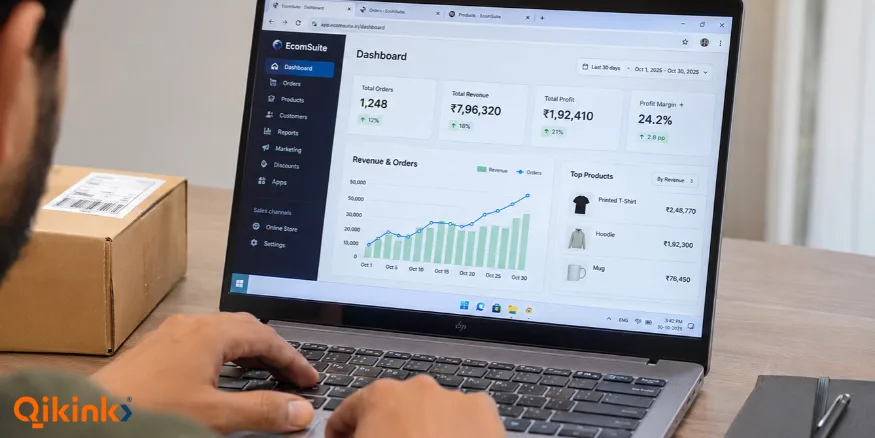
Dropshipping is a retail business model that lets you sell products online without storing inventory. When a customer places an order, a third-party supplier prepares and ships it to the customer.
You manage product listings, prices, marketing and customer communication. The supplier handles the fulfilment services agreed with you, which may include packing, printing and delivery.
In India, a fulfilment partner such as Qikink can print, pack and ship eligible product orders for online sellers. You still need to plan for marketing expenses, customer support, returns and other dropshipping costs before treating sales as income.
What Is Dropshipping Salary?
Dropshipping salary is a common way to describe how much a person earns from a dropshipping business. However, independent store owners do not get a fixed salary from the platform or supplier.
Their income depends on business profit after paying the relevant expenses. An owner may keep some profit in the business to cover future orders, refunds and tax payments rather than withdraw it all.
Someone employed to manage another person’s dropshipping store can receive a regular salary. This is different from the variable earnings of a business owner.
Dropshipping Monthly Income in India
Dropshipping monthly income in India depends on how many orders you complete and the money left after paying your business expenses. Two stores with similar sales can earn different amounts if one spends more on advertising, shipping or returns.
Let’s consider a T-shirt store to understand how monthly income changes as sales increase. In this example:
- Each T-shirt sells for ₹799.
- Product, printing, shipping, advertising and payment charges together cost ₹620 per completed order.
- The store also spends ₹5,000 every month on regular expenses, such as website subscriptions, apps and other running costs. These are called fixed monthly expenses because they do not change with every order.
For example, completing 100 orders generates ₹79,900 in sales. After paying ₹62,000 in order-related expenses and ₹5,000 in fixed monthly expenses, the store earns ₹12,900 in estimated profit.
The same store may earn more as orders increase, provided its selling prices and costs remain similar. Actual results can change because of returns, refunds, failed deliveries, taxes, and other expenses not included here.
Dropshipping Earnings for Beginners
Dropshipping beginner earnings can be unpredictable. A new store may spend money on promotion and setup before receiving enough orders to cover its costs.
Some beginners make sales quickly, while others earn nothing or lose money. Rather than expecting a fixed dropshipping earning per month, track completed sales, profit per order and monthly expenses. Once you have real order data, you can estimate future income more accurately.
Start Your Online Selling Business!
Qikink supports product printing, packing and delivery for online sellers.
Sign Up Free Today →
Low-Ticket vs High-Ticket Dropshipping: Income Comparison
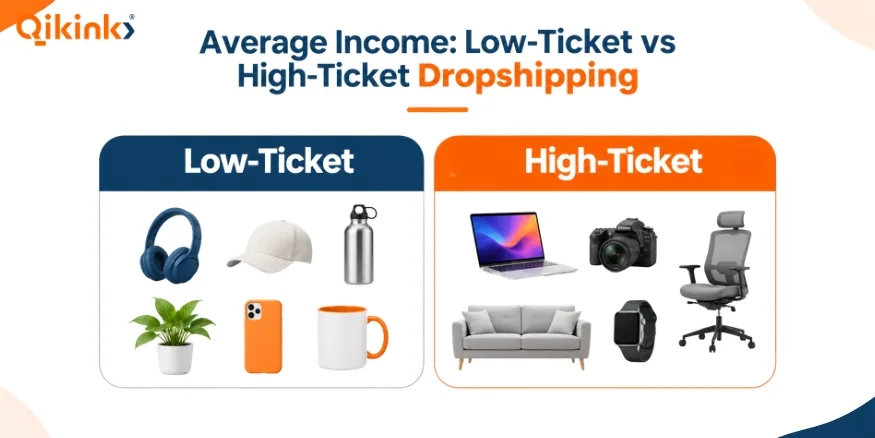
Low-ticket and high-ticket dropshipping describe the selling prices of products, not guaranteed profit margins. Both can generate income, but the number of sales needed and the possible losses from a failed order may differ.
1. Low-Ticket Dropshipping
Low-ticket dropshipping involves relatively inexpensive products, such as phone accessories, household items and fashion accessories. Items priced around ₹100 to ₹1,000 are examples, not a fixed industry threshold.
Pros:
- Affordable items may appeal to a wider group of customers.
- Sellers can test several product ideas without buying bulk stock.
- Repeat orders may be possible when products meet customer needs.
Cons:
- Smaller rupee profit per order may require more completed sales.
- Advertising and delivery can take up a large share of the selling price.
- Price competition can reduce the amount left after expenses.
2. High-Ticket Dropshipping
High-ticket dropshipping focuses on more expensive items such as premium furniture or specialised office equipment. The selling price alone does not determine whether the product is profitable.
Pros:
- A larger rupee profit per order is possible when costs are controlled.
- Fewer sales may be needed to reach a target profit.
- Specialist products can serve customers with specific needs.
Cons:
- Buyers may take longer to decide.
- Returns, damage and failed deliveries can be more costly.
- Supplier checks and after-sales support may require more attention.
Choose a selling approach based on demand, likely profit per order and the risks you can manage. Neither model automatically delivers a higher percentage margin.
Average Dropshipping Profit Margin in India
A dropshipping profit margin shows what percentage of your sales revenue remains after expenses. For example, if you sell a product for ₹1,000 and earn ₹200 after all relevant business costs, your net profit margin is 20%.
When comparing profit margins, check which expenses have been included. A margin calculated only after product and shipping costs will be different from one that also includes advertising, store fees and other business expenses.
A single average dropshipping profit margin in India cannot describe the range of costs across every seller. Product costs, advertising, returns and operating expenses all affect the result.
Typical Profit Margins
Dropshipping profit margins are sometimes estimated at 10% to 30% in industry articles, but this is not a verified average for Indian sellers. These estimates may also use different calculations, so compare gross and net profit margins carefully.
A store with a high product markup can still earn little net profit after advertising, delivery and other expenses. Your own sales and expense records provide a more useful measure.
Factors That Affect Your Profit Margin
- Supplier costs: Product and printing charges directly reduce the amount left per order.
- Shipping and returns: Delivery charges, refunds, damaged products and return-to-origin (RTO) losses can reduce your profit.
- Advertising: A costly campaign can reduce earnings even when sales increase.
- Store and payment fees: Subscriptions, marketplace charges and gateway fees must be included.
- Pricing and repeat purchases: The right price and repeat orders can support profit, provided additional expenses are covered.
For cash-on-delivery (COD) sales, an unaccepted parcel may still lead to shipping and advertising costs. Use your own records rather than assuming one typical RTO rate.
How to Calculate Dropshipping Profit Margin?
Calculating your dropshipping profit margin helps you understand how much money remains from each sale and how much your store earns in a month.
Start by calculating the money left after paying the expenses connected to one completed order.
Money left per order = Selling Price − Total Cost per Order
For example, suppose you sell a printed T-shirt for ₹799.
Your calculation is:
₹799 − ₹620 = ₹179 left per completed order
This represents approximately 22.4% of the selling price before fixed monthly expenses.
Calculating Monthly Profit
To calculate how much your store earns in a month, use:
Monthly Profit = (Money Left per Order × Completed Orders) − Fixed Monthly Expenses
Using the same example, if you complete 200 orders and spend ₹5,000 on fixed monthly expenses:
(₹179 × 200) − ₹5,000 = ₹30,800 estimated monthly profit
You can then calculate the net profit margin:
Net Profit Margin (%) = (Monthly Profit ÷ Monthly Revenue) × 100
(₹30,800 ÷ ₹1,59,800) × 100 = 19.3%
The 22.4% figure shows the percentage remaining from each completed order after the listed per-order costs. The 19.3% figure is the estimated monthly net profit margin after also deducting fixed monthly expenses.
These figures are illustrative and do not represent Qikink’s actual product prices. Your calculation should also account for applicable GST treatment, refunds, failed deliveries and any other relevant expenses.
You can use a dropshipping profit margin calculator to work with your own selling prices and costs.
Dropshipping Revenue in India
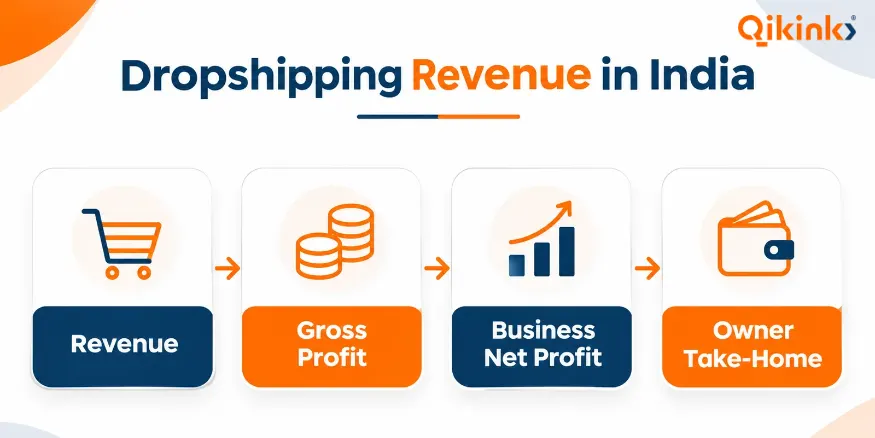
Dropshipping revenue is the value of sales made by your store before subtracting business expenses. Revenue tells you how much you sold, but it does not show how much you earned.
It helps to separate four figures:
In our T-shirt example, ₹1,59,800 in monthly revenue leaves ₹30,800 in estimated business profit after ₹1,24,000 in order costs and ₹5,000 in fixed expenses.
A store owner may choose to keep part of that amount available for future orders, refunds, bills and taxes. That is why dropshipping revenue, net profit and personal withdrawals should not be described as the same figure.
The Monthly Income Receipt
Set a T-shirt price and completed orders. Print the month-end bill.
Can I Earn 1 Lakh per Month from Dropshipping?
Earning ₹1 lakh per month in dropshipping is possible, but it depends on how many profitable orders you complete. Reaching ₹1 lakh in monthly sales does not mean you have earned ₹1 lakh in profit.
Using the same T-shirt example, you earn ₹179 per completed order before fixed monthly expenses. To reach ₹1 lakh in monthly business profit, you need to cover both your ₹1,00,000 profit target and ₹5,000 in monthly expenses.
Required Orders = (Target Monthly Profit + Fixed Monthly Expenses) ÷ Money Left per Order
(₹1,00,000 + ₹5,000) ÷ ₹179 = 587 completed orders, rounded up.
That works out to roughly 20 completed orders per day over a 30-day month.
At this volume, the estimated monthly profit would be ₹1,00,073 under the example’s assumptions. Higher advertising costs, returns or other expenses could increase the number of orders needed.
Build Your Online Brand Today!
Focus on building your brand while Qikink manages your order fulfilment.
Create Your Account →
Amazon Dropshipping Earnings in India
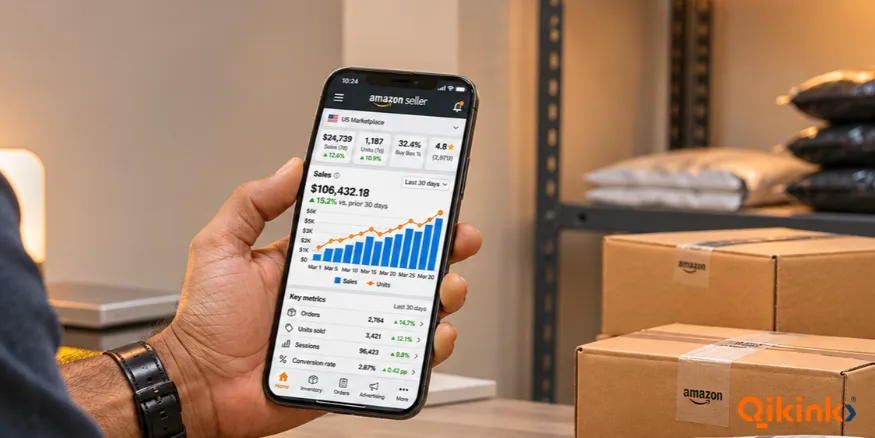
Amazon gives eligible sellers access to an established marketplace audience, but it does not pay independent dropshippers a fixed monthly salary. Amazon dropshipping earnings depend on sales, selling fees, supplier costs, advertising and fulfilment expenses.
Average Earnings on Amazon Dropshipping
There is no verified, representative figure for the average Amazon dropshipping salary in India. Use the actual fee schedule and costs relevant to your product instead of assuming a typical income range.
For example, if a product sells for ₹1,000 and the relevant per-order expenses total ₹850, ₹150 remains before other monthly costs. This is an illustrative example, not an Amazon-wide margin.
Amazon permits dropshipping subject to its seller-of-record and fulfilment requirements. Check Amazon’s dropshipping policy for its requirements concerning invoices, packaging and customer returns. Amazon FBA, where Amazon stores and ships seller-supplied inventory, is a different fulfilment model.
Why Choose Amazon for Dropshipping?
Amazon offers a marketplace where customers already search for products. That can make it easier to reach potential buyers than starting from a store with no visitors, but competition and marketplace charges still affect income.
Challenges to Consider on Amazon
- Marketplace policies: Sellers must follow Amazon’s dropshipping requirements, including being identified as the seller of record and handling customer returns.
- Fees and competition: Marketplace charges, advertising expenses and competition can reduce the profit earned from each sale.
- Customer service: Sellers must resolve complaints, delivery problems and return requests, even when a third-party supplier fulfils the order.
Shopify Dropshipping Earnings in India
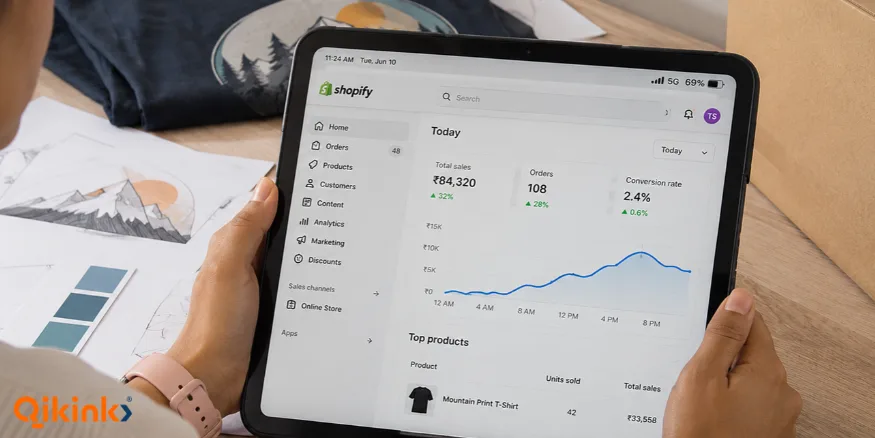
Shopify lets sellers build an online store and manage their product pages, pricing and customer experience. Unlike an established marketplace, a new Shopify store usually needs its own marketing to attract visitors. Shopify dropshipping income depends on how much profit remains from sales after paying product, fulfilment and operating expenses.
Average Earnings on Shopify Dropshipping
There is no well-supported fixed average monthly income for Indian Shopify dropshippers. A store generating ₹2 lakh in revenue may earn a modest profit or lose money depending on its costs.
When estimating a Shopify dropshipping profit margin, include product and shipping charges, advertising, payment processing, subscriptions, apps, returns and other relevant expenses. More control over pricing does not guarantee a higher margin.
Why Choose Shopify for Dropshipping?
- You control your store’s product presentation and pricing.
- You can build direct customer relationships and repeat-purchase channels.
- Compatible apps and integrations can support store operations.
- You can promote products through search, social channels and paid campaigns.
Challenges to Consider on Shopify
- Attracting visitors is your responsibility.
- Subscription and application costs continue even during slow sales.
- Customer trust, service and returns must be managed carefully.
Shopify suits sellers who want more control over their own store, provided their expected profit covers these costs.
Connect Your Store With Qikink!
Manage eligible store orders through supported integrations and fulfilment.
Start Selling →
Case Study: A Successful Indian Dropshipper’s Story
An Indian seller’s experience can help explain how dropshipping earnings develop over time. In an AliDropship interview published on 29 April 2020, entrepreneur Asif Siddiqui shared his experience running four dropshipping stores.
The article reported monthly profit of more than $2,000 (approximately ₹1.51 lakh at April 2020 exchange rates). These were self-reported earnings from one seller, not the average dropshipping income in India.
Asif Siddiqui: Discovery of Dropshipping in India
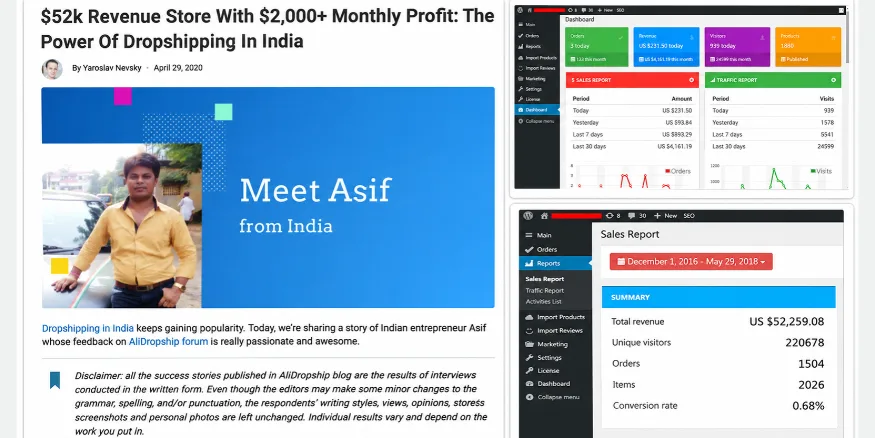
Source: AliDropship-Dropshipping India Success Story
Asif said he had explored other online businesses before starting dropshipping. He liked being able to sell products without buying stock in advance.
Business Setup and Product Strategy
At the time of the interview, he reported operating four dropshipping stores that together accounted for more than 60% of his income. This was his self-reported experience in 2020, not a typical income figure for Indian sellers.
He also said he selected products based on customer interest, product ratings and supplier reliability. He initially followed an existing niche before exploring categories that matched his own interests.
Marketing and Promotions
Asif reported making his first $12.95 sale (approximately ₹980) within three days of launching a store, after spending $3 (approximately ₹227) on an Instagram promotion. The INR amounts use April 2020 exchange rates. His experience shows how he tested an early promotion, although similar results are not guaranteed.
Challenges and Resilience
Asif also discussed periods with low sales and how he continued testing products and marketing methods. His experience shows that dropshipping earnings can change from month to month, even for someone running multiple stores.
How to Maximise Your Dropshipping Income?
Improving your dropshipping income means keeping more profit from completed orders, not just increasing traffic or sales. These steps can help you manage your numbers:
- Review profit by product: Identify which items leave enough money after fulfilment and marketing.
- Track advertising cost per order: Check how much you spend on ads to get a completed order. Reduce spending on campaigns that repeatedly cost more than the profit they bring.
- Improve product listings: Accurate photos, sizes and descriptions can help prevent avoidable returns.
- Check product bundles carefully: Extra items can increase order value, but only when their added costs are covered.
- Support repeat buyers: Consistent product quality and timely responses may reduce the need to pay for every new order through advertising.
- Track failed deliveries and refunds: Their costs can make a high-sales month less profitable than expected.
- Review monthly results before increasing your budget: Compare completed orders, money left per order and net profit to see whether your store is earning enough to support more spending.
Turn Product Ideas Into Orders!
Qikink handles eligible printing, packing and shipping for your orders.
Join Qikink →
Frequently Asked Questions (FAQs)
1. How Much Can You Make With Dropshipping?
2. How Much Can a Beginner Earn From Dropshipping per Month?
3. How Much Can Dropshippers Earn per Day in India?
4. What Is the Average Amazon Dropshipping Salary in India?
5. Can You Make Six Figures From Dropshipping?
6. How Long Does It Take for a Dropshipping Business to Become Profitable?
7. Do You Pay Income Tax on Dropshipping Earnings in India?
8. Do I Need GST Registration for Dropshipping in India?
9. Is Dropshipping a Job or a Business?
Final Thoughts
Dropshipping in India can provide income without requiring sellers to purchase and store stock in advance. However, the amount you keep depends on completed sales, product costs, advertising, fulfilment and other expenses.
Instead of relying on one claimed average dropshipping salary, calculate profit per order and track your monthly results. This will give you a clearer picture of what your business earns and what you can afford to reinvest.
For sellers building their own brands, Qikink supports eligible printing, packing and order fulfilment while they focus on their store and customers.
Sign up Today! →Read More
- Best Passive Income Ideas to Make Extra Money in India
- Top Dropshipping Statistics and Trends: Beginner Guide
- Dropshipping Ads: Guide to Create Winning Campaigns
- How to Start a Dropshipping Business in India: Guide
Share the Article


