
Print on demand is a business model where products such as t-shirts, hoodies, mugs, and posters are printed and produced only after a customer places an order, so the seller does not need to buy or hold stock in advance. A print on demand provider handles production, packing, and shipping for every order, while the seller manages designs, pricing, and marketing.
For Indian sellers, this means no upfront inventory purchase, with Cash on Delivery (COD) available on eligible orders and fulfilment handled by local providers such as Qikink rather than shipped in from an overseas warehouse.
A print on demand business is built on this model by selling custom products through an online store, marketplace, or other sales channel. The core difference from traditional retail is timing. A POD seller’s products are made only after an order comes in, while a traditional retailer buys or manufactures stock in bulk ahead of time and carries the risk if it does not sell.
Key Takeaways:
- Print on demand reduces inventory risk, but it does not remove other business costs such as product samples, marketing, platform fees, or customer acquisition.
- The seller controls the brand, product designs, pricing, and marketing, while the provider handles production, packing, and shipping.
- POD generally costs more per unit than bulk manufacturing, since each product is made after an individual order rather than in a large batch, and that gap is the price paid for carrying no unsold stock.
- Because there is no bulk order to commit to, sellers can add, drop, or test new product designs without the upfront cost that stops most new businesses from experimenting.
- Print on demand fits businesses that value low inventory exposure and product flexibility more than businesses chasing the lowest possible per-unit production cost.
What Is a Print on Demand Business?
A print on demand service is a fulfilment partner that produces and ships a product only once it has been ordered, and a print on demand business is what a seller builds around that service, selling custom products through an online store, marketplace, or another sales channel. The seller chooses the products and designs, sets the selling price, builds the brand, and markets the products, while the provider produces and fulfils each order.
Revenue comes from the margin between the selling price and the total cost of fulfilling each order. For example, a seller using print on demand in India might list a printed T-shirt at ₹599. If the combined cost of production, packing, and shipping for that order comes to ₹350, the remaining ₹249 is the amount available to cover other selling expenses and profit. This margin applies to each order rather than being tied to a large upfront purchase.
Print on demand is often confused with dropshipping, since neither requires the seller to hold finished stock. Dropshipping resells a product a supplier already has on hand, while print on demand produces the item only once the order is placed. A POD provider may also ship directly to the customer, which is why the two business models can look similar, but production timing is what actually separates them.
What Does “On Demand” Mean?
“On demand” describes how production is triggered, not how fast an order reaches the customer. A unit is manufactured because a specific order exists, rather than being manufactured in anticipation of future sales. Under this approach, a seller does not need finished units in stock before a product can be sold. Each order results in a unit being produced specifically for that order.
This differs from forecast-based production, where a business estimates expected demand and manufactures stock accordingly. In that model, the business carries the risk of unsold inventory if actual sales fall below the forecast.
‘On demand’ does not mean instant production or delivery. It describes when production begins; production, dispatch, and delivery times depend on the product and provider.
Quick Check
Is This Print on Demand?
The test: were the products made after the order?
YES This is Print on Demand
- Order
- Madeafter order
- Delivered
The item is produced because a specific order exists.
You carry: no unsold stock.
YES This is Print on Demand
- Order
- Madeafter order
- Delivered
The partner produces and ships each order only after it is placed.
You carry: no unsold stock.
NO This is Dropshipping
- Madebefore order
- Order
- Delivered
The supplier already had it on hand. You resell it, you don’t produce it.
You carry: no stock, but not your design.
NO This is Bulk Stock
- Madebefore order
- Order
- Delivered
The units were made before any order, based on expected demand.
You carry: unsold stock if sales fall short.
Seller vs POD Provider: Who Does What?
The seller manages the main customer-facing parts of the business, including the store, product presentation, pricing, and marketing. The provider handles the physical fulfilment process, from production and packing to shipping.
Curious about starting POD in India?
Explore simple setup, fulfilment, marketing, and key strategies to start
Start a Print on Demand Business →
How Does Print on Demand Work?
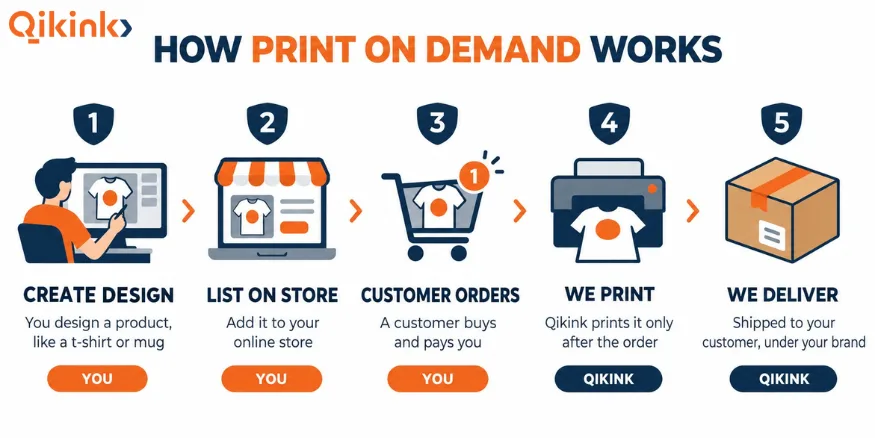
Print on demand works through five stages, from preparing a product for sale to producing and delivering the finished order to the customer.
1. A Product Design Is Prepared
The process starts with a design and a product to print the design on. The seller creates or supplies the artwork and selects the product on which it will be used, such as a T-shirt, hoodie, mug, or poster.
The design is prepared to match the selected product’s print area, dimensions, and file requirements, which can vary between products.
2. The Product Is Added to a Sales Channel
The seller creates a product listing with the design, product details, images, selling price, and available options such as size or colour. The listing can be published through an online store, marketplace, or other sales channel.
3. A Customer Places an Order
When a customer purchases a product, the order contains the information required to produce and deliver that item. This includes details such as the product, quantity, size, colour, design, and delivery address. The order is then passed to the POD provider through the connected store, marketplace, or ordering system.
4. The Provider Produces the Ordered Product
The POD provider uses the order details to produce the required quantity. Once production is complete, the items are checked, packed, and prepared for dispatch.
5. The Order Is Dispatched to the Customer
The completed order is packed and shipped to the delivery address provided by the customer. Tracking information is then made available through the relevant store or provider system, allowing the shipment to be monitored through delivery.
Benefits of Print on Demand
Print on demand offers practical advantages for sellers who want to start and test products without taking on traditional inventory commitments.
- Lower Starting Capital
Sellers can launch products without paying for a large production run upfront, reducing the capital needed to get started.
- Less Inventory Management
Sellers do not need to store, count, or manage finished products, which reduces storage needs and the risk of unsold stock.
- Easier Product Testing
New custom designs can be tested without committing to a large print run. Products that receive little interest can be removed, while new designs can be added without leaving the seller with an existing batch to clear.
- More Product Variety
A single design can often be offered across compatible products such as t-shirts, hoodies, mugs, and posters, depending on the provider’s catalogue.
- Easier Scaling
As order volume increases, sellers can use the provider’s existing fulfilment infrastructure instead of immediately investing in printing equipment or additional storage.
Tip
Qikink has no minimum order quantity, so sellers can place an order for a single unit when testing a product or design.
Challenges of Print on Demand
Print on demand simplifies production and fulfilment, but it also has limitations that can affect margins, quality, control, and customer experience.
- Higher Per-Unit Costs: Competing purely on the lowest shelf price is difficult under this cost structure, since bulk producers can usually beat a per-unit price at volume.
- Additional Selling Costs: Shipping, payment processing, platform fees, advertising, discounts, returns, and replacements can further reduce the margin on each order.
- Less Production Control: The seller relies on the provider for printing, quality checks, packing, and dispatch, so the provider’s processes can affect the customer experience.
- Quality Requires Checking: Print placement, colours, materials, sizing, and finishing can vary. Ordering samples helps sellers check the product before selling it widely.
- Limited Customisation: Available products, colours, sizes, print areas, printing methods, and packaging options depend on the provider’s catalogue.
- Customer Experience Still Depends on the Seller: Delays, damaged products, incorrect orders, and delivery problems still affect the seller’s relationship with the customer, even when a provider handles fulfilment.
These trade-offs are the cost of removing inventory risk, not a sign the model doesn’t work. Most sellers offset them through pricing, product choice, or building a stronger brand rather than trying to compete on unit cost alone.
What Products Can Be Sold With Print on Demand?
Print on demand can be used across several product categories, including clothing, home goods, stationery, wall art, and accessories. The exact range depends on the POD provider’s catalogue and product capabilities.
Product selection depends on the target customer, design, selling price, and the provider’s available catalogue.
Identify Your Suitable Niche
List of free creative product ideas to start a successful POD business.
Best Print on Demand Niches →
Printing Methods Used in Print on Demand
Print on demand is not tied to a single printing technique. The method used depends on the product, material, and design. Several printing and decoration methods are commonly used across POD catalogues.
- DTG (Direct-to-Garment): Ink is printed directly onto the fabric, making it suitable for detailed, multi-colour designs on apparel.
- DTF (Direct-to-Film): The design is printed onto a transfer film and then heat-transferred onto the product. It can be used across a wider range of fabrics and products than DTG.
- Sublimation: Dye is transferred into the product using heat. It is commonly used for mugs and products suited to all-over printing, particularly where the design needs to cover a larger surface area.
- Screen Printing: Ink is pushed through a mesh stencil onto the product. It is generally suited to simple designs with one or a limited number of colours, particularly for larger production runs.
- Embroidery: A design is stitched directly into the fabric using thread rather than printed. It is commonly used for logos, text, and simple designs on caps, jackets, and other apparel.
- All-Over Print (AOP): The fabric is printed before the product is cut and sewn, allowing a design to cover most or all of the finished product rather than being limited to a single print area.
Who Can Use Print on Demand?
Print on demand can work for individual creators, new brands, established businesses, and sellers using online marketplaces. The model is particularly useful for adding products without setting aside dedicated production space, equipment, or manufacturing capacity.
Creators and Influencers
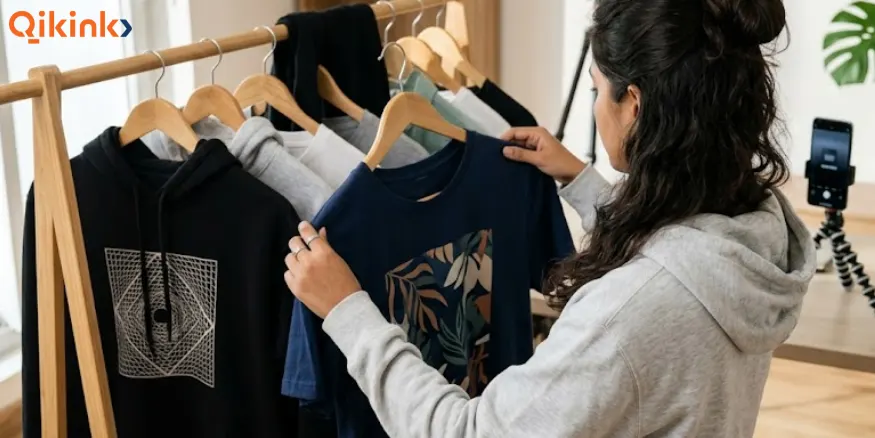
Creators and influencers can turn their audience into a product line by putting their name, artwork, or a recognisable slogan on items such as t-shirts, hoodies, or mugs. This gives them a way to offer merchandise without needing to store or manage stock themselves.
Artists and Designers
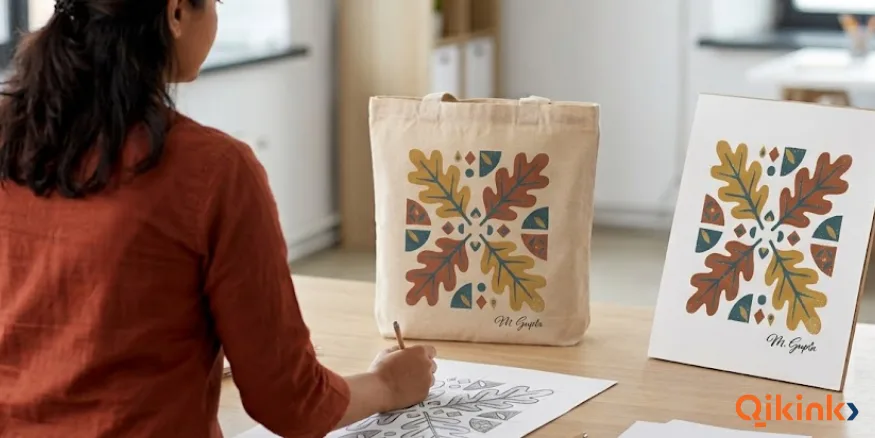
Artists and designers can turn original artwork into physical products such as apparel, wall art, stationery, and accessories. A single design can be adapted across several product types, allowing an artist to test different formats without buying printing equipment or arranging a bulk production run.
Businesses Adding Custom Merchandise
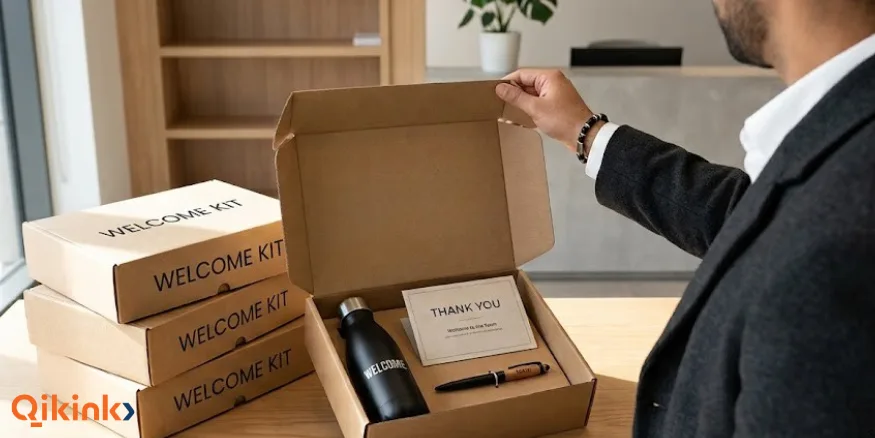
New and established businesses can use print on demand to add branded or custom products to their existing range without setting up a separate production line. A new brand can build its early catalogue this way, while an established business can test a new product category before committing to bulk manufacturing.
Event Organisers and Communities
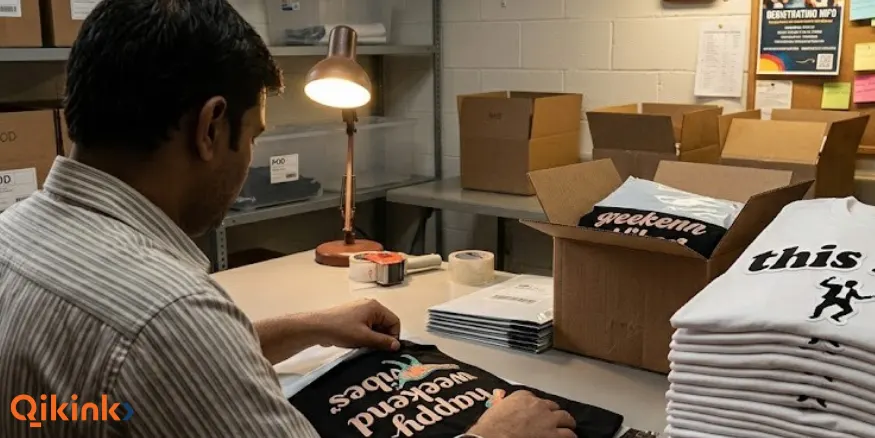
Colleges, sports teams, community groups, and event organisers may need custom merchandise for a specific occasion, such as a class reunion, college fest, or tournament. Print on demand can make smaller, one-time requirements practical when a large production run would leave the organiser with more products than needed.
Gifting and Personalisation Sellers

Sellers focused on personalised gifts, such as name mugs, photo prints, or custom-text apparel, can use print on demand to handle products that vary from one customer order to another. Names, photos, messages, and other personal details can be applied according to the individual order instead of being prepared as a standard product range in advance.
Marketplace Sellers
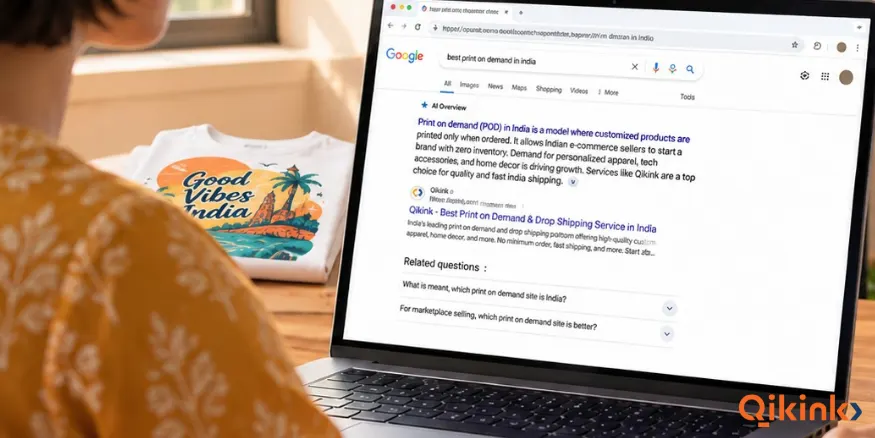
Sellers running stores on Etsy, Amazon, or similar marketplaces can add custom products to their existing catalogue without taking on the production side themselves. This can be useful for marketplace sellers who want to expand into personalised, branded, or design-led products while keeping their focus on listings, marketing, and customer relationships.
How to Choose a Print on Demand Partner?
Choosing a print on demand partner affects product quality, delivery speed, cost, and how much control a seller has over the customer experience, so it’s worth looking past the paper price.
- Confirm the provider actually supports the sizes, colours, and print areas the store needs, not just the one product being launched with, since catalogues can vary more than expected between providers.
- Compare the full cost of getting an order to the customer, shipping and COD charges included, rather than the base product price alone, since two providers quoting the same rate can still work out very differently once fulfilment is added.
- Ask for production and delivery timelines broken down by product type, since a plain t-shirt and a custom all-over print job rarely move through production at the same pace.
- Check that the provider integrates with the sales channel already in use, Shopify, WooCommerce, or an API setup, since manually managing orders gets difficult once sales pick up.
- Order a sample before committing, since print placement, colour accuracy, and fabric feel are easier to judge in hand than on a spec sheet.
- Confirm COD availability and applicable charges directly rather than assuming them from general marketing.
Why Choose Qikink for Print on Demand in India?
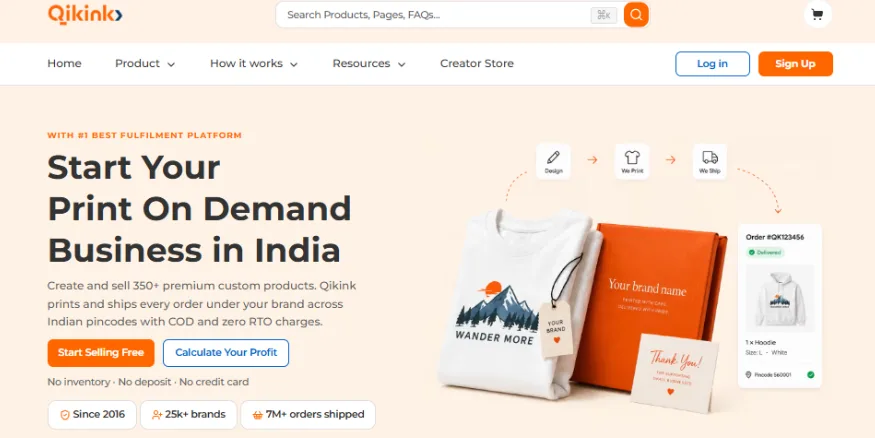
For sellers in India, Qikink offers several fulfilment features that can be relevant when comparing POD partners, particularly around order flexibility, integrations, branding, COD, and delivery coverage.
No Minimum Order Quantity
There is no minimum order quantity, so an order can be as small as a single piece regardless of catalogue size or how long a seller has been selling.
COD Support & No RTO Charges
Cash on Delivery is supported for eligible orders, giving sellers the option to offer COD to their customers. Return to Origin orders also do not carry an RTO charge for sellers.
Shopify, WooCommerce and API Integrations
Integrations with Shopify and WooCommerce can automate order flow, while API access supports custom store and application setups.
Free Neck Label Branding
Free neck label branding is available on eligible apparel products, with free refills for the lifetime of the store.
Nationwide Delivery
Orders can be delivered across 29,000+ pincodes in India. Qikink states that 95% of orders are dispatched within 2 to 3 days, although delivery time depends on the destination and shipping service.
The right provider depends on the products being sold, the sales channel in use, customer locations, and fulfilment needs. Comparing these factors helps a seller find a service that fits how the business operates.
Is Print on Demand Right for Your Business?
India’s print on demand market is projected to grow at a CAGR of 26.2% from 2026 to 2033, according to Grand View Research, which shifts the real question from growth to fit: whether the model suits a specific business.
Print on demand is a good fit when low inventory exposure and the ability to test products quickly matter more than achieving the lowest possible per-unit production cost. It’s a natural fit for a first product line, a side business alongside other work, or a new category you want to test before committing to bulk manufacturing.
The model becomes less attractive when consistently low per-unit cost and predictable high-volume production become the priority. Bulk manufacturing usually offers a lower per-unit price once order volumes are large and predictable enough to justify it. Sourcing a specific fabric or exact print finish may also be easier to manage through dedicated manufacturing than a shared POD catalogue.
Your stage of business is a useful filter. If you’re testing five designs to find the one that sells, print on demand fits well. If you already have a bestseller moving thousands of units a month, shifting that product to bulk manufacturing may lower costs enough to outweigh POD’s flexibility. You can also use both models: POD for new and unproven designs, and bulk manufacturing for products that consistently sell.
Want to Master Print on Demand?
Discover the best POD courses and fast-track your business success.
Top Print on Demand Courses →
Frequently Asked Questions
1. Is Print on Demand the Same as Custom Printing?
2. Do I Need GST Registration to Sell Print on Demand in India?
3. Can Print on Demand Be Started With Zero Investment?
4. Does Print on Demand Offer Better Margins Than Dropshipping?
5. Is Print on Demand a Good Business Model for Beginners?
6. How Do I Get Designs for a Print on Demand Business?
Final Thoughts
Print on demand is a production model that lets sellers offer customised products without buying finished inventory in advance. Its main advantage is flexibility: products can be tested, added or removed without committing to large production runs, while the trade-off is a higher per-unit fulfilment cost and less direct control over production.
For Indian sellers, this works especially well once fulfilment is handled by a provider that understands COD, domestic delivery, and low-inventory selling. Qikink covers that side of the business for print on demand sellers across India, leaving the seller free to focus on the product and the brand built around it.
Sign up & Start Today →Read More
- How to Make Money with Print on Demand: Learn More
- Eco-Friendly Print on Demand: Sustainable Suppliers
- Print On Demand Marketing Strategies For Online Store
- Must-Have Top Print On Demand Tools for Business
- How to Start T-Shirt Printing Business: Complete Plan
Share the Article


