

You can sell online without GST registration in India when your business qualifies for the applicable turnover exemption or another specific exemption under GST law. For eligible sellers dealing exclusively in goods, the general threshold is ₹40 lakh in many states and ₹20 lakh in specified states and Union Territories. The general threshold for services is ₹20 lakh, with a ₹10 lakh threshold in specified states.
If you want to know how to sell online without GST, check your product type, annual turnover, customer locations and sales channel. Interstate sales of taxable goods generally require registration, subject to specific exceptions. Eligible small sellers of goods can also use a marketplace enrolment route under Notification No. 34/2023-Central Tax, provided they meet its conditions.
A business dealing only in exempt or non-taxable goods may qualify for a separate registration exemption. For Print on Demand (POD) and dropshipping in India, the seller’s own supply, turnover, customer location and fulfilment arrangement determine the GST position.
Key Takeaways
- Eligible suppliers dealing exclusively in goods may qualify for a ₹40 lakh annual turnover threshold in many states, subject to the applicable conditions.
- The goods threshold is ₹20 lakh in specified states and Union Territories, while the general services threshold is ₹20 lakh and ₹10 lakh in some states.
- Interstate sales of taxable goods generally require GST registration, even when turnover is below the usual threshold.
- Eligible unregistered sellers of goods can sell through a participating e-commerce operator using an enrolment number.
- An unregistered seller must not collect GST from customers as tax or issue a GST tax invoice.
- A POD or dropshipping fulfilment arrangement does not automatically remove the seller’s GST responsibilities.
GST Terms to Know
These terms appear throughout GST rules, so it helps to understand them before checking your eligibility.
- GST is India’s Goods and Services Tax.
- GST Identification Number (GSTIN) is the 15-character number issued to a registered taxpayer.
- Turnover is the total value of relevant supplies made during a financial year.
- Aggregate turnover is the combined value of relevant supplies across India under the same Permanent Account Number (PAN).
- Intra-state supply is a supply within the same state or Union Territory.
- Interstate supply is generally a supply from one state or Union Territory to another, subject to the place-of-supply rules.
- Input tax credit (ITC) is credit for GST paid on eligible business purchases, available only to a registered person subject to the statutory conditions.
- Enrolment number is the number obtained by an eligible unregistered seller of goods to use the marketplace route under Notification No. 34/2023-Central Tax.
A GSTIN allows a registered seller to collect GST from customers and claim input tax credit, subject to the applicable conditions. An unregistered seller cannot do either.
Where Do You Stand?
| Your situation | What it generally means for GST registration |
|---|---|
| You sell only goods to customers in your own state | You may remain unregistered up to the applicable goods threshold, subject to the conditions. |
| You sell services, or goods and services together | The general threshold is ₹20 lakh in most states and ₹10 lakh in Manipur, Mizoram, Nagaland and Tripura. |
| You sell taxable goods to a customer in another state | Registration is generally required, regardless of turnover, unless a specific exception applies. |
| You sell goods through a marketplace | You may use the enrolment route only if you meet every condition of Notification No. 34/2023-Central Tax. |
| You sell only exempt or non-taxable products | A separate registration exemption may apply, depending on the exact tax treatment of the products. |
The sales channel does not create an exemption by itself. Whether a customer finds your product through Instagram, WhatsApp, a website, or a marketplace, the registration position depends on turnover, product type, customer location, and applicable marketplace conditions.
What Is the GST Limit for Selling Online Without Registration?
The GST registration threshold depends on the type of supply, the state or Union Territory from which the seller operates, and whether a compulsory-registration provision applies.
| Type of business or supply | General annual threshold |
|---|---|
| Eligible seller dealing exclusively in goods, in many states | ₹40 lakh |
| Eligible seller dealing exclusively in goods, in specified states and Union Territories | ₹20 lakh |
| Service provider, or seller of goods and services together, in many states | ₹20 lakh |
| Service provider in Manipur, Mizoram, Nagaland or Tripura | ₹10 lakh |
The ₹20 lakh goods threshold applies in Arunachal Pradesh, Manipur, Meghalaya, Mizoram, Nagaland, Puducherry, Sikkim, Telangana, Tripura and Uttarakhand under Notification No. 10/2019-Central Tax.
The ₹40 lakh exemption does not apply to every seller. It does not apply to a seller who must register under Section 24 of the CGST Act, a seller of ice cream and other edible ice, pan masala, or tobacco and manufactured tobacco substitutes, or a seller who has chosen to register voluntarily.
Sellers who want to sell online without GST registration should first confirm whether their turnover, product type and customer locations meet the exemption conditions.
Do You Need GST to Sell Online?
Answer four questions to check your likely GST registration position.
This is an initial eligibility check based on your answers. GST registration requirements can change through official notifications. Check the latest rules on the GST Portal, CBIC and GST Council websites.
What Counts Toward the GST Limit?
Aggregate turnover is not calculated separately for each website, marketplace, brand or product category. It includes:
- Taxable supplies of goods and services
- Exempt supplies
- Exports
- Interstate supplies
GST and cess charged on sales are excluded, as are inward supplies on which tax is payable under reverse charge. Turnover is not profit, a wallet balance or the payout received after marketplace charges.
Example: Several years after launch, Meena in Coimbatore runs two online stores under the same PAN. In one financial year, her T-shirt store sells ₹22 lakh and her accessories store sells ₹19 lakh. Neither store crosses ₹40 lakh alone, but the combined turnover is ₹41 lakh. Meena must assess registration liability using the combined amount. The financial year runs from April to March.
Where Can You Sell Online Without GST?
Where to sell online without GST depends on whether you use your own website, social media or a marketplace that supports the enrolment route. The channel does not remove GST obligations, but it can change the conditions that apply.
Your Own Website
A seller may operate an independent online store without GST registration if the business qualifies for the applicable threshold or another exemption and no compulsory-registration provision applies.
Before launching, check the product classification, expected turnover, customer locations and payment setup.
Instagram and WhatsApp
Selling through Instagram, WhatsApp or another social channel follows the same underlying GST rules as selling through a website. These channels can be used to display products, receive enquiries and accept orders, but they do not create a tax exemption.
Sellers who want to sell without GST online through a website, Instagram or WhatsApp should track turnover and customer locations from the first order. If a platform collects payments and facilitates supplies in a way that makes it an e-commerce operator under GST law, the marketplace conditions may apply.
Marketplaces
A seller of goods can sell through an e-commerce operator without GST registration under Notification No. 34/2023-Central Tax, in force since October 1, 2023. The seller’s turnover must stay within the Section 22(1) limit in both the preceding and the current financial year, and sales must stay within one state, with no interstate supplies.
The seller also needs a PAN and an enrolment number, generated on the GST portal before the first supply through the operator. The enrolment number is not a GSTIN.
A marketplace separately decides whether to accept the enrolment number. Meesho’s supplier page states that sellers without a GSTIN can register with an enrolment number from the GST website, and sellers with a composition GSTIN can register with that GSTIN, both for sales within their own state.
Amazon and Flipkart set their own onboarding rules by category and seller type, so the current seller-registration instructions need to be checked before listing.
Struggling with GTIN Requirements?
Explore the steps and criteria needed to qualify for GTIN exemption on Amazon
GTIN Exemption from Amazon to Sell →
Can an Unregistered Seller Collect GST From Customers?
No. Section 32 of the CGST Act prohibits a person who is not registered from collecting an amount as GST under the Act.
An unregistered seller should quote one selling price without adding a separate GST charge and must not issue a GST tax invoice. A bill can include the business name, date, product, quantity, price, delivery charge and total payable.
A note such as “Not registered under GST. No GST charged separately” can clarify the bill, but it does not replace compliance with the applicable rules.
How to Sell Online Without GST: Step-by-Step
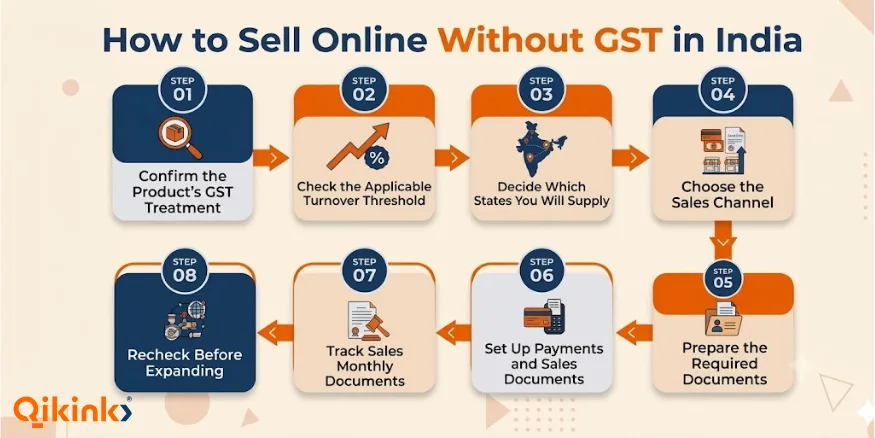
The following checklist helps you review the main requirements before accepting orders.
Step 1: Confirm the Product’s GST Treatment
Check whether the product is taxable, exempt or subject to a specific rate condition. Printed T-shirts, hoodies, mugs and other customised products should not be assumed exempt because they are made to order.
Example: Meena plans to sell printed T-shirts and hoodies. Both are taxable goods, so she cannot treat them as exempt, and she relies on the turnover limit.
Step 2: Check the Applicable Turnover Threshold
Estimate aggregate turnover across all sales channels under the same PAN. Include relevant supplies and do not subtract marketplace charges or business expenses when calculating turnover.
Example: In her first year, Meena expects ₹3 lakh of sales from her T-shirt store, which is well within ₹40 lakh. If she adds an accessories store under the same PAN later, that store’s sales are added to the same total.
Step 3: Decide Which States You Will Supply
For sellers who want to sell products online in India without GST, the customer location and sales channel determine which rules apply. Identify the state where the business operates and the locations where customers will receive orders. Interstate supplies of taxable goods can require registration.
Example: Meena operates from Tamil Nadu and decides to deliver only within Tamil Nadu for now. An order from Bengaluru would be an interstate sale, so she limits delivery to Tamil Nadu in her store settings where the platform allows it, and declines out-of-state orders otherwise.
Step 4: Choose the Sales Channel
An independent website, Instagram or WhatsApp does not create a GST exemption by itself. Marketplace sellers must check whether they qualify for the enrolment route and whether the platform accepts it.
Example: Meena sells through her own website and promotes on Instagram, and neither needs registration while she stays within the limit and within Tamil Nadu. If she later lists on a marketplace, she would first generate an enrolment number and sell only within Tamil Nadu on that platform.
Step 5: Prepare the Required Documents
Keep PAN, identity and address details, bank information and product records ready. If relying on the marketplace exemption, obtain the enrolment number before supplying goods through the operator.
Example: Meena keeps her PAN, address proof, bank details and product list ready before launch. For a marketplace listing, she would also keep her enrolment number.
Step 6: Set Up Payments and Sales Documents
Confirm the payment provider’s current onboarding requirements before setup. An unregistered seller must not add GST as a separate tax charge or issue a GST tax invoice. Keep suitable sales documents and records of payments, refunds and purchases.
Example: Meena’s bill shows a T-shirt at ₹799 and delivery at ₹60, with a total of ₹859 and no GST line.
Step 7: Track Sales Monthly
Maintain an order register with the date, order value, sales channel, customer state and refund status. Review the combined turnover regularly to see whether the business is approaching the relevant threshold.
Example: In her first year, Meena’s order register shows ₹25,000 of sales in July. She adds this to the earlier months to get her running total for the financial year and compares it with ₹40 lakh.
Step 8: Recheck Before Expanding
Before adding a new marketplace, accepting orders from another state or changing the fulfilment arrangement, review whether the change affects GST registration. Seek professional advice if the rules are unclear or registration liability may have arisen.
Example: Before Meena adds the accessories store or accepts her first order from Karnataka, she checks whether the change adds to her turnover or creates an interstate supply, since either could require registration.
Which Products Can Be Sold Online Without GST?

A business supplying only goods or services that are not liable to tax or are wholly exempt may qualify for a registration exemption under Section 23 of the CGST Act. The exact tax treatment of each product matters.
Some food products and other goods may be exempt depending on the specific notification entry and conditions. Certain exemptions apply only to particular forms, packaging or descriptions of a product. Check the applicable GST rate notification for the exact item.
A product is not automatically GST-exempt because it is handmade, homemade or produced only after an order. If a business sells both exempt and taxable products, it must assess the registration rules that apply to the overall business. Exempt sales still count toward aggregate turnover.
Do Dropshipping and Print on Demand Change the Interstate Rule?
Interstate sales of taxable goods generally require GST registration, even when turnover is below the usual threshold (Section 24 of the CGST Act). In a typical POD or dropshipping arrangement, the seller makes the sale to the customer while a supplier or fulfilment partner prints and ships the order. The seller’s own turnover, supply and customer location help determine the GST position.
The location of the printing or fulfilment partner does not automatically determine whether the seller’s own sale is interstate. Similarly, purchasing goods or services from a supplier in another state does not, by itself, establish that the seller has made an interstate outward supply.
For example, Meena sells printed T-shirts through her online store and uses a fulfilment partner to print and dispatch the orders. Meena still needs to establish who supplies the product to the customer, who invoices the customer and which business is responsible for the relevant tax obligations.
A POD fulfilment partner does not automatically take over the seller’s GST responsibilities. Because contractual and fulfilment arrangements can differ, confirm the treatment of your specific model with a qualified GST professional.
Compare & Choose Your Model!
Learn how both models work, with their pros and cons, and identify yours
Print On Demand vs Dropshipping →
What Else Is Needed When Selling Without GST?
GST registration is only one part of setting up an online business. An exemption from GST registration does not remove other legal, licensing or record-keeping requirements.
Sell Online Without a Business License
A seller can sometimes sell online without a business license, but the requirement depends on the product, location, business structure and activity. There is no single license that applies to every online seller in India.
Depending on the business, requirements may include:
- PAN and identity details for tax and platform verification.
- Food Safety and Standards Authority of India (FSSAI) registration or licensing for food businesses, where applicable.
- Specific approvals for medicines and other regulated products.
- Local registrations or shop-related permissions required by the relevant state or local authority.
- Permission to use designs, logos, characters or other protected artwork.
GST registration and business licenses are separate matters. Check the requirements for the particular product and location before starting sales.
Is Tax Still Paid on Business Purchases?
Yes. A supplier may charge GST on a purchase even if the buyer does not have a GSTIN. An unregistered seller generally cannot claim input tax credit, so the GST paid on business purchases becomes part of the cost.
For example, if the printing partner’s invoice for one of Meena’s T-shirt orders totals ₹350, including GST, Meena, as an unregistered seller, generally treats the full ₹350 as the purchase cost rather than claiming the GST component as input tax credit.
Do Payment Gateways Require a GSTIN?
Requirements vary by provider and business type. Some payment providers may accept eligible sellers without a GSTIN after identity and bank verification, while others may request GST details or a declaration.
Check the provider’s current onboarding requirements before setting up payments. Approval from a payment gateway does not confirm that the business is exempt from GST registration.
What Happens If a Seller Does Not Register for GST When Required?
A seller who is liable to register but fails to do so may face tax demands, interest and penalties under the applicable provisions. Section 122(1)(xi) of the CGST Act provides for a penalty of ₹10,000 or the amount of tax evaded, whichever is higher, for the specified failure to obtain registration despite being liable.
For example, if the tax evaded under the relevant provision is ₹4,000, the stated penalty would be ₹10,000. If the tax evaded is ₹60,000, the penalty under that provision would be ₹60,000. The outcome in an actual case depends on the facts, the applicable section and any other relevant provisions.
A seller who discovers that registration was required earlier should seek advice from a qualified tax professional about registration, prior supplies, tax dues and interest.
When Should a Seller Register for GST?
A person who becomes liable for GST registration must apply within the period prescribed by law. Section 25(1) of the CGST Act generally requires an application within 30 days from the date the person becomes liable.
Registration liability can arise when:
- Aggregate turnover exceeds the applicable threshold.
- The seller makes an interstate supply of taxable goods, and no exception applies.
- Marketplace sales no longer meet the conditions of Notification No. 34/2023-Central Tax.
- Another compulsory registration provision applies to the business.
The effective date of registration depends on when the application is made and the applicable provisions. Under Rule 10 of the CGST Rules, registration may take effect from the date the person became liable when the application is submitted within the prescribed period. Where the application is made later, the effective date may be the date of grant.
For example, if Meena’s combined sales cross ₹40 lakh and she becomes liable for registration on January 10, and she submits the application within the prescribed 30-day period, registration may take effect from January 10. If the application is made after that period, the effective date may differ. A tax professional can confirm the correct treatment for the specific facts.
A seller may also register voluntarily under Section 25(3). Once registered, the business must follow the applicable requirements for invoicing, returns and tax payment.
What Is the Proposed Rule 14B for Small E-Commerce Sellers?
At its 57th meeting on October 8, 2026, the GST Council recommended introducing Rule 14B to simplify registration for certain small suppliers selling goods through e-commerce operators in states where they do not have a physical place of business.
Under the recommended mechanism, an eligible seller could declare an e-commerce operator’s warehouse as the principal place of business in a state or Union Territory where the seller has no physical presence. The recommendation applies to sellers who intend to pass on input tax credit of no more than ₹2.5 lakh per month, excluding stock transfers between distinct persons.
Rule 14B is a proposed registration facility, not an exemption from registration. The Council’s press release states that recommendations are to be given effect through the relevant notifications, circulars or legal amendments. Check the latest official update before relying on the route.
Is Dropshipping Legal in India?
Register your business, obtain a GST number and learn laws & regulations
Dropshipping Legal Requirements →
Common Mistakes to Avoid
- Treating ₹40 lakh as a universal limit, regardless of state, product or compulsory-registration rules.
- Enabling nationwide checkout for ordinary taxable goods while relying on an intra-state exemption.
- Assuming a supplier’s GSTIN or tax invoice covers your own customer sale.
- Counting only profit or marketplace settlements instead of aggregate turnover.
- Adding a GST line to customer invoices while unregistered.
- Calling taxable clothing “GST-exempt” because the seller qualifies for a registration exemption.
- Treating a composition GSTIN as the same thing as an unregistered seller’s enrolment number.
- Assuming marketplace approval confirms GST eligibility.
Frequently Asked Questions
1. Can I Sell Online Without GST in India?
2. How Can I Sell My Products Online Without a GST Number?
3. Can I Sell on Amazon or Flipkart Without GST?
4. Can I Sell Clothes Online Without GST?
5. Can I Sell Online Without a Business License?
6. Do Payment Gateways Require a GSTIN?
7. Can I Sell Products Online Without GST Through Dropshipping or POD?
8. Can I Use Someone Else’s GST Number to Sell Online?
9. Does Cash on Delivery Change the GST Rules?
10. Is Tax Collected at Source on the Marketplace Route for Unregistered Sellers?
11. Do I Pay Income Tax if I Sell Without GST?
Final Thoughts
Selling online without GST registration in India depends on the applicable turnover threshold, the nature of the products, the locations of the supplies and the sales channel. Some eligible businesses can operate without registration under a threshold exemption, while certain marketplace sellers can use a separate enrolment route if they meet its conditions.
Before starting, identify the products, estimate combined turnover, decide where orders will be delivered and check the current requirements of the chosen channel. Keep sales records from the beginning and review registration requirements before expanding.
Qikink provides fulfilment for custom-printed clothing and merchandise. Businesses using dropshipping model should assess their own GST position based on the actual selling and fulfilment arrangement rather than assuming the fulfilment partner determines their registration status.
Start Selling Online →Read More
- What is a Dropshipping Business in India & How Does it Work
- Average Dropshipping Income in India Per Month: Guide
- Can Dropshipping Make You Rich? Stories and Success Tips
- How to Start an eCommerce Business Without Money
Summarise the Article


Share the Article


