
The D2C business model allows businesses to sell products directly to customers through their own sales channels. However, running a profitable D2C business involves much more than setting up an online store.
Every customer order involves several financial and operational decisions. Businesses must manage product costs, payment processing, marketing expenses, fulfilment, customer support and returns.
For example, an Indian clothing entrepreneur can sell graphic T-shirts through a branded website while outsourcing printing and shipping. The brand manages its customer relationships, pricing and sales without necessarily owning a manufacturing facility.
But how much money does the business actually earn from each order? What expenses should the entrepreneur plan for? And how can the business operate efficiently?
This guide explains how the D2C business model works in India, including revenue generation, operating costs, profit calculations, business models and practical decisions for entrepreneurs.
Key Takeaways
- Direct selling: D2C brands sell through their own websites, stores or other brand-controlled channels.
- Flexible operations: Businesses can manufacture products themselves or outsource production and fulfilment.
- Revenue is not profit: Product costs, marketing, shipping, returns and overheads determine actual earnings.
- Different operating models: Inventory-based, made-to-order, subscription and outsourced approaches have different financial requirements.
- Customer acquisition matters: Increasing sales does not guarantee profitability if acquisition costs rise.
- Break-even planning: Businesses should calculate how many orders they need to cover recurring expenses.
- Print on demand: Suitable custom products can be produced after orders arrive, reducing the need for bulk finished printed inventory.
What Is the D2C Business Model?
The D2C business model, or Direct-to-Consumer business model, is an approach in which a brand sells products directly to end customers through its own sales channels.
For example, a clothing brand selling T-shirts through its official ecommerce website operates a D2C channel.
The brand manages product pricing, customer communication and the shopping experience while arranging production and delivery.
A D2C business does not necessarily need its own factory, warehouse or delivery network. These operations can be outsourced to suitable partners.
The important distinction is the relationship between the brand and the buyer.
For a more detailed introduction, explore D2C meaning, full form and business fundamentals.
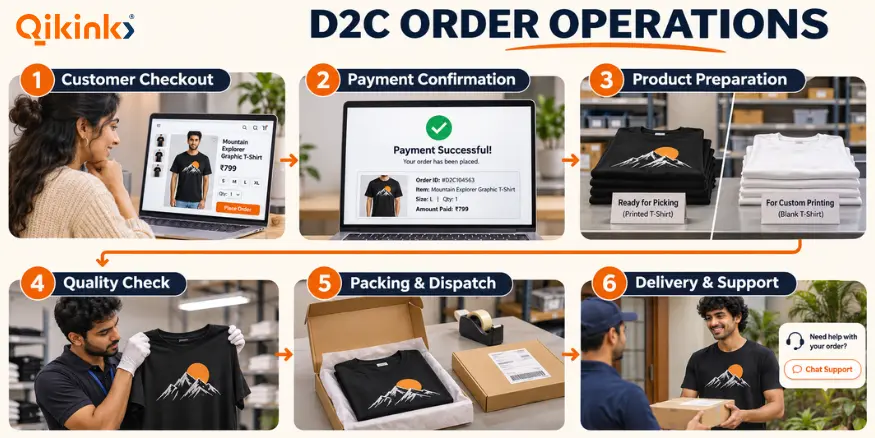
How Does a D2C Business Operate From Order to Delivery?
A D2C business operates by accepting customer orders through a direct sales channel and coordinating the activities required to deliver the purchased products.
Although the customer sees a simple shopping experience, several processes take place after an order is submitted.
What Happens After a Customer Places an Order?
Consider an entrepreneur selling oversized graphic T-shirts through a branded ecommerce website.
A customer selects a design, chooses a size, enters delivery details and completes checkout.
The store records the order information, including the selected product, quantity, payment method and shipping address.
The business then checks whether the product is available or needs to be manufactured.
For an inventory-based business, the product may already be stored in a warehouse.
For a made-to-order business, production begins after the order is confirmed.
The order is then prepared for dispatch.
Who Handles Payments, Production and Shipping?
Different service providers can perform different parts of the order process.
The brand remains responsible for delivering the customer experience it promises, even when external companies perform operational tasks.
How Are Returns and Customer Support Managed?
After shipping, the business must monitor delivery status and respond to customer concerns.
Customers may request support because of incorrect sizes, damaged products, delivery delays or other issues.
The business needs clear procedures for cancellations, returns, replacements and refunds.
These activities also affect profitability.
A returned product may create shipping expenses, replacement costs and additional customer service work.
Therefore, order fulfilment should be evaluated not only by dispatch speed but also by successful deliveries and customer satisfaction.
Practical Example: A clothing brand using Qikink can connect its Shopify or WooCommerce store to an outsourced print-on-demand fulfilment service. When a customer places an order, the order details can be sent for processing. Qikink prints the supported product, completes quality checks, packs it and arranges shipping. The clothing brand manages its store front, customer communication and selling strategy without maintaining bulk finished printed inventory.
What Are the Different Types of D2C Business Models?
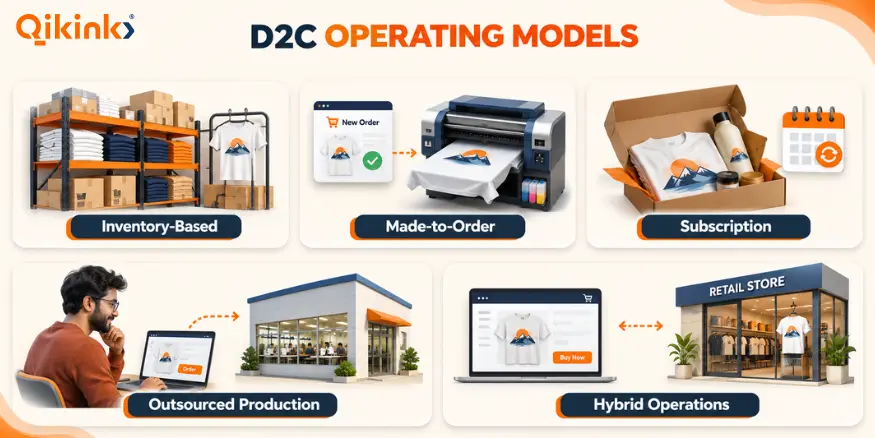
Choosing the right D2C business model depends on product demand, available investment, inventory requirements and fulfilment capabilities.
These operating models are not mutually exclusive. A brand may combine inventory-based production, outsourced fulfilment and recurring sales within the same business.
1. Inventory-Based D2C Model
In an inventory-based model, products are manufactured or purchased before customers place orders.
For example, a clothing brand may manufacture 300 oversized T-shirts in different sizes and colours, store them and ship individual products when orders arrive.
This approach can support faster dispatch when stock is available.
However, the business must invest money before knowing whether every product will sell.
Slow-moving sizes, colours or designs can create unsold inventory.
Inventory-based operations generally work better when demand is reasonably predictable and production volume supports the investment.
2. Made-to-Order or Print-on-Demand Model
In a made-to-order model, production or customisation takes place after an order is received.
For example, a clothing entrepreneur can list original graphic T-shirt designs online and arrange printing only when customers purchase them.
This reduces the need to purchase bulk quantities of finished printed products.
However, per-unit manufacturing costs and production timelines may differ from those of bulk production.
Print on demand can be especially useful when testing new designs or selling products to smaller audiences.
3. Subscription-Based D2C Model
A subscription model generates recurring revenue through scheduled product deliveries or memberships.
For example, a personal-care brand may offer customers a monthly subscription for products they regularly use.
Recurring purchases can improve revenue predictability when customers remain subscribed.
However, subscriptions require ongoing customer satisfaction, predictable fulfilment and careful management of cancellations.
Not every product category is suitable for recurring delivery.
4. Outsourced Production and Hybrid Operations
Some D2C businesses outsource manufacturing, storage or shipping while controlling their own sales channels.
For example, a brand may work with a contract manufacturer and a separate logistics company instead of operating both facilities.
Other businesses combine direct ecommerce sales with independent marketplaces or retail distribution.
This hybrid approach can expand customer reach but introduces additional channel-management responsibilities.
D2C Operating Models Comparison
The most suitable model depends on product demand, production capacity, cash availability and expected order volume.
For a new clothing brand selling custom designs, made-to-order production may reduce the initial commitment to finished printed inventory.
Start Selling Without Bulk Inventory
Turn your designs into products. Qikink handles printing and shipping.
Get Started with Qikink →
How Do D2C Brands Make Money?
D2C brands generate revenue by selling products directly to customers.
Their main revenue source is usually product sales, although some businesses also offer subscriptions, memberships, complementary products or recurring purchases.
However, the amount customers pay is not the amount the brand earns as profit.
The business must account for the costs associated with producing, marketing and delivering each order.
What Are the Main Revenue Sources of D2C Brands?
Common revenue sources include:
- Individual product sales: Customers purchase products through the brand’s direct sales channels.
- Product bundles: Brands sell related items together, such as a T-shirt and cap.
- Subscriptions: Customers pay periodically for scheduled products or services.
- Repeat purchases: Existing customers return to purchase additional products.
- Product upgrades: Customers choose higher-value variants or optional additions.
Revenue models should match actual customer needs rather than simply increasing the number of products offered.
What Are the Major Costs of Running a D2C Business?
D2C expenses generally fall into two categories.
Variable costs change with sales activity. These may include product manufacturing, payment processing, shipping, packaging, performance-based acquisition expenses and return-related costs.
Fixed or recurring costs may include website subscriptions, salaries, rent, software and other overheads.
Some expenses have both fixed and variable elements.
Businesses should separate these costs to understand how much each successful order contributes toward monthly expenses.
How to Calculate Contribution Margin per Order
Contribution margin shows how much revenue remains after variable costs.
Contribution per order = Net sales revenue − Variable costs per order
Contribution margin (%) = Contribution per order ÷ Net sales revenue × 100
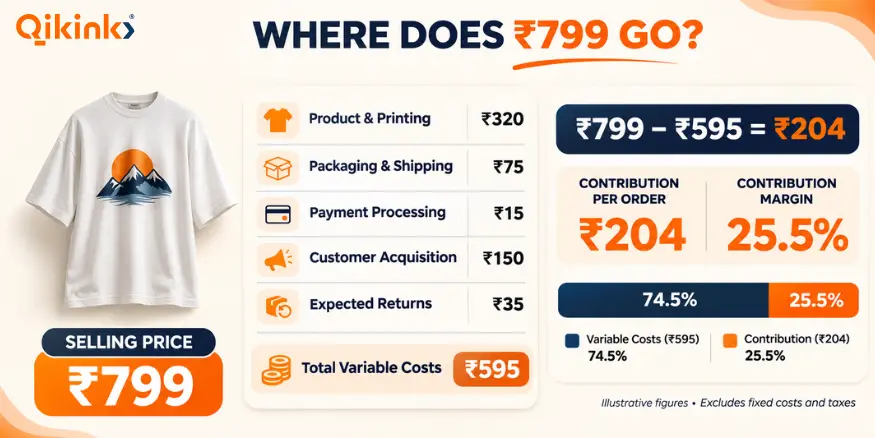
Consider a hypothetical Indian clothing brand selling a graphic T-shirt for ₹799.
Example: ₹799 D2C T-Shirt Cost Breakdown
The business generates ₹204 in contribution from the illustrative order.
This amount is available to cover fixed expenses and contribute toward operating profit.
It does not represent final net profit.
A positive contribution margin is encouraging, but the business still needs enough completed sales to cover its recurring expenses.
How Much Does It Cost to Run a D2C Business in India?
The operating costs of a D2C business model in India vary depending on the product category, inventory requirements, sales volume, customer acquisition and fulfilment expenses.
Businesses must carefully plan their operating expenses to maintain profitability and support long-term growth.
For example, a small online clothing business may have a different cost structure from a cosmetics brand that maintains inventory and physical storage facilities.
Rather than relying on a general startup-cost estimate, entrepreneurs should examine their recurring monthly expenses.
Fixed Costs vs Variable Costs in D2C
This classification helps businesses estimate their operating requirements at different sales volumes.
How Does Customer Acquisition Cost Affect Profit?
Customer Acquisition Cost (CAC) measures the average amount spent acquiring a new customer.
CAC = Customer acquisition expenditure ÷ New customers acquired
Suppose an entrepreneur spends ₹15,000 on customer acquisition during a campaign and gains 100 new customers.
The CAC is ₹150.
If the brand later spends ₹20,000 to acquire the same number of customers, CAC increases to ₹200.
Using the previous ₹799 T-shirt example, that additional ₹50 acquisition cost reduces the contribution from ₹204 to ₹154, assuming every other expense remains unchanged.
This explains why increasing advertising spending does not automatically improve profitability.
The business should evaluate how much contribution acquired customers generate, including any subsequent purchases, against the cost of acquiring and serving them.
How Do COD Returns and RTO Affect Earnings?
Cash on Delivery (COD) is a payment option used in Indian ecommerce, but unsuccessful deliveries can create additional expenses.
Return to Origin (RTO) occurs when a shipment returns to the sender without successful delivery.
Possible reasons include customers refusing delivery, incorrect addresses or unsuccessful delivery attempts.
An RTO order may generate:
- Outbound shipping charges.
- Return shipping expenses.
- Packaging costs.
- Customer support work.
- Product damage or reprocessing costs.
A business should distinguish between orders placed, orders dispatched and orders successfully delivered.
For example, receiving 100 orders does not necessarily mean earning revenue from 100 completed sales.
Tracking successful delivery rates and return-related expenses helps brands understand actual financial performance.
How to Estimate Monthly Operating Expenses
Entrepreneurs can prepare a simple monthly expense forecast before increasing sales activity.
Suppose a small D2C business estimates the following fixed expenses:
These are hypothetical planning figures, not market averages.
Variable order expenses should be calculated separately to avoid counting the same cost twice.
For clothing brands, costs can also depend on the product’s fabric, print size, production method, packing requirements and shipping location.
A useful approach is to compare costs across several order volumes rather than relying on a single sales forecast.
Is the D2C Business Model Profitable in India?
The D2C business model can be profitable in India when customer revenue consistently exceeds variable costs and fixed operating expenses.
However, selling directly does not guarantee higher profits.
A D2C brand may retain more control over its selling price, but it must also pay for customer acquisition, operations, fulfilment and support.
The most useful way to evaluate profitability is through contribution margins and break-even calculations.
How to Calculate Break-Even Sales
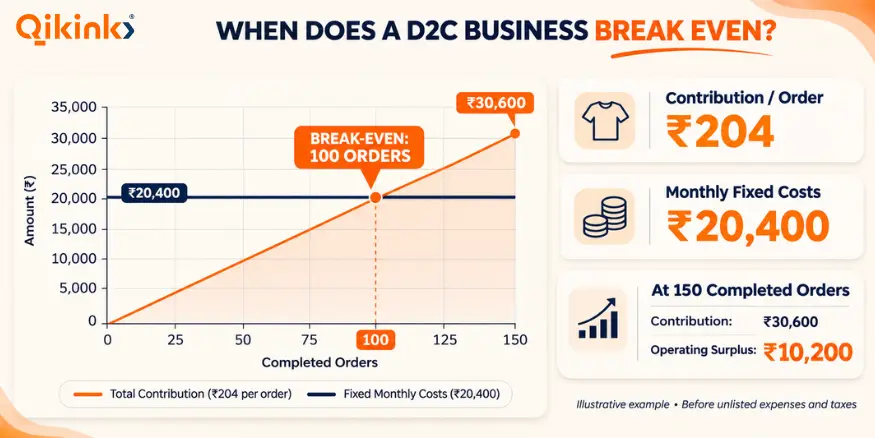
The break-even point is the sales volume at which the business covers its operating costs without generating an operating profit or loss.
Break-even orders = Monthly fixed expenses ÷ Contribution per order
Using our hypothetical example:
• Contribution per order: ₹204.
• Monthly fixed operating expenses: ₹20,400.
Break-even orders = ₹20,400 ÷ ₹204
Break-even point = 100 successfully completed orders
Under these simplified assumptions, the business needs 100 equivalent orders per month to cover its fixed expenses.
At 150 orders:
Total contribution = 150 × ₹204 = ₹30,600.
Illustrative operating surplus = ₹30,600 − ₹20,400 = ₹10,200.
This is not a guaranteed profit forecast. Actual results depend on changing order costs, returns, taxes and additional expenses.
What Is a Good D2C Contribution Margin?
There is no universal contribution margin that works for every D2C business.
A suitable margin depends on the product category, customer acquisition expenses, repeat purchase behaviour and fixed operating costs.
For example, a brand with low fixed expenses may operate sustainably at a margin that would be insufficient for another brand maintaining warehouses and a large team.
Instead of targeting an arbitrary percentage, entrepreneurs should calculate whether their contribution can cover fixed expenses at a realistic sales volume.
How Do Repeat Orders Affect Profitability?
Repeat purchases can improve business economics when returning customers generate additional contribution without requiring the same acquisition spending as first-time buyers.
For example, a customer who purchases a graphic T-shirt may later purchase a hoodie from the same brand.
However, repeat sales still involve product, shipping, payment and customer service expenses.
Discounts and retention campaigns can also reduce contribution.
Brands should therefore measure the actual contribution generated by returning customers.
Build Your D2C Clothing Brand
Sell custom clothing without bulk inventory. Qikink handles fulfilment.
Start Your Clothing Brand →
What Are the Advantages and Financial Risks of the D2C Model?
The benefits of D2C come from building direct customer relationships and having greater control over pricing, sales channels and the customer experience.
According to McKinsey & Company’s research on India’s D2C market, 53% of surveyed Indian MSMEs prefer direct-to-consumer selling channels, highlighting the importance of direct selling for businesses.
However, these advantages also come with responsibilities. D2C brands must manage customer acquisition, order fulfilment, returns and operational expenses to maintain profitability.
Where Can D2C Brands Create More Value?
Direct customer feedback: Brands can learn which products customers prefer and use that information to improve future collections.
Pricing flexibility: Businesses can adjust direct-channel pricing based on product costs, customer expectations and positioning.
Product experimentation: Brands can introduce new variants, measure demand and discontinue products that do not perform.
Customer retention opportunities: Direct communication provides opportunities for repeat sales and customer service improvements.
These advantages can support long-term development, but their financial value depends on execution.
Which Operating Costs Can Reduce Those Benefits?
Several factors can reduce the financial advantages of direct selling.
A business may face high advertising expenses, unsold inventory, delivery failures or expensive product returns.
For example, saving money on distribution may provide little benefit if the business spends too much acquiring each customer.
Similarly, maintaining large quantities of stock can reduce cash available for other operations.
How Can Brands Reduce Financial Risk?
Businesses can reduce some operational risks by testing product demand, reviewing unit economics and choosing suitable fulfilment arrangements.
Useful practices include checking samples before launching products, maintaining accurate size information, monitoring customer acquisition expenses and tracking return rates.
Brands should also compare suppliers based on product quality, delivery reliability and total fulfilment expenses-not price alone.
For a deeper introduction to the broader benefits and limitations, refer to Qikink’s D2C business guide.
D2C Business Model Example: An Indian Clothing Brand
Consider a hypothetical entrepreneur launching a small graphic T-shirt brand in India.
The founder identifies an audience interested in minimal typography designs and creates an online store featuring five T-shirt designs.
Instead of ordering hundreds of printed products in advance, the founder chooses a made-to-order fulfilment approach.
A customer visits the website and purchases a T-shirt for ₹799.
The brand records the order and sends the required product information to its fulfilment partner.
The partner prints the design, checks the product, packs it and arranges delivery.
The founder remains responsible for product selection, pricing, marketing and customer support.
Using the earlier hypothetical calculation, the order generates ₹204 in contribution after the listed variable costs.
The founder can then estimate how many successful orders are needed to cover fixed monthly expenses.
This example demonstrates how production arrangements and financial planning work together in a D2C business.
The brand does not need to own manufacturing machinery to sell directly to consumers, but it must still manage customer expectations and operating costs.
For examples of established companies, explore Qikink’s Top 100 D2C Brands in India.
Should a D2C Clothing Brand Hold Inventory or Outsource Fulfilment?
The decision to hold inventory or outsource fulfilment depends on order volume, available capital, product requirements and demand predictability.
When Does Holding Inventory Make Sense?
Maintaining inventory may be useful when a business has consistent demand and wants ready stock for popular products.
Bulk production can reduce certain per-unit expenses, but it requires upfront investment and exposes the business to unsold inventory.
When Can Print on Demand Be a Better Fit?
Print on demand may suit businesses testing designs, launching niche collections or avoiding bulk purchases of finished printed products.
With Qikink’s print-on-demand fulfilment service, clothing brands can arrange supported products to be printed after customer orders arrive.
Qikink handles printing, packing and shipping, allowing entrepreneurs to focus on their brand, designs and customers.
The service supports white-label fulfilment and integrations with Shopify and WooCommerce.
However, entrepreneurs should compare production charges, samples, shipping timelines and expected margins before selecting a fulfilment approach.
Turn Your Product Idea Into a D2C Brand
Launch your D2C brand with Qikink. No bulk inventory needed.
Get Started for Free →
Frequently Asked Questions
1. Can a D2C Business Operate Without Its Own Factory?
2. What Is the Difference Between D2C Revenue and Profit?
3. How Do You Calculate D2C Break-Even Sales?
4. Can a D2C Business Use a Subscription Model?
5. Which Costs Matter Most for a Small D2C Brand?
6. How Much Investment Is Needed to Start a D2C Business in India?
7. Is the D2C Business Model Profitable in India?
Final Thoughts
The D2C business model offers entrepreneurs an opportunity to build direct customer relationships and manage their own selling experience.
However, a successful D2C business model requires more than increasing orders. Long-term growth depends on managing costs, maintaining profitability and retaining customers.
Businesses must understand their revenue, contribution margins, customer acquisition expenses, fulfilment costs and break-even requirements.
Choosing between inventory-based production and outsourced fulfilment can also influence cash flow and operational responsibilities.
For aspiring clothing entrepreneurs in India, evaluating these factors before scaling can help build a more financially sustainable business.
Sign Up & Start Today! →Read More
- https://qikink.com/blog/the-actual-cost-of-print-on-demand-business/
- https://qikink.com/blog/clothing-business-ideas/
- https://qikink.com/blog/print-on-demand-vs-dropshipping-which-is-profitable/
Share the Article

