

Launching an online brand is one thing. Getting customers to discover your products, trust your business and complete their first purchase is another.
An Indian clothing entrepreneur might spend weeks creating an oversized T-shirt collection, building a website and preparing product photographs. But without a clear marketing plan, the collection may receive very little attention.
This is where a D2C marketing strategy becomes important.
Direct-to-consumer brands use channels such as search engines, social media, paid advertising and email to reach customers and encourage purchases through their own selling channels.
However, spending money on advertisements does not automatically generate profitable sales. A brand also needs relevant products, a clear message, a reliable website and a reason for customers to return.
This guide explains 12 D2C marketing strategies, how to select marketing channels, plan a realistic budget, measure campaign performance and create a 30-day action plan.
Key Takeaways
- Understand your audience: Identify who is likely to buy your products and what influences their purchasing decisions.
- Combine marketing channels: SEO, social media, advertisements and influencer partnerships serve different purposes.
- Focus on conversion: Attracting visitors is useful only when they can understand and confidently purchase your products.
- Measure marketing expenses: Track customer acquisition cost, conversion rate and contribution after marketing.
- Encourage repeat purchases: Relevant communication and reliable customer experiences support long-term relationships.
- Test before scaling: Begin with manageable campaigns and increase spending only after evaluating the results.
What Is D2C Marketing?
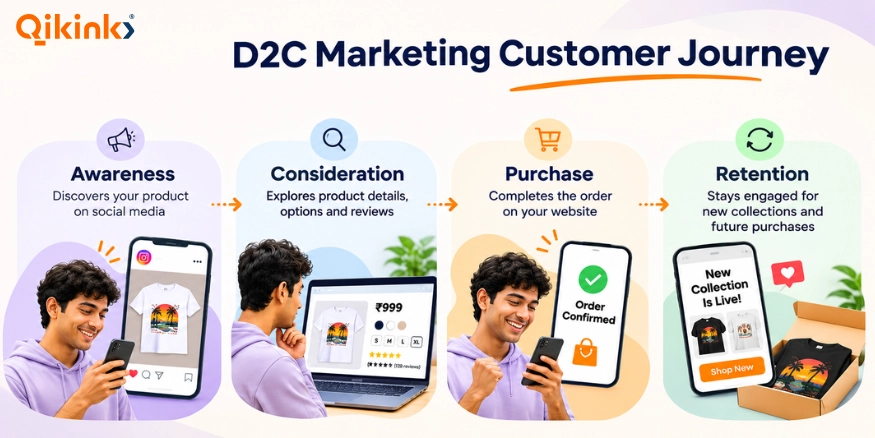
D2C marketing is the process of promoting products directly to consumers through channels such as brand-owned websites, search engines, social media, advertisements and customer communication platforms.
A D2C marketing strategy is a plan that explains how a brand will attract potential customers, turn interested visitors into buyers and encourage existing customers to purchase again.
For example, a clothing brand might publish Instagram styling videos, run Google advertisements for specific products and send new collection updates to customers who have opted in.
These activities work together to support the customer’s journey from discovering a product to purchasing it.
D2C marketing generally focuses on four stages:
Awareness → Consideration → Purchase → Retention
A new customer may first discover a brand through a social media video, compare products on its website and return later after receiving useful product information.
If you want to understand the sales approach itself, read our guide explaining what D2C means.
How to Create a D2C Marketing Strategy
Before choosing advertising platforms, a brand needs to understand its customers and establish clear marketing goals.
A useful marketing plan connects customer research, product positioning, promotional channels and performance measurement.
1. Identify Your Target Audience
Start by defining the people most likely to purchase your products.
Consider their interests, age group, location, shopping habits and reasons for choosing a particular product.
For example, a clothing brand selling oversized graphic T-shirts might focus on college students who enjoy streetwear, relaxed fits and original artwork.
A brand selling premium minimalist T-shirts may appeal to a different audience.
Instead of targeting everyone, create a customer profile describing who the product is for and what matters to them.
Tip
Read customer reviews and social media comments about similar products. Repeated questions about price, fabric, sizing and comfort can reveal useful marketing opportunities.
2. Define Your Unique Selling Proposition
A unique selling proposition (USP) explains why customers should consider your brand.
For a clothing business, differentiation might come from original designs, a particular fit, fabric characteristics, personalisation or a strong community identity.
Avoid generic claims such as “best quality” unless they can be supported.
A clearer message might describe the actual product, such as a collection of original oversized graphic T-shirts designed around a particular interest.
3. Set Measurable Marketing Goals
Decide what you want marketing to achieve.
A new brand might initially focus on attracting relevant visitors and generating its first customer orders.
An established brand may prioritise conversion rate, repeat purchases or customer acquisition costs.
| Marketing Goal | Metric to Track |
|---|---|
| Increase product discovery | Relevant website traffic |
| Generate new customers | First-time customer orders |
| Improve website performance | Purchase conversion rate |
| Control acquisition costs | Customer acquisition cost (CAC) |
| Increase order value | Average order value (AOV) |
| Encourage repeat purchases | Repeat purchase rate |
Choose two or three main goals at a time.
4. Select Channels and Set a Budget
Choose marketing channels based on where your audience spends time and how they discover products.
A visual fashion brand may initially benefit from Instagram content and creator partnerships.
A brand with products that customers actively search for may also benefit from Google Search and SEO.
Set a budget you can afford to test, along with a clear method for reviewing the results.
Note
A successful marketing strategy does not require using every platform. A small brand may achieve more useful learning from one carefully managed campaign than several poorly tracked campaigns.
12 D2C Marketing Strategies to Grow Your Brand
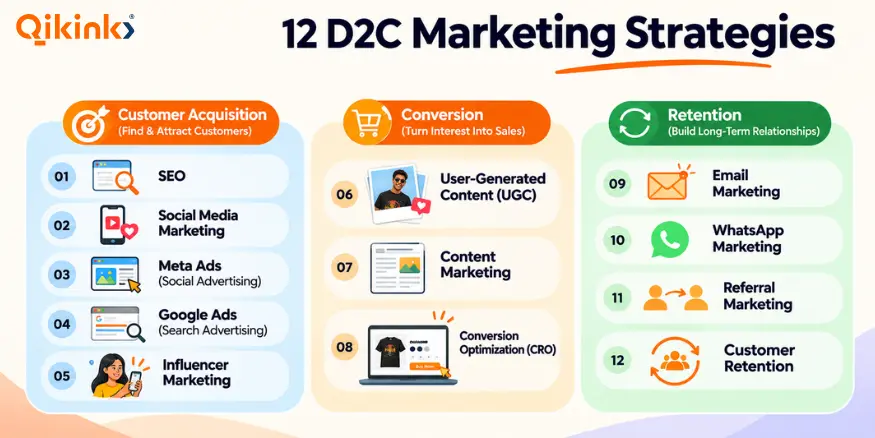
The following strategies cover customer discovery, advertising, conversion and retention.
You do not need to implement all 12 immediately. Select the approaches that match your audience, resources and current business goals.
1. Use SEO to Attract Customers Searching for Products
Search engine optimisation (SEO) helps your website appear when potential customers search for relevant products or information.
Unlike paid advertising, organic search does not charge for each click. However, SEO requires content development, website maintenance and time.
A clothing brand might target searches related to:
- Oversized cotton T-shirts.
- Graphic T-shirts in India.
- Streetwear styling ideas.
- How to choose an oversized T-shirt size.
- Different T-shirt fits and fabric weights.
Optimise product pages with descriptive titles, original product information, useful images and accurate size charts.
Educational content can also attract people researching products before purchasing.
Example: A brand publishes a guide comparing regular-fit and oversized T-shirts, including garment measurements and photographs.
Readers can use the guide to understand which fit suits them and explore relevant products.
Tip
Prioritise keywords that match your products and customers’ needs. High search volume alone does not make a keyword suitable for your business.
2. Build Brand Awareness Through Social Media
Social media allows D2C brands to introduce products and demonstrate how they fit into customers’ everyday lives.
For apparel brands, visual content can communicate garment fit, colour, styling and design details.
Useful formats include:
- Outfit styling videos.
- New collection previews.
- Product close-ups.
- Behind-the-scenes content.
- Customer outfit photographs.
- Fabric and fit demonstrations.
Avoid turning every post into a direct sales message.
Customers may follow a clothing brand because they enjoy its designs, styling ideas or community.
Example: An oversized T-shirt brand publishes a short Reel showing three ways to style the same black T-shirt with different trousers and accessories.
The video demonstrates product versatility rather than simply displaying the selling price.
3. Test Meta Ads With Different Creatives
Meta Ads can help D2C brands reach audiences through Facebook and Instagram.
Advertising performance depends on several factors, including creative quality, audience relevance, product pricing and the website experience.
Instead of repeatedly showing the same product image, test different ways of communicating its value.
For example:
- A model wearing the T-shirt.
- A close-up showing fabric texture.
- A video demonstrating the garment fit.
- A customer-style unboxing video.
- A short collection introduction.
Start with a manageable budget and review purchase-related performance.
Example: A clothing brand tests three advertisements promoting the same oversized T-shirt collection.
One shows the garment on a model, another focuses on fit and a third demonstrates styling.
The brand compares meaningful outcomes such as purchases and acquisition cost rather than judging success only by views.
Note
Advertising platforms may report attributed conversions differently. Compare their reports with your store’s actual orders before making spending decisions.
4. Use Google Ads to Capture Purchase Intent
Google Search Ads can reach people actively searching for products.
A person searching for “buy printed oversized T-shirts” may have a more immediate purchase intention than someone casually viewing fashion content.
Brands can advertise relevant products and direct users to suitable product or collection pages.
A good campaign should connect the search term, advertisement and destination page.
For example, an advertisement promoting graphic oversized T-shirts should lead to a matching collection rather than an unrelated homepage.
Google Shopping campaigns may also help eligible ecommerce brands display product information through supported advertising formats.
Tip
Before launching advertisements, confirm that your product pages include clear prices, product images, available sizes, shipping information and accessible purchase options.
5. Collaborate With Micro-Influencers
Influencer marketing helps brands introduce products through creators who already communicate with relevant audiences.
For new D2C brands, smaller creators with suitable audiences may be more useful than large influencers whose followers have limited interest in the products.
Consider the creator’s content style, audience location, engagement authenticity and relevance.
A streetwear brand might collaborate with fashion styling creators, while a sportswear business may prefer fitness-focused creators.
Possible collaborations include:
- Styling videos.
- Product demonstrations.
- Original content featuring the product.
- Collection introductions.
- Creator-led discount campaigns.
Example: A clothing brand collaborates with a fashion creator who produces an oversized T-shirt styling video.
The brand provides a unique referral link to monitor attributable visits and orders.
Note
Paid or incentivised collaborations should include appropriate advertising disclosures. Agree on content usage rights before using creator material in your own advertisements.
Ready to Launch Your Clothing Brand?
Create and sell custom clothing without purchasing bulk printed inventory.
Start Selling with Qikink →
6. Build Customer Trust With User-Generated Content
User-generated content (UGC) includes photographs, videos and feedback created by customers or other users.
It can help shoppers understand how a product looks outside a professional photoshoot.
For clothing businesses, customer photographs may be especially useful for showing fit and styling.
With permission, brands can feature relevant customer content on product pages and social media.
Examples include:
- Customer outfit photographs.
- Product reviews.
- Unboxing videos.
- Styling demonstrations.
- Customer-created tutorials.
Example: A clothing store includes genuine customer photographs alongside its studio images to help visitors understand the garment’s fit in everyday situations.
Do not present sponsored creator content as an independent customer review.
7. Create Useful Content for Your Audience
Content marketing should answer questions customers have before and after purchasing.
For a clothing brand, useful topics may include:
- How to select the right T-shirt size.
- Understanding common fabric weights.
- Styling oversized clothing.
- Caring for printed garments.
- Choosing colours for different outfits.
These topics can support blog articles, videos, product-page guides and social content.
The objective is to help customers make informed decisions.
Example: A brand publishes a guide explaining the differences between 180 GSM and 240 GSM T-shirts, using accurate product information and examples.
Readers can compare garment options before purchasing.
Tip
Create content around genuine customer questions. One useful product guide may be more valuable than several articles repeating the same basic information.
8. Encourage Repeat Purchases With Email Marketing
Email marketing allows brands to communicate with subscribers and customers who have provided appropriate permission.
It can support collection launches, customer education and repeat purchases.
A simple email sequence might include:
- A welcome message introducing the brand.
- Useful sizing or product information.
- A relevant collection recommendation.
- Garment-care advice after a purchase.
- Updates about new products.
Avoid sending identical promotional emails to everyone.
Where the necessary information and permissions are available, segment communication according to customer interests or previous purchases.
Example: A customer who purchases a graphic T-shirt receives useful care instructions and later an announcement about a related collection.
9. Use WhatsApp for Customer Communication
WhatsApp can support customer communication for Indian ecommerce brands.
Businesses may use suitable messaging tools to answer questions, provide requested information and send permitted updates.
Possible use cases include:
- Responding to size enquiries.
- Providing order information.
- Answering delivery questions.
- Sharing product availability.
- Sending relevant collection updates to opted-in customers.
Marketing messages should follow applicable consent requirements and WhatsApp’s platform policies.
Example: A customer who requests restock updates receives a message when the selected T-shirt becomes available again.
Note
WhatsApp communication should be relevant and permission-based. Avoid sending repeated promotional messages to customers who have not agreed to receive them.
10. Improve Your Website Conversion Rate
Attracting additional visitors is not always the most effective way to increase sales.
A website may already receive relevant traffic but lose potential customers because important information is missing.
Conversion rate optimisation (CRO) focuses on improving the experience between arriving at a website and completing a purchase.
For clothing brands, review:
- Product photographs and videos.
- Size charts and garment measurements.
- Mobile usability.
- Shipping charges.
- Payment options.
- Return and exchange information.
- Product descriptions.
- Checkout reliability.
Example: If customers frequently ask whether an oversized T-shirt is true to size, adding accurate measurements and model references may help them make decisions.
Use actual customer questions and analytics data to identify improvements.
11. Launch a Customer Referral Programme
Referral marketing encourages existing customers to recommend products to others.
A clothing brand might offer a small reward when an existing customer successfully refers a new buyer.
For example, a referral code could provide a first-order discount to an eligible friend and a later benefit to the existing customer.
Before introducing incentives, calculate whether the programme is financially sustainable.
Referral programmes are most useful when customers already have positive product experiences.
Tip
Keep referral conditions clear. Avoid complicated reward systems or incentives that encourage misleading reviews.
12. Focus on Customer Retention
Customer retention involves maintaining relationships with people who have already purchased from your brand.
It matters because an existing customer may return to explore complementary products or future collections.
Retention strategies can include:
- Reliable customer support.
- Consistent product quality.
- Relevant product recommendations.
- New collection previews.
- Loyalty programmes.
- Customer feedback.
- Useful post-purchase communication.
For example, someone who purchases an oversized T-shirt may later be interested in a sweatshirt or another graphic design.
However, not every buyer will make a repeat purchase.
Measure actual customer behaviour rather than assuming future revenue.
Which Marketing Channels Work Best for D2C Brands?
Each marketing channel serves a different purpose.
Choose channels based on customer behaviour, product demand and the resources available to your business.
| Marketing Channel | Primary Purpose | Main Cost Consideration | Suitable Use |
|---|---|---|---|
| SEO | Attract search visitors | Content and optimisation | Long-term discovery |
| Social Media | Build awareness | Content creation and time | Visual products |
| Meta Ads | Reach potential customers | Paid media and creative testing | Product discovery |
| Google Ads | Capture existing demand | Advertising spend | Purchase-focused searches |
| Influencer Marketing | Reach relevant communities | Fees, samples and coordination | Niche audiences |
| Email Marketing | Engage subscribers | Platform and content costs | Retention |
| WhatsApp Marketing | Support customer communication | Messaging and management costs | Service and relevant updates |
| Referral Marketing | Encourage recommendations | Rewards and administration | Existing customer communities |
A new clothing brand may begin with social media, basic SEO and one carefully measured advertising channel.
An established business with repeat customers might place more emphasis on email, retention and conversion optimisation.
Turn Your Designs Into Products
Sell custom T-shirts and more while Qikink manages printing and fulfilment.
Create Your Free Account →
Real D2C Marketing Examples in India
Successful marketing campaigns show how brands connect their products with the interests, emotions and everyday experiences of their customers.
Two Indian clothing brands, SNITCH and The Souled Store, demonstrate different approaches to D2C marketing.
Example 1: SNITCH — Using Humour and Storytelling to Promote a Sale
In June 2026, Indian menswear brand SNITCH launched a campaign celebrating its sixth anniversary.
The campaign used a simple creative idea: someone dressed so well that other people mistakenly believed it was their birthday.
The brand released three humorous films featuring familiar situations.
- College: A student arrives on campus and receives unexpected birthday wishes.
- Office: Colleagues surprise an employee with a birthday celebration.
- Café: A customer enjoying a date is surprised when café staff bring out a birthday cake.
Each situation eventually reveals a connection to SNITCH’s Birthday Sale.
The campaign ran across digital and social media channels, creator collaborations and the brand’s own platforms.
Rather than presenting only discounts and product photographs, the brand used entertaining stories to connect the promotional offer with everyday experiences.
What Can D2C Brands Learn?
Marketing becomes more memorable when a campaign communicates a relatable idea rather than simply announcing a discount.
A new clothing brand can apply this approach without producing expensive advertising films.
For example, an oversized T-shirt brand could create a short video showing a college student receiving compliments on an outfit before revealing the product.
The lesson is to build a creative concept around the customer’s experience, not just the product price.
Source: SNITCH’s Sixth Birthday Campaign – IMPACT
Example 2: The Souled Store — Building a Brand Around Fandom and Community
The Souled Store has developed a distinctive identity in Indian fashion by connecting apparel with pop culture and shared interests.
The brand is known for licensed collections associated with entertainment franchises, including anime and superhero properties.
Instead of relying only on individual product promotions, The Souled Store connects clothing with the interests and identities of its audience.
Its marketing includes licensed collaborations, product storytelling and community-focused activities.
One example is its Super Screenings, where fans come together to watch releases associated with their favourite entertainment franchises.
These experiences extend the customer relationship beyond a single online purchase.
The brand’s approach demonstrates how a consistent theme can connect products, content and community engagement.
What Can D2C Brands Learn?
A brand does not need to appeal to every customer.
Building a clear identity around a specific audience can make marketing more relevant.
For example, an independent clothing entrepreneur interested in illustration could create original artwork inspired by everyday experiences, hobbies or a particular creative style.
The brand could then build content and conversations around those interests.
This approach helps customers understand what the brand represents beyond the products it sells.
Source: The Souled Store: Building a D2C Brand Around Fandom – Inc42
Note
These are real brand-marketing examples, not evidence of guaranteed campaign returns. The results, resources and marketing budgets of established brands may differ significantly from those of new businesses.
For more company examples across different product categories, explore Qikink’s guide to top D2C brands in India.
How Much Should a D2C Brand Spend on Marketing?
Marketing budgets depend on the product, available capital, customer acquisition costs and business goals.
A new brand should avoid committing large amounts before understanding how its customers respond.
Consider a clothing entrepreneur planning a monthly marketing test budget of ₹15,000.
Example: ₹15,000 Monthly D2C Marketing Budget
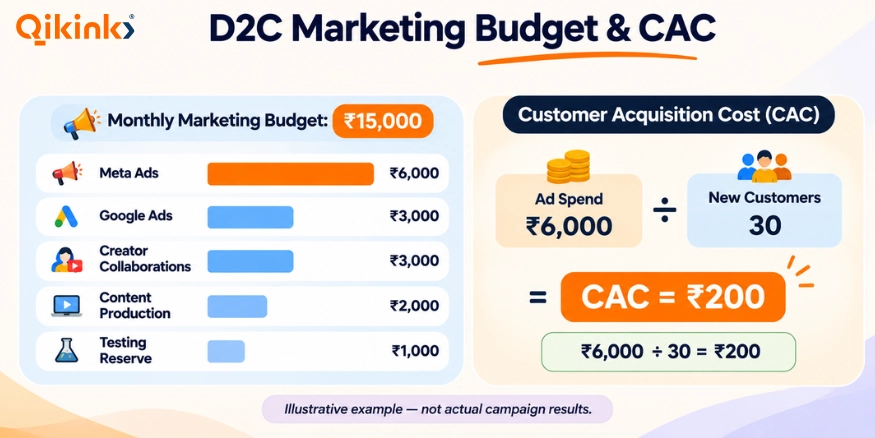
| Marketing Activity | Budget |
|---|---|
| Meta Ads | ₹6,000 |
| Google Ads | ₹3,000 |
| Creator Collaborations | ₹3,000 |
| Content Production | ₹2,000 |
| Testing Reserve | ₹1,000 |
| Total | ₹15,000 |
Note
This is an illustrative budget allocation, not an industry standard or a guaranteed profitable marketing plan. Brands should adjust spending based on product economics, customer demand and actual results.
How to Calculate Customer Acquisition Cost
Customer acquisition cost (CAC) measures how much a business spends to acquire a new customer.
CAC = Customer Acquisition Expenses ÷ New Customers Acquired
Suppose a clothing brand spends ₹6,000 on a campaign and acquires 30 new customers.
₹6,000 ÷ 30 = ₹200 CAC
This means the campaign’s advertising-only acquisition cost is ₹200 per customer.
A broader CAC calculation may also include relevant creative, agency, software or other acquisition expenses.
How to Calculate Return on Ad Spend
Return on ad spend (ROAS) compares advertising-attributed revenue with the amount spent on advertisements.
ROAS = Attributed Revenue ÷ Advertising Spend
Suppose a campaign generates ₹29,970 in attributed sales from ₹6,000 in advertising spend.
ROAS = ₹29,970 ÷ ₹6,000 = approximately 5×
The brand generated approximately ₹5 in attributed revenue for every ₹1 spent on advertisements.
However, a 5× ROAS does not necessarily mean the business earned a profit.
Why Marketing Profitability Matters
Imagine the brand sells a T-shirt for ₹999.
| Calculation | Illustrative Amount |
|---|---|
| Selling Price | ₹999 |
| Product and Printing Cost | ₹350 |
| Shipping and Payment Costs | ₹100 |
| Advertising Acquisition Cost | ₹200 |
| Amount Remaining | ₹349 |
The ₹349 is the illustrative contribution remaining before other costs such as returns, discounts, taxes and fixed business expenses.
Tip
Review marketing costs alongside product costs and order value before increasing advertising budgets. For a more detailed explanation of business operating costs, read our D2C business model guide.
How to Measure D2C Marketing Performance
Marketing performance should be evaluated using business outcomes rather than only likes, impressions and follower counts.
Important metrics include:
| Metric | Meaning |
|---|---|
| Customer Acquisition Cost | Cost of acquiring a new customer |
| Return on Ad Spend | Attributed revenue compared with ad spending |
| Conversion Rate | Percentage of website sessions resulting in orders |
| Average Order Value | Average revenue per order |
| Click-Through Rate | Percentage of impressions generating clicks |
| Repeat Purchase Rate | Percentage of customers making multiple purchases |
| Contribution After Marketing | Revenue remaining after relevant variable and marketing costs |
For example, an advertisement may receive many clicks but generate few purchases.
That could indicate an issue with audience relevance, product pricing, landing-page information or checkout experience.
Before making changes, review enough data to understand whether the result is meaningful.
Use Analytics to Understand Customer Behaviour
Google Analytics 4 supports ecommerce events such as:
- view_item – Viewing product details.
- add_to_cart – Adding a product to the cart.
- begin_checkout – Starting checkout.
- purchase – Completing a purchase.
These events can help businesses understand where customers interact with products and where they may abandon the buying process.
For implementation details, refer to Google’s official ecommerce measurement guide.
Note
Advertising reports, analytics platforms and actual store orders may show different results because of attribution and measurement differences. Verify revenue and purchase data before making major spending decisions.
30-Day D2C Marketing Action Plan
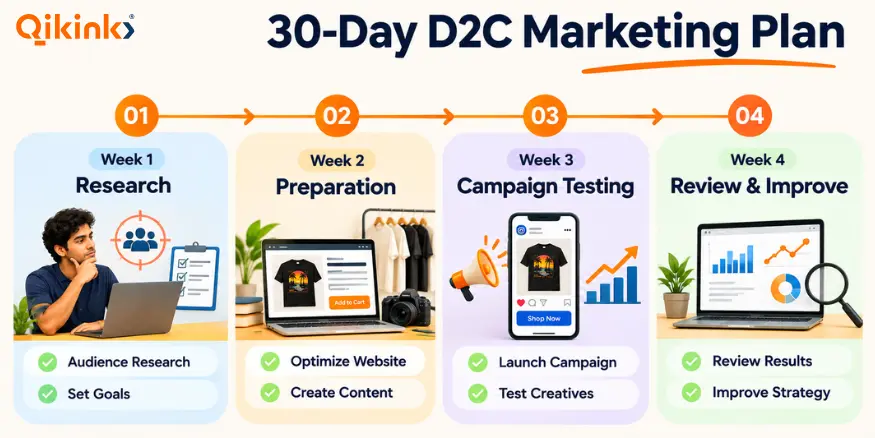
A new D2C brand does not need to launch all 12 marketing strategies immediately. Use the first month to prepare your website, test suitable channels and understand customer behaviour.
| Week | Main Focus | Activities |
|---|---|---|
| Week 1 | Research and Planning | Define your target audience, brand positioning, marketing goals and budget. |
| Week 2 | Website and Content | Improve product pages, create marketing content and verify conversion tracking. |
| Week 3 | Campaign Testing | Publish content, launch one controlled campaign and test different creatives. |
| Week 4 | Performance Review | Evaluate orders, customer acquisition costs and feedback to identify improvements. |
Tip
The goal of the first 30 days is to learn what works for your audience, not to achieve a guaranteed sales target. Use the results to refine your strategy before increasing marketing spending.
Common D2C Marketing Mistakes to Avoid
1. Advertising Before Improving Your Website
Paid advertisements cannot compensate for unclear product information or a difficult checkout experience.
Check the website before investing heavily in traffic.
2. Targeting Everyone
Trying to appeal to every customer often produces generic marketing messages.
Define a specific audience and explain why your products are relevant to them.
3. Focusing Only on ROAS
ROAS measures advertising-attributed revenue, not final profit.
Include product, shipping, payment and other relevant costs when evaluating campaigns.
4. Ignoring Existing Customers
Brands that focus only on first-time purchases may overlook customer retention opportunities.
Provide reliable service and communicate relevant new products where customers have agreed to receive updates.
5. Copying Competitor Campaigns
A strategy that works for a large brand may not work for a business with a smaller audience and budget.
Adapt marketing ideas to your own products and customer behaviour.
6. Increasing Advertising Spend Too Quickly
Early campaign results may not represent long-term performance.
Verify tracking, review acquisition costs and evaluate order economics before increasing budgets.
How Can Qikink Support D2C Clothing Brands?
Marketing helps a D2C clothing brand attract customers, but the business must also deliver the products customers purchase.
For entrepreneurs launching custom apparel, maintaining large quantities of printed inventory can require upfront investment.
Qikink’s print-on-demand fulfilment services let sellers offer supported custom products while outsourcing printing, packing and shipping.
This can help entrepreneurs test designs, introduce collections and spend more time developing their brand and marketing.
With print on demand, products are printed after orders are placed rather than requiring the seller to buy bulk printed inventory in advance.
However, sellers must still account for product costs, fulfilment expenses, marketing spending and customer service responsibilities.
Ready to Grow Your D2C Clothing Brand?
Launch custom products while Qikink handles printing, packing and shipping.
Start Your Brand Today →
Frequently Asked Questions
1. What Is a D2C Marketing Strategy?
2. Which Marketing Strategy Is Best for a D2C Brand?
3. How Can a D2C Brand Get Its First 100 Customers?
4. What Is D2C Advertising?
5. How Much Should a D2C Brand Spend on Marketing?
6. Is SEO Important for D2C Brands?
7. What Is CAC in D2C Marketing?
8. How Can D2C Brands Increase Repeat Sales?
9. How Long Does a D2C Marketing Strategy Take to Work?
Final Thoughts
An effective D2C marketing strategy helps a brand connect with the right customers, communicate product value and improve its marketing decisions.
The key is not to use every available marketing platform. It is to select channels that suit your products, provide a reliable buying experience and measure the results.
For a new Indian clothing brand, this may mean starting with organic content, one controlled advertising campaign and a website that clearly explains its products.
As the business grows, SEO, creator collaborations, email marketing and customer retention activities can support further development.Begin with a defined audience, test your ideas and improve your strategy using actual customer behaviour. Consistent learning is more useful than increasing marketing spending without understanding the results.
Sign up with Qikink →Read More
- T-Shirt Marketing Ideas to Boost Sales
- How to Start a Clothing Brand in India
- How to Create T-Shirt Designs That Sell
- Clothing Business Ideas in India
Share the Article
