

Dropshipping is an ecommerce fulfilment model where a seller sells products online without holding any inventory, while a supplier stores or produces the item and ships it directly to the customer once an order comes in. The seller lists the products, sets the selling price and manages the store, while the supplier handles inventory or production, packing and shipping after receiving the order.
Because the seller does not normally purchase inventory in advance, dropshipping reduces the amount of capital tied up in unsold stock while shifting storage and fulfilment to the supplier. In India, this same model runs alongside local factors such as COD, delivery networks and compliance requirements.
With a fulfilment platform like Qikink, sellers can offer custom products through dropshipping in India, with orders printed, packed and shipped under their brand. Qikink delivers across 29,000+ pincodes with Cash on Delivery support, and manages the production and fulfilment side, while the seller remains responsible for the storefront, marketing and customer relationship.
Key Takeaways:
- Dropshipping is an ecommerce fulfilment model where the seller does not hold product inventory.
- The supplier fulfils the order and ships it directly to the customer, while the seller manages the store and customer relationship.
- In India, COD, Return to Origin (RTO) handling, and domestic fulfilment shape how the model operates day to day.
- Revenue from a sale is not the same as net profit because shipping, fulfilment, payment, marketing and return-related costs can reduce the amount retained.
What is Dropshipping?
Dropshipping is a method of selling products online in which the seller does not purchase or store inventory before receiving customer orders. Instead, a supplier keeps the products in stock, or produces them when required, and fulfils orders on behalf of the seller.
The seller operates the customer-facing side of the business. This includes choosing the products to list, creating product listings, setting prices, accepting orders and managing customer communication. The supplier handles the physical side of the order, including storing or producing the product, packing it and sending it to the customer.
It is a fulfilment model within ecommerce, not a separate category of online selling. Ecommerce describes the broader activity of selling goods or services through online channels, while dropshipping describes how the products are sourced, stored and fulfilled after a customer places an order.
Same order, two ways
Product you want to sellTraditional store: you hold the stock
Bought before your first sale
20 T-shirts
If only half of them sell
10 T-shirts left with you
Who packs and ships
You, from your own stock
Dropshipping: the supplier holds the stock
Bought before your first sale
0 T-shirtsNothing is bought up front
If only half of them sell
0 left with youOnly the 10 ordered are made or picked
Who packs and ships
Your supplier, straight to your customer
Traditional store: you buy stock first and ship every order. Dropshipping: you list the product and take the order, and a supplier makes or picks the item and ships it to the customer.
What is a Dropshipping Business Model?
Consider a seller running an online store that lists an animal-printed t-shirt. A customer finds the listing, places an order and pays the seller directly. The seller then forwards that order to a supplier, who produces or picks the hoodie, packs it and ships it to the customer's address.
At no point does the customer interact with the supplier directly; the purchase, the brand and the after-sales support all come from the seller, even though the supplier is the one who physically handled the product. This is what separates a dropshipping business model from a traditional retail model, where the same business usually handles both the sale and the physical fulfilment.
Types of Dropshipping Business Models
The dropshipping business model can be structured in different ways depending on the products being sold, how they are sourced and whether the seller adds custom branding or designs.
Retail Dropshipping
The seller lists an existing product exactly as the supplier makes it, without any custom branding or design. This is a common form of dropshipping because the seller offers products that are already available from the supplier.
Private Label Dropshipping
The supplier produces the product while the seller offers it under their own brand, where the supplier supports private-label branding, packaging or other customisation.
Print on Demand Dropshipping
The product itself is customised, printed or designed only after the customer places an order. Qikink supports this model through on-demand production of products with the seller's own designs.
The fulfilment arrangement remains similar across these models: the seller receives the customer order, while the supplier provides or produces the product and fulfils the order directly to the customer.
How Does Dropshipping Work?
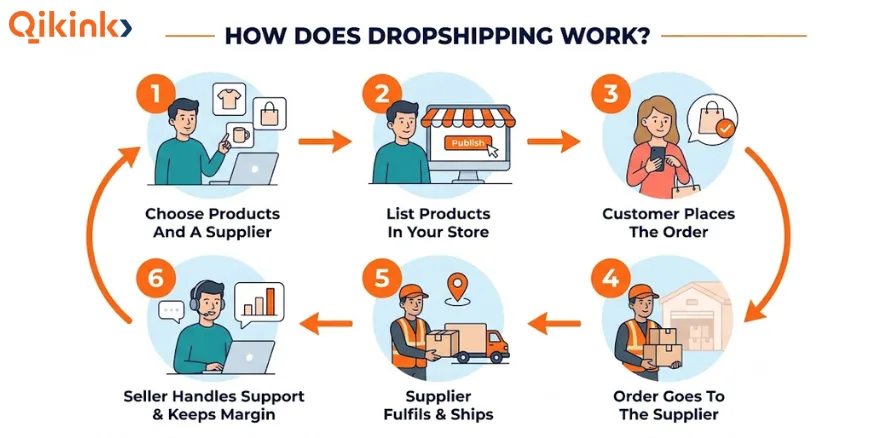
Dropshipping works by letting a seller take customer orders online while a supplier holds or produces the products, fulfils each order and ships it directly to the customer.
1. Choose products and a supplier:
The seller decides which products to offer and selects a supplier that can provide and fulfil those products when orders arrive.
2. List the products in the store:
The seller adds product information, images and selling prices to an online store or marketplace. Customers see these listings as products offered by the seller.
3. Customer places the order:
A customer selects a product, completes the purchase and provides the delivery details needed to fulfil the order.
4. Order goes to the supplier:
The seller sends the customer's order details to the supplier so the correct product can be prepared for fulfilment.
5. Supplier fulfils and ships:
The supplier prepares and packs the product, then dispatches it directly to the customer. A fulfilment supplier can print, pack and ship dropshipping products directly to the customer.
6. Seller handles support and manages the margin:
The seller manages customer communication and post-sale support. The amount left after fulfilment and other direct order costs contributes to the seller's gross margin before marketing and other business expenses are deducted.
Across all six steps, each party has a consistent role. The seller owns the storefront, sets prices, runs marketing and handles the customer relationship from checkout through after-sales support.
The supplier holds the product or produces it after an order, depending on the fulfilment model, and takes care of packing, fulfilment and shipping once an order is confirmed. The customer places the order through the seller's store and receives the fulfilled product through the supplier's delivery process.
See how Qikink handles your orders
Qikink prints, packs and ships each order for you, so you never hold stock.
See the Qikink process
How Dropshipping Works in India?
The order flow in India follows the same basic model described: the seller lists products, a customer places an order, the supplier fulfils it, and the product is delivered to the customer.
Indian payment methods, domestic courier networks, GST compliance and Return to Origin (RTO) processes affect how individual orders are handled. India's digital payment infrastructure also plays a role here; NPCI reports that UPI alone processed 24.51 billion transactions worth ₹29.82 lakh crore in August 2026, across 752 banks.
Customer Places the Order
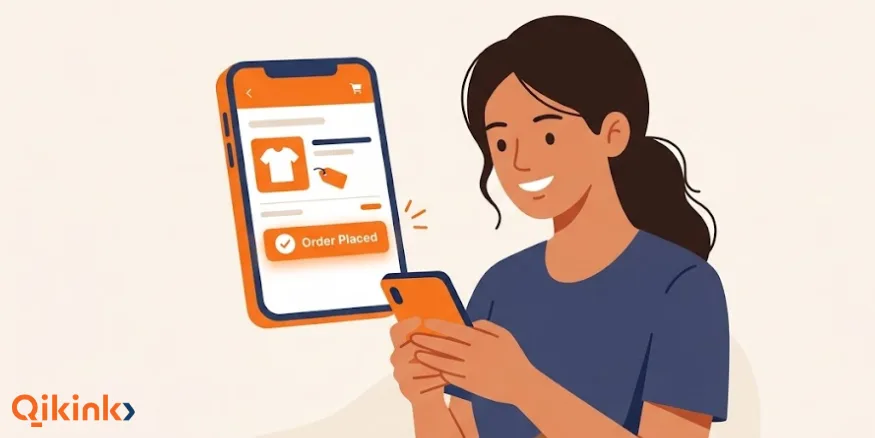
An Indian customer buys a product through the seller's online store and chooses either online payment or Cash on Delivery, if the seller offers it. For a prepaid order, payment is made before fulfilment, while for a COD order, payment is collected when the shipment is delivered, with settlement to the seller following the fulfilment or payment provider's process.
The Order Moves to the Supplier
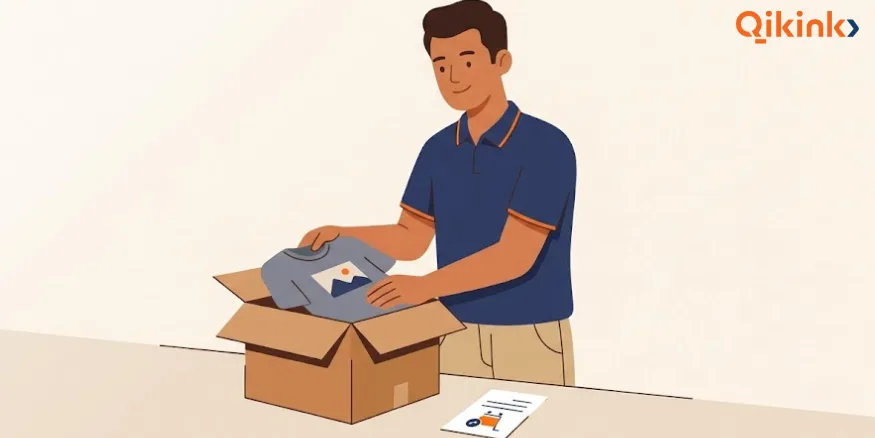
After receiving the order, the seller sends the order details to the supplier. The supplier then prepares or produces the product, packs it and hands the shipment to a courier for delivery.
Order Dispatched and Delivered
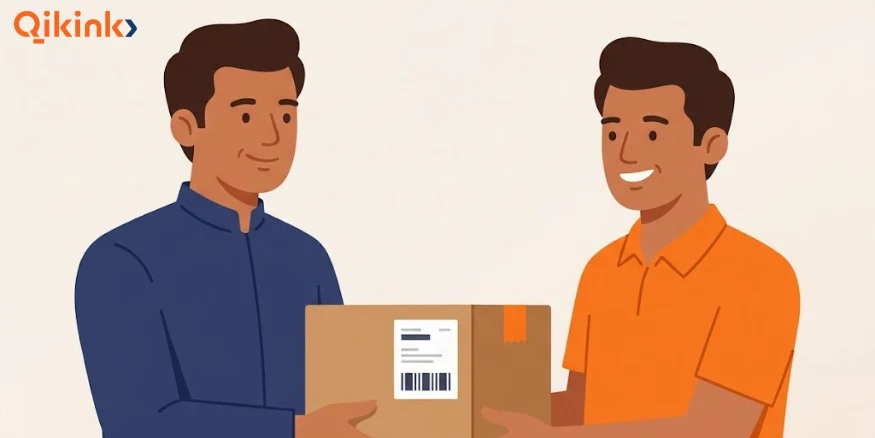
When the supplier fulfils the order from within India, the shipment moves through a domestic courier network. Delivery time depends on the supplier, destination, courier service and other fulfilment factors.
Note
Qikink reports that 95% of orders are dispatched within 2 to 3 days.
COD and Returns
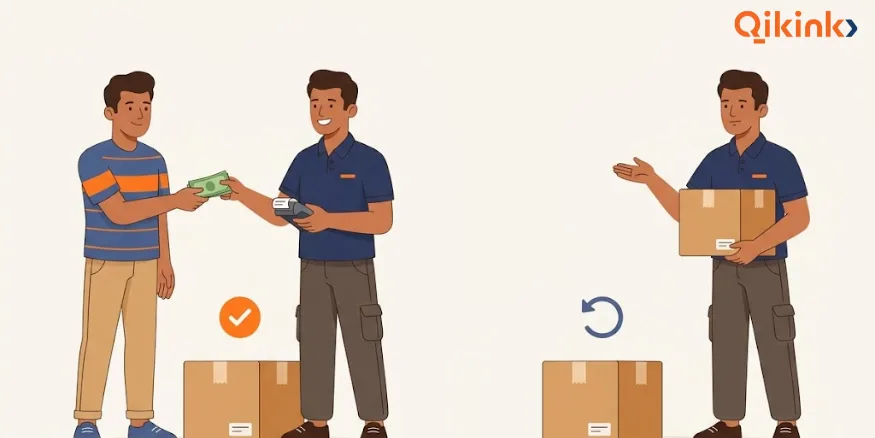
For a COD order, the courier collects payment when the shipment is successfully delivered. If delivery cannot be completed because of reasons such as an incorrect address, an unreachable customer or refusal to accept the shipment, the order may move to RTO.
An RTO shipment is returned to the fulfilment provider or other designated origin, depending on the arrangement. RTO handling and charges vary between fulfilment providers.
GST and Compliance
GST and other business compliance requirements apply alongside the fulfilment process rather than as a step within it. GST registration and other obligations depend on factors such as the seller's business circumstances, products, turnover and sales channels. These legal requirements should be checked separately rather than treated as part of the physical order flow.
Example of a Dropshipping Order
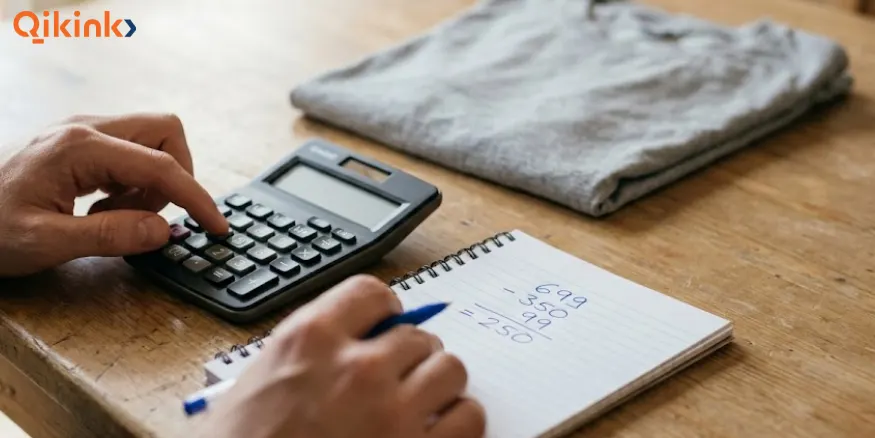
The basic calculation for a dropshipping order starts with the amount paid by the customer and deducts the costs directly tied to fulfilling that order.
Gross margin = Selling price − Fulfilment cost − Other direct costs
For example, in a prepaid order, a seller lists a printed T-shirt for ₹699. The supplier charges ₹350 to fulfil the order, while shipping and payment gateway charges total ₹99.
Applying the formula for calculating the margin:
₹699 − ₹350 − ₹99 = ₹250 gross margin
The ₹250 is the amount remaining after the direct costs included in this example. It is not net profit, since marketing, returns, customer support, software and other operating expenses have not been deducted.
If the customer does not accept the order and the shipment returns to its origin, the seller does not complete the ₹699 sale. Depending on the fulfilment arrangement, some fulfilment, shipping, or return-related costs may still apply. The order can therefore produce a different financial outcome from a successfully delivered order.
Launch Your Dropshipping Business!
Explore steps, costs, supplier selection, legal basics, practical tips & tricks
Start Dropshipping Business →
What Are the Advantages and Disadvantages of Dropshipping?
Dropshipping removes the need for the seller to manage inventory or product handling directly, but the seller remains responsible for the customer experience and depends on the supplier for reliable fulfilment.
The model reduces the need to invest in inventory before making sales, but it does not remove the costs and responsibilities of running an ecommerce business. The seller still needs enough margin to cover fulfilment, shipping, payment fees, marketing, customer support and returns. The lower inventory commitment comes with greater dependence on supplier performance and fulfilment quality.
Dropshipping Terms You Should Know
A few ecommerce and fulfilment terms describe how products, orders, payments and returns move through the business. Knowing these terms makes the rest of the dropshipping process easier to follow.
- Fulfilment: The process of preparing and sending a customer order, including producing or storing the product, packing it, dispatching it and getting it delivered to the customer.
- Inventory: The products a business has available to sell. In a dropshipping model, the seller does not normally purchase or store inventory in advance; the supplier holds or produces the products and fulfils them when orders are received.
- Cash on Delivery (COD): A payment method where the customer pays when the order is delivered instead of paying online at checkout. COD is commonly offered in Indian ecommerce and becomes part of the order and delivery process when a seller supports it.
- Return to Origin (RTO): When an order cannot be delivered and is sent back to its origin, which can happen if a customer refuses the shipment, is unavailable, or delivery cannot be completed.
- Print on Demand (POD): A fulfilment method where a product is produced only after a customer places an order, commonly used for printed T-shirts, mugs, posters and other customisable products.
- Payment Gateway: The system that processes online payments made by customers during checkout. Payment gateway charges are one of the direct costs that affect the gross margin on an order.
Dropshipping vs Ecommerce vs Print on Demand
Ecommerce describes the broader activity of selling online. Dropshipping describes one way an ecommerce order can be fulfilled. Print on demand describes how a product is produced after an order and then fulfilled to the customer.
Third-party Logistics (3PL dropshipping) is different because the seller normally owns the inventory while a third-party logistics provider stores, packs and ships it. In dropshipping, the supplier generally holds or produces the inventory and fulfils the order after the sale.
Print on demand and dropshipping can also operate as a single model when the POD provider produces, packs and ships the product directly to the customer after an order.
Is Dropshipping Legal in India?
Yes, dropshipping is legal in India. A dropshipping business still needs to follow the tax, consumer protection, invoicing and other compliance requirements that apply to its products, sales channels and business structure.
Government-backed platforms such as ONDC, which the Ministry of MSME's TEAM initiative aims to onboard around 5 lakh micro and small enterprises over its three-year rollout, with an outlay of ₹277.35 crore, typically require sellers to have valid business registration and GST compliance before they can list products.
This reflects how formal business and tax registration increasingly matters beyond a seller's own store.GST registration is not governed by one universal rule for every dropshipping seller, so the applicable requirements depend on the business's circumstances. Sellers sourcing products internationally may also have additional import and customs obligations.
Make Your Dropshipping Store Legal!
Register, obtain a GST number, follow tax requirements, & sell in compliance
Dropshipping Legal Requirements in India →
Why Qikink for Dropshipping in India?
Qikink provides the production and fulfilment infrastructure needed to run a dropshipping store without holding product inventory. As of August 2026, Qikink reports 25,000+ active brands and 7M+ orders fulfilled.
For sellers, the main value is having production and fulfilment managed through one platform rather than coordinating these functions separately. Qikink supports:
- On-demand production: Products are made when an order is received, so sellers do not need to purchase finished stock in advance.
- Product catalogue: Sellers can choose from 350+ base products and 2,750+ SKUs across different product types and variants.
- Custom products: Sellers can add their own designs to eligible products and offer them through their stores.
- Branding options: Available branding and packaging options allow sellers to present orders under their own store identity.
- RTO handling: Sellers are not charged for RTO orders, including undelivered COD and prepaid shipments, under its current RTO policy.
- Order management: Orders are processed through the Qikink platform, reducing the need to manually coordinate production and fulfilment for individual purchases.
Frequently Asked Questions (FAQs)
1. Is Dropshipping Easy To Start?
2. Is Dropshipping Profitable In India?
3. Who Is Responsible For Customer Service In Dropshipping?
4. What is Meant by Dropshipping?
5. Is Dropshipping Worth It?
6. What Type Of Business Is Dropshipping?
7. Why Does Dropshipping Work?
Final Thoughts
The dropshipping model provides a way to sell products online without purchasing and storing finished inventory upfront. The supplier takes responsibility for production or stock, fulfilment and shipping, while the seller focuses on building the store, attracting customers and managing the customer experience.
For sellers in India, the model also involves practical considerations such as COD, RTO, domestic delivery, fulfilment costs and applicable business requirements. These factors matter because avoiding inventory investment does not eliminate the other costs and responsibilities of running an ecommerce business.
Sellers who want to offer custom printed products can use Qikink's production and fulfilment infrastructure to run a branded dropshipping store without maintaining their own production or warehouse setup.
Sign up & Start Today →Read More
- Branded Dropshipping: The Guide to Build an Online Business
- Average Dropshipping Income in India Per Month: Complete Guide
- What is Return to Origin (RTO): How to Reduce It in eCommerce?
- Is Dropshipping a Profitable Business in India: Key Factors to Consider
Share the Article


