

Meesho dropshipping is a low-investment way to sell products through Meesho’s marketplace without manufacturing products yourself or holding inventory upfront. You list products, set pricing, and manage orders, while Meesho manages payments, logistics, and delivery through its marketplace ecosystem.
As a seller, you can register with a GSTIN for nationwide selling, or, if eligible, without one using an Enrolment ID or UIN, though this route limits you to selling within your own state. Meesho follows a 0% commission model across most categories, which, combined with minimal startup costs, makes it a practical starting point for individuals and small businesses entering ecommerce in India.
This guide explains how dropshipping works in Meesho in 2026, how to register as a seller, what it costs, which products perform well, how much you can realistically earn, common mistakes to avoid, and how to decide whether selling on Meesho or building your own store is the right move for your business.
Key Takeaways:
- Meesho dropshipping enables you to sell products without managing inventory, while Meesho supports payments, shipping, and delivery.
- Creating a Meesho Seller account involves meeting the platform’s eligibility requirements, completing registration, and listing products that comply with marketplace policies.
- Understanding seller fees, payment cycles, logistics, and returns helps you estimate profitability before you start selling.
- Selecting the right products, pricing them competitively, and providing a good customer experience are key to building a sustainable business on Meesho.
What is Meesho Dropshipping?
Meesho dropshipping is a marketplace-based business model where you sell products through Meesho instead of running your own online store. You decide which products to sell, set their selling prices within the platform’s guidelines, and manage every order through the Meesho Seller Panel.
Meesho takes care of payment processing, logistics, and delivery. These are usually the most time-consuming and expensive parts of starting an ecommerce business, so sellers don’t need to build a website, integrate payment gateways, or arrange fulfilment themselves.
Meesho provides the marketplace and selling infrastructure. Sellers remain responsible for choosing the right products, pricing them well, and managing their catalogue. This allows sellers to start with much less upfront work than running an independent ecommerce business.
How Does Meesho Dropshipping Differ from Traditional Dropshipping?
Meesho dropshipping and traditional dropshipping appear similar because both allow you to sell products without maintaining large inventories. However, the way each business operates is fundamentally different.
In a traditional dropshipping business, sellers typically build their own ecommerce store, source products directly from the best dropshipping suppliers, set their own pricing, and manage customer relationships independently.
Meesho follows a marketplace model, where sellers list products through the platform and use its integrated seller tools, payment processing, and logistics support to manage their business.
| Feature | Meesho Dropshipping | Traditional Dropshipping |
|---|---|---|
| Selling Platform | Meesho marketplace | Independent ecommerce store or online marketplace |
| Inventory | No upfront inventory required | No upfront inventory required |
| Customer Acquisition | Through Meesho’s marketplace | Through your own marketing channels |
| Order Management | Managed through the Meesho Seller Panel | Managed through your ecommerce platform |
| Payment Processing | Supported by Meesho | Managed by the seller using payment gateways |
| Logistics & Delivery | Supported through Meesho’s fulfilment ecosystem | Supported through your chosen supplier or fulfilment partner |
| Branding | Limited to marketplace guidelines | Full control over branding and customer experience |
| Business Ownership | Marketplace-based business | Independent ecommerce business |
For sellers looking to enter ecommerce with minimal operational complexity, Meesho offers a structured marketplace with integrated selling tools and fulfilment support. Traditional dropshipping provides greater flexibility and brand ownership but requires sellers to manage more aspects of the business independently.
One example is packaging: Meesho requires plain, unbranded packaging on every order, so sellers cannot add their own logo or branded inserts. Meesho does provide a custom branding service feature, but this refers to an internal anti-fraud system, not an option for sellers to brand their own shipments.
Choose Your Business Model
Compare the Key Differences between Dropshipping and Print on Demand
Print on Demand vs Dropshipping →
Who Can Start Selling on Meesho?
Before creating a Meesho Seller account, you need to meet the platform’s basic requirements. Meesho allows individuals, proprietorships, partnerships, LLPs, private limited companies, and other recognised business entities to sell through its marketplace.
To become a seller, you will typically need:
- PAN card
- Active bank account for receiving seller payouts
- Pickup address for order fulfilment
- GST registration (if applicable)
Meesho also allows eligible sellers to register without a Regular GSTIN under its current onboarding policy. Whether GST registration is required depends on your business and the products you intend to sell.
Sellers without a GSTIN can register instead using an Enrolment ID or UIN. This route lets you sell without full GST registration, but you can only sell to customers within your own state. Sellers who later register for GST can move to nationwide selling.
Meesho accepts both Regular GSTIN and Composite GSTIN registrations, depending on which GST scheme your business is registered under. Once you have confirmed that you meet these requirements, the next step is creating your Meesho Seller account.
How to Register as a Meesho Seller?
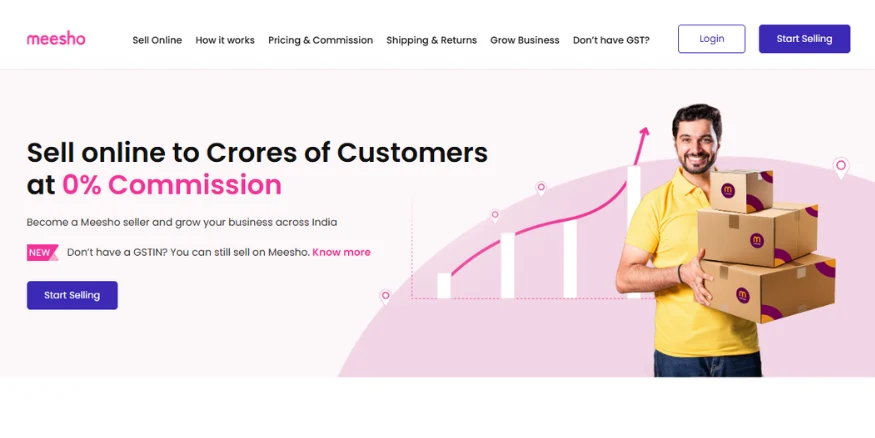
Creating a Meesho Seller account takes only a few steps. Once you have completed the registration process and your account is verified, you can start listing and selling products through the online marketplace.
Step 1: Visit the Meesho Seller Portal
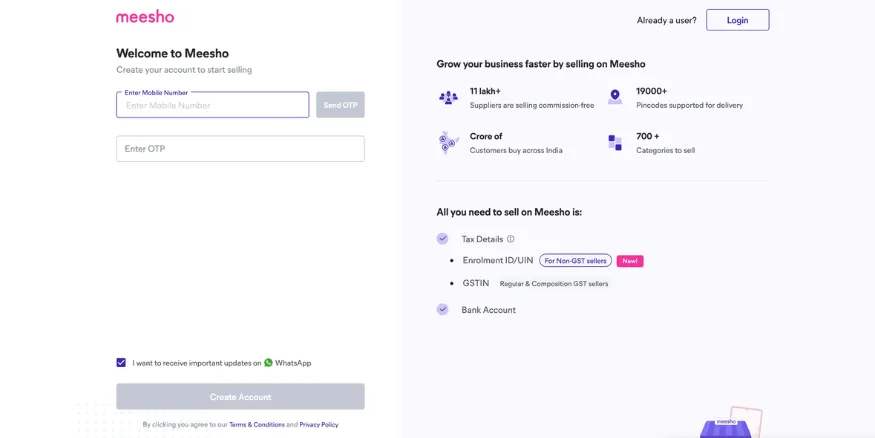
Go to the official Meesho Seller website and click Start Selling. Enter your mobile number and verify it using the OTP sent to your phone.
Step 2: Enter Your Business Details
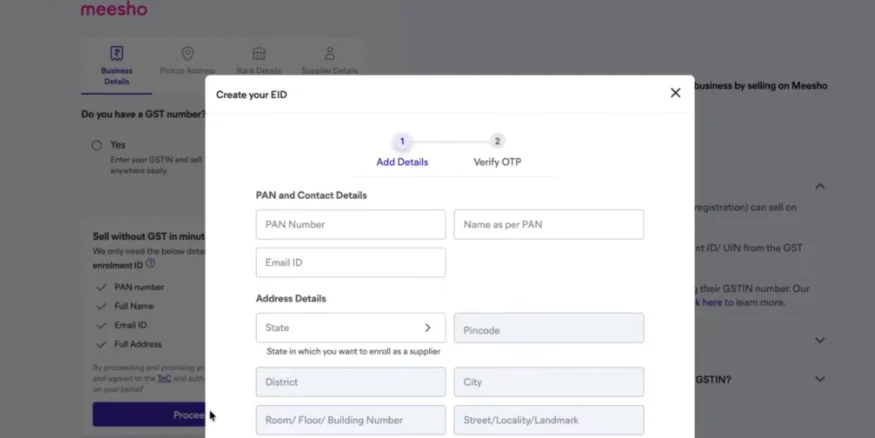
Provide your business information based on your registration type. Depending on your eligibility, either provide your GST details or complete the alternative onboarding process available for eligible non-GST sellers.
You will also be asked to provide basic information such as your PAN, email address, and business details.
Step 3: Add Your Pickup Address
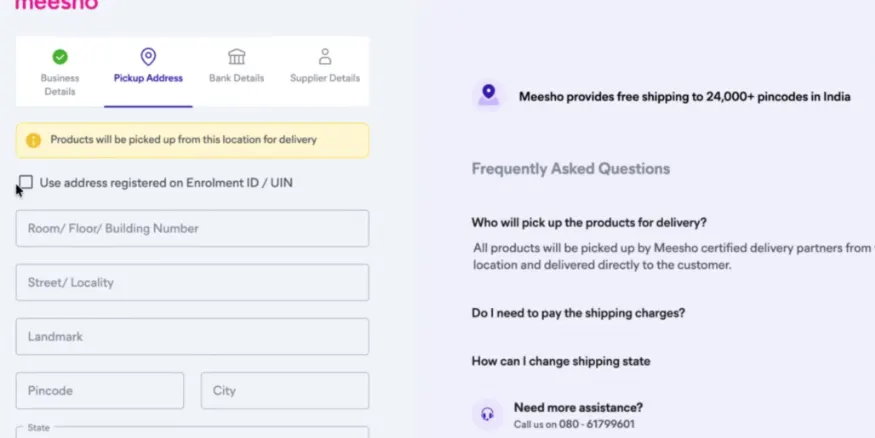
Enter the address from which Meesho’s logistics partners will collect your orders. This becomes your default pickup location for order fulfilment. Ensure the address is accurate, as it will be used for product pickups and return shipments when applicable.
Step 4: Add Your Bank Account
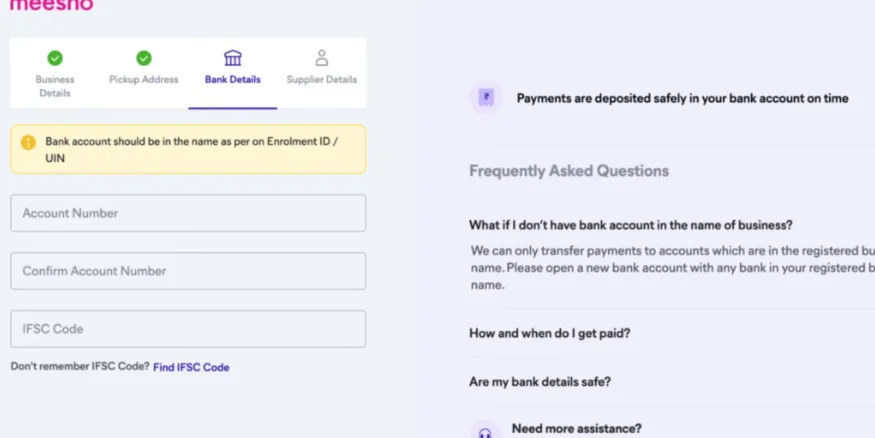
Provide the bank account where your seller payments will be credited. Double-check your account number and IFSC code before submitting, as payouts will be processed using these details.
Step 5: Complete Your Seller Profile
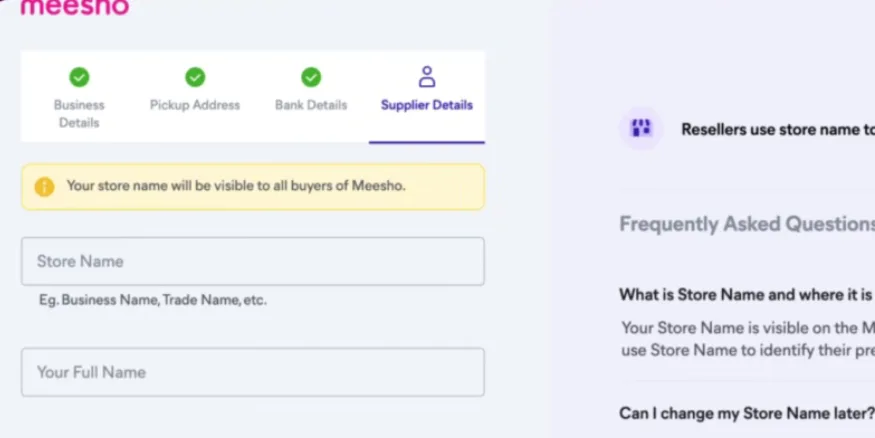
Finish setting up your store by entering your store name and the remaining seller information requested by Meesho. Once your details are verified, your Seller account becomes active.
You can log back in anytime through the Meesho Seller Portal using your registered mobile number, since Meesho does not support email-based login. If you are unable to access your account, the most common reasons are an unverified mobile number or an account still awaiting verification.
You can then access the Seller Panel to upload your catalogue and begin selling.
Step 6: Upload Your Product Catalogue
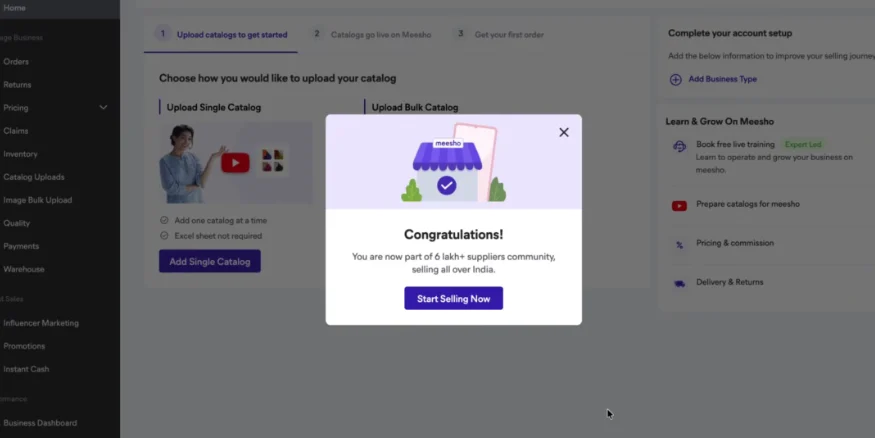
After your account is approved, upload your product listings individually or in bulk through the Seller Panel. Once your catalogue goes live, your products become available for customers to purchase on Meesho.
Upon completing these steps, your seller account is ready to start listing products. Before your first sale, it’s important to understand the fees that affect your overall profitability on Meesho.
Meesho Seller Fees & Charges
One of the biggest advantages of selling on Meesho is its simple pricing structure. Meesho does not charge sellers an upfront subscription fee. Instead, marketplace charges are applied based on the orders you receive. Understanding these charges helps you price products accurately and estimate your profit margins.
Your final payout for each order depends on your selling price and the applicable marketplace charges. These may vary depending on the product category, order value, and delivery location.
The most common charges include:
Commission
Meesho currently follows a 0% commission model across all product categories. However, sellers should still review the latest pricing and commission policies, as shipping charges, GST on marketplace services, and other applicable fees continue to affect final payouts.
Shipping Charges
Shipping charges are calculated based on factors such as the product category, weight, dimensions, destination, and order value. These charges are reflected during the selling process and are deducted before seller payouts.
GST on Marketplace Charges
Where applicable, GST is charged on marketplace services such as shipping and other platform fees. These charges are shown in your order settlement details.
Returns and Reverse Logistics
If a customer returns an eligible product, reverse logistics charges may apply according to Meesho’s return and shipping policies. Understanding these costs is important when deciding your selling price.
Note:
Before listing a product, calculate your expected payout after shipping and applicable marketplace charges. Pricing products based only on the selling price can significantly reduce your actual profit margin.
How Does Selling on Meesho Work?
Once your product is live, every customer order follows a standard workflow through the Meesho marketplace. Sellers manage orders from the Meesho Seller Panel, while Meesho supports logistics, delivery, and payment processing.
- Customer places an order: A customer purchases one of your listed products through the Meesho marketplace.
- Order appears in the Seller Panel: The order is reflected in your Seller Panel, where you can review the details and prepare it for dispatch.
- Pickup and delivery: Meesho’s logistics partners collect the shipment from your registered pickup address and deliver it to the customer.
- Returns, if applicable: Sellers cannot opt out of Cash on Delivery (COD), a common source of returns. Approved returns are handled through Meesho’s reverse logistics process.
- Seller payout: After successful delivery and settlement under Meesho’s payment cycle, the payout is credited to your linked bank account. Settlement details can be tracked from the Seller Panel.
Best Products to Sell on Meesho in 2026
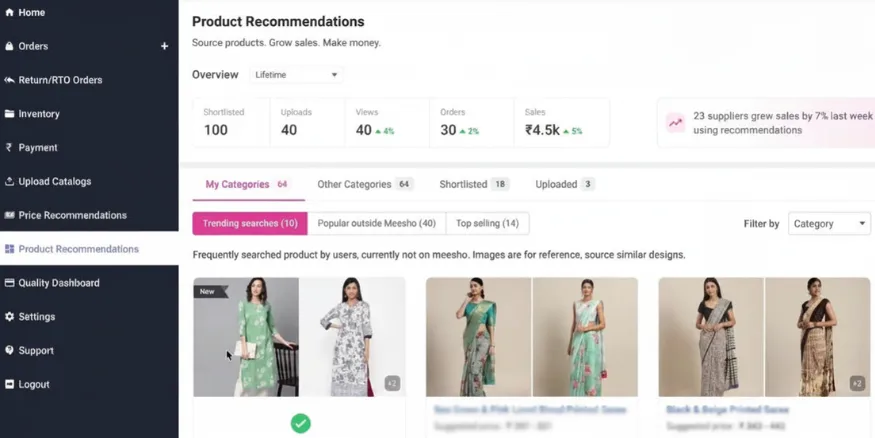
Choosing the best dropshipping products is one of the biggest factors in building a successful Meesho business. Since the platform serves millions of value-conscious shoppers across India, products with consistent demand, good profit margins, and reliable quality are generally easier to sell than highly seasonal or premium items.
Some of the product categories that consistently perform well on Meesho include:
- Women’s fashion and ethnic wear: Kurtis, sarees, dress materials, and leggings continue to see steady demand throughout the year, with higher sales during festive and wedding seasons.
- Home and kitchen products: Storage containers, organisers, cookware, and other everyday household essentials benefit from repeat purchases.
- Artificial jewellery and fashion accessories: Earrings, bangles, necklaces, and similar accessories remain popular because they are affordable, lightweight, and frequently purchased.
- Beauty and personal care products: Skincare, grooming products, and beauty essentials generate recurring demand as customers replenish them regularly.
- Mobile accessories: Phone cases, chargers, cables, and screen protectors continue to sell because they are often replaced after wear or damage.
- Baby and kids’ products: Children’s clothing and daily essentials experience repeat demand as kids quickly outgrow sizes.
- Men’s clothing and accessories: T-shirts, shirts, wallets, belts, and similar products maintain consistent demand across different seasons.
- Footwear: Affordable casual footwear remains a popular choice among shoppers looking for everyday use.
- Home décor products: Decorative items, organisers, and utility products continue to attract budget-conscious shoppers looking to improve their living spaces.
While choosing the right category is important, selecting the right product within that category matters even more. Before listing a product, review customer ratings, product reviews, images, descriptions, pricing, and your expected profit margin after marketplace charges. Products with clear specifications, consistent quality, and lower return rates are usually a better choice for new sellers.
Instead of uploading hundreds of products immediately, begin with a small catalogue and monitor which listings generate consistent orders. Expanding gradually based on actual sales performance usually produces better long-term results than trying to sell every available product from the start.
If you are unsure what to sell next, the Product Recommendations tool in the Meesho Seller Panel can help identify trending products and demand patterns to discover new selling opportunities.
Tip:
Focus on building a catalogue of products you understand well. As you identify consistent sellers and learn customer buying patterns, gradually expand into additional categories and product variants.
What a New Meesho Seller Learned From Starting Small?
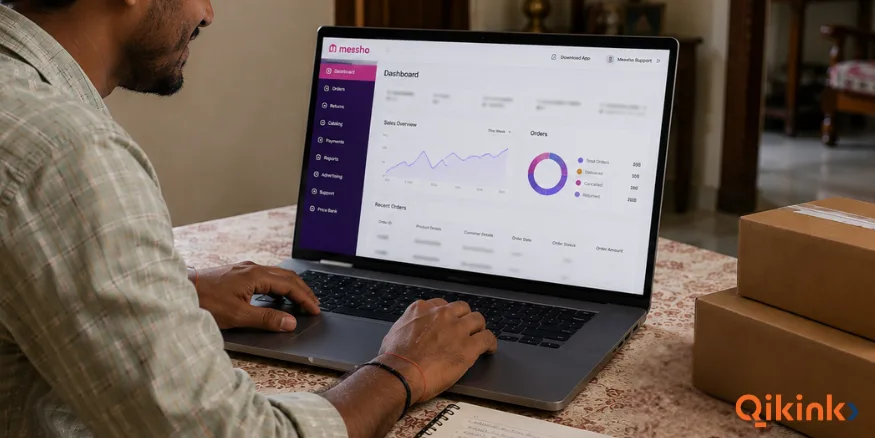
One new seller from Tiruppur started on Meesho with just five shirt designs to test customer demand before expanding their catalogue. By the end of the first day, they had received approximately 50 orders, demonstrating that a carefully chosen catalogue can generate demand without launching hundreds of listings.
More importantly, the experience showed that early sales alone do not determine long-term success. Sustainable growth depends on maintaining healthy profit margins, managing returns, monitoring product performance, and expanding the catalogue based on customer demand rather than assumptions.
Every seller’s journey is different, but this example shows that you don’t need hundreds of listings to validate demand. Starting with a focused product range makes it easier to understand customer preferences and update listings over time.
Dropshipping Income
How profit and revenue flow in a typical store: Explanation Guide
Average Income in India →
Is Meesho Dropshipping Profitable?
Meesho dropshipping can be profitable, but there is no guaranteed income. Your earnings depend on product selection, pricing strategy, profit margins, order volume, and how effectively you manage returns and marketplace costs.
Rather than focusing only on sales, successful sellers monitor the payout they actually receive after shipping charges, marketplace fees, and returns. Higher sales do not always translate into higher profits if margins are too low.
The table below shows illustrative examples of how monthly earnings can vary based on successful deliveries and average profit per order.
| Successful Orders / Month | Average Profit per Order | Illustrative Monthly Profit |
|---|---|---|
| 50 | ₹40 | ₹2,000 |
| 100 | ₹45 | ₹4,500 |
| 250 | ₹50 | ₹12,500 |
| 500 | ₹60 | ₹30,000 |
| Note: These figures are illustrative examples only. Actual earnings vary depending on product costs, pricing strategy, marketplace charges, returns, cancellations, advertising expenses, and successful order volume. | ||
Factors That Affect Your Meesho Profit
Several factors determine how profitable your Meesho business becomes:
Product Selection
Choosing products with steady demand, healthy margins, and lower return rates gives you a stronger chance of earning consistent profits.
Profit Margin
Setting the right selling price after accounting for marketplace charges helps protect your earnings on every successful order.
Order Volume
A steady flow of successful orders generally contributes more to long-term profitability than relying on a few high-margin sales.
Returns and Cancellations
Lower return and cancellation rates help preserve profits that would otherwise be reduced by reverse logistics and settlement deductions.
Catalogue Management
Refreshing listings, improving product information, and adding new products regularly helps maintain visibility and generate consistent orders. Most sellers spend their first few weeks testing products, refining prices, and understanding customer demand.
Over time, sustainable profitability comes from improving product selection, protecting profit margins, reducing returns, and maintaining consistent order volume instead of depending on one high-performing listing.
Common Mistakes to Avoid
Many new sellers struggle not because Meesho is unprofitable, but because of a few avoidable mistakes during their first few weeks. Avoiding them early can help you build a more sustainable business.
- Uploading too many products at once makes it difficult to identify which listings actually drive sales and profits. Starting with a smaller catalogue gives you more control and makes it easier to improve your best-selling products.
- Listing products without checking customer reviews, ratings, product quality, or expected profit margins often leads to higher returns and lower earnings.
- Pricing products without considering shipping charges, marketplace fees, and returns can reduce your actual profit even when sales are growing, especially for low-priced products, which tend to attract impulse Cash on Delivery orders and see higher return rates.
- Ignoring insights in the Meesho Seller Panel means missing opportunities to optimize listings, track performance, and spot issues before they affect sales.
- Leaving your catalogue unchanged for long periods can reduce visibility. Adding new products every 10–15 days keeps a catalogue active in search, and stock-outs can suppress a listing’s ranking even after restocking.
Most of these mistakes come from trying to grow too quickly. Building a profitable Meesho business usually comes from improving your catalogue gradually, protecting your margins, and learning from your sales data.
Should You Sell Only on Meesho or Build Your Own Store?
Meesho works well as a starting point for most new sellers. It removes the two biggest barriers to entry, inventory investment and building a website, so you can test whether a product sells before committing more time or money to it. Because of its low entry requirements, Meesho is widely used by first-time entrepreneurs, students, homemakers, and small businesses.
Compared with larger marketplaces like Amazon and Flipkart, Meesho generally has a lower barrier to entry, making it easier for first-time sellers to get started. Amazon and Flipkart, on the other hand, are often better suited to businesses with established operations, larger product catalogues, and more mature selling processes.
There is also a structural limit worth knowing before building a business entirely around one marketplace. Your product visibility, customer relationships, and catalogue performance all sit inside Meesho’s system. Policy changes or shifts in competition are decisions Meesho makes, not ones you control, and a business built entirely on one platform has no fallback if any of these change.
This does not make Meesho the wrong choice. It makes it a different kind of business than an independent store. Many sellers eventually choose to use both, Meesho for steady order volume, and their own store for what a marketplace does not offer: direct customer relationships and full control over branding and pricing.
If you eventually want that second layer, Qikink simplifies dropshipping in India by letting you launch your own branded store without holding inventory, giving you greater control over branding, pricing, and customer experience than selling exclusively through a marketplace.
For most sellers, the practical path is simple. Use Meesho to find out what sells and build early experience, then decide whether to continue growing on the marketplace or build a business you own.
Launch Your Online Store
Explore the best free and paid alternatives to start selling online
Top Shopify Alternatives →
Frequently Asked Questions (FAQs)
1. Can I Sell on Meesho Without a GST Number?
2. Why Can’t I Log in to My Meesho Seller Account?
3. How Long Does It Take to Get Paid on Meesho?
4. Can I Turn Off Cash on Delivery on Meesho?
5. Why are Return Rates High on Meesho?
6. What Happens if a Meesho Customer Returns the Wrong or Damaged Product?
7. Does Meesho Charge Any Commission?
8. Does the Meesho Quality Score Affect My Sales?
9. Can I Build My Own Brand Instead of Selling Only on Meesho?
Final Thoughts
Meesho dropshipping works well for exactly what it’s built for: a low-cost way to start a dropshipping business without purchasing inventory, building a website, or setting up your own fulfilment system. If your goal is to test whether a product can find buyers, it’s one of the easiest ways to get started.
What happens next depends on how you run your business. The sellers who succeed over time aren’t necessarily the ones with the biggest catalogues. They are the ones who choose products carefully, price them with fees and returns in mind, keep improving their listings, and use the Seller Panel to understand what’s actually working.
At the same time, it’s worth remembering that you are building on someone else’s marketplace. Your branding, customer relationships, and product visibility all depend on Meesho’s platform and policies. That’s not a drawback for everyone, but it does influence how far you can grow without eventually building something of your own.
That’s why many sellers use Meesho as a launchpad rather than the final destination. They validate products, gain selling experience, and later expand into their own online store.
If you decide to take that next step, a fulfilment partner like Qikink lets you launch your online business, giving you the freedom to build your brand while keeping the low-investment approach that helped you get started.
Ready to build your own branded ecommerce business? Sign up with Qikink and start selling with your own brand today!
Sign up Now! →Read More
- Branded Dropshipping: The Guide to Build an Online Business
- Alibaba Dropshipping: Complete Beginner’s Guide To Get Started
- Amazon Dropshipping in India: Start, Scale & Succeed with Zero Inventory
- Aliexpress Dropshipping India: Best Products and Supplier Guide
- What is Dropshipping Business in India & How Does it Work
Share the Article

