

Amazon dropshipping allows you to sell products on Amazon without maintaining finished inventory. When a customer places an order, a third-party supplier prepares and ships the product. To start Amazon dropshipping in India, you need an Amazon seller account, suitable products, a reliable supplier and a fulfilment arrangement that follows Amazon’s policies.
Amazon permits dropshipping under specific conditions. You must remain the seller of record and take responsibility for customer service, returns and applicable selling requirements.
Although dropshipping can reduce upfront inventory investment, it does not eliminate operating costs. Amazon seller fees, supplier charges, shipping expenses and potential returns still affect profitability.This guide explains Amazon’s dropshipping policy, seller registration, product research, supplier selection, costs and shipping methods. It also covers how eligible Amazon orders can be fulfilled using Qikink’s manual Self-Ship workflow.
Key takeaways
- Amazon permits dropshipping: You must follow its Drop Shipping Policy and remain the seller of record.
- Bulk finished inventory is not essential: A supplier can prepare products after customers place orders.
- Supplier reliability matters: Product quality, delivery timelines, packaging and return arrangements affect customer satisfaction.
- Amazon fees vary: Referral fees depend on the product category and price, while closing fees depend on applicable selling and fulfilment conditions.
- Qikink supports Amazon Self Ship: Eligible Amazon orders must be placed manually in the Qikink Dashboard because direct Amazon integration is unavailable.
What is Amazon Dropshipping?
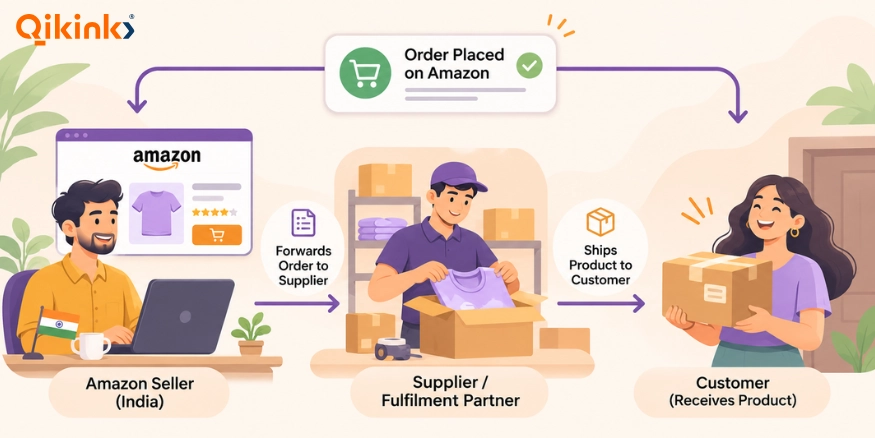
Amazon dropshipping is an ecommerce business model where sellers list products on Amazon without purchasing and storing finished inventory in advance.
When a customer places an order, the seller forwards the order to a third-party supplier, such as a manufacturer, wholesaler or fulfilment provider. The supplier prepares and dispatches the product directly to the customer.
The seller manages the Amazon listing, product pricing, customer communication and returns. The supplier handles the agreed production, packing and shipping activities.
For example, a seller might list a graphic T-shirt on Amazon and work with a print-on-demand supplier that prints the design after receiving an order.
The amount earned depends on the selling price after deducting supplier payments, Amazon fees, shipping charges and other business expenses.
Important: Working with a supplier does not remove your responsibilities as the Amazon seller. Your fulfilment arrangement must comply with Amazon’s seller-of-record requirements.
How Does Amazon Dropshipping Work?
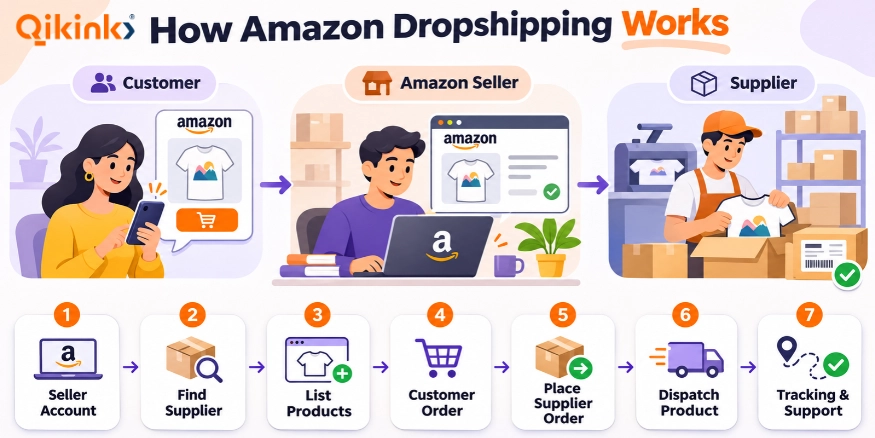
Amazon dropshipping connects three parties: the customer purchasing a product, the seller managing the Amazon listing and the supplier fulfilling the order.
The process generally follows seven steps:
- Create an Amazon seller account: Register through Seller Central and complete the required business and tax verification.
- Find a suitable supplier: Choose a supplier capable of fulfilling individual orders under Amazon’s requirements.
- List products on Amazon: Add accurate product titles, descriptions, images, prices and available variations.
- Receive a customer order: Amazon records the customer’s purchase in Seller Central and processes payment according to its procedures.
- Place the supplier order: Submit the required product, quantity and delivery information to your supplier.
- Dispatch the product: The supplier prepares and ships the order using the agreed fulfilment arrangement.
- Manage tracking and support: Update shipment details and handle customer enquiries, returns and other order issues.
For customised products, manufacturing may begin only after the customer places an order.The supplier’s processing time should therefore be considered when setting Amazon dispatch and delivery expectations.
Does Amazon allow Dropshipping?
Yes, Amazon allows dropshipping in India, provided sellers follow its official Drop Shipping Policy.
Sellers can use third-party suppliers to fulfil customer orders, but arrangements that violate Amazon’s requirements may result in restrictions on their selling privileges.
Amazon Dropshipping Policy: What Is Allowed?
To comply with Amazon’s dropshipping policy, sellers must meet these requirements:
- Be the seller of record: Your business must be identified as the seller on relevant packing slips, invoices, external packaging and shipment information.
- Remove third-party seller information: Ensure shipments do not contain documents or packaging identifying another retailer or seller.
- Have a supplier agreement: Confirm that your supplier agrees to follow Amazon’s seller-identification and fulfilment requirements.
- Manage customer returns: Accept and process returns according to Amazon’s policies, even when a supplier ships the product.
- Follow Amazon’s selling policies: Ensure your products, listings, fulfilment arrangements and customer service meet applicable requirements.
What Is Not Allowed in Amazon Dropshipping?
Certain sourcing and fulfilment practices can violate Amazon’s policy:
- Non-compliant retail sourcing: Purchasing products from another online retailer and having that retailer ship directly to your customer without meeting Amazon’s seller-of-record requirements.
- Shipping under another seller’s identity: Allowing a supplier or retailer to send an order with invoices, packing slips or packaging identifying a different seller.
Example: If you purchase a T-shirt from another online retailer and have it shipped directly to an Amazon customer with that retailer’s invoice and branding, the arrangement violates Amazon’s dropshipping policy.
Before working with a supplier, review Amazon India’s official Drop Shipping Policy and confirm that your fulfilment process meets its requirements.
Key Considerations for Amazon Dropshipping in India
Before selling on Amazon, evaluate the registration requirements, product demand, competition and costs involved.
These factors influence which products you can list and whether your business can operate sustainably.
1. GST and Seller Registration Requirements
Amazon India generally requires a valid GSTIN when selling taxable products.
Sellers dealing exclusively in eligible GST-exempt products can select Amazon’s tax-exempt registration option instead.
You should determine the applicable tax requirements before registering.
For more information about GST, taxation and business compliance, read our guide on dropshipping legal requirements in India.
Amazon also requires relevant business information, contact details and bank account details.
For current registration instructions, see Amazon India’s Seller Registration Guide.
2. Indian Supplier Availability
Indian suppliers may help reduce international shipping delays and make communication easier.
However, availability and location alone do not guarantee suitable fulfilment.
Before selecting products, check whether suppliers can maintain consistent stock, meet dispatch requirements and provide reliable delivery tracking.
The detailed supplier evaluation process is covered later in this guide.
3. Marketplace Competition
Amazon gives sellers access to an established customer base, but competing listings can make it difficult to attract buyers.
Review comparable products, customer feedback, pricing and product information before deciding what to sell.
Look for opportunities to offer accurate specifications, dependable fulfilment and products suited to a specific audience.
4. Working Capital
Dropshipping reduces the need to purchase finished inventory in bulk, but you may still need money to pay suppliers before receiving Amazon settlements.
Budget for product samples, production, shipping, fees, returns and any advertising expenses.
Plan your available working capital before increasing order volume.
Profit Margin Calculator
Trying to figure out your profit on dropshipping? Here is a Guide:
Dropshipping Profit Margin →
How Much Does It Cost to Start Dropshipping on Amazon?
Amazon does not charge a separate, universal dropshipping fee. Its standard marketplace fees apply according to the product category, selling price and fulfilment method.Your overall costs also depend on what you pay your supplier and how you ship orders.
1. Amazon Referral Fees
A referral fee is the commission Amazon charges on eligible product sales.
The rate depends on the product category and selling price.
According to Amazon India’s published fee schedule, men’s T-shirts excluding polos, tank tops and full-sleeve tops have a 0% referral fee when priced at ₹1,000 or less.
For products in that category priced above ₹1,000, Amazon’s published referral rate is 23%.
Other products and categories may have different rates.
You must confirm the category assigned to your actual Amazon listing before applying these percentages.
2. Amazon Closing Fees
Amazon charges a closing fee on each eligible product sale. This fee is separate from the referral fee and varies depending on the product’s selling price and fulfilment method.
For example, the closing fee for a ₹499 product may differ from that of a ₹999 product. Sellers using Self Ship may also have different closing fees from those using Amazon Easy Ship or FBA.
Before setting your product price, check the applicable closing fee using Amazon India’s official Fees and Pricing page.
3. Product and Printing Costs
Your supplier charges depend on the product and services ordered.
For print-on-demand products, charges may include:
- Blank product cost.
- Printing or personalisation.
- Packaging and handling.
- Additional selected services.
The exact price should be obtained from the supplier before creating your Amazon listing.
4. Shipping Costs
For Amazon Self Ship, sellers arrange delivery through a permitted shipping arrangement and pay the applicable courier or fulfilment charges.
Costs depend on factors such as parcel weight, service, destination and supplier terms.
When using Qikink, check the current shipping charges in the Qikink Dashboard before confirming an order.
5. Other Operating Expenses
Other expenses may include:
- Product samples.
- Advertising.
- Refunds and return handling.
- Software subscriptions.
- Applicable taxes.
- Fixed business operating costs.
Your selling price must account for these expenses rather than only the cost of purchasing the product.
Example: Amazon Dropshipping Cost Calculation for a ₹999 T-Shirt
Consider a hypothetical standard men’s T-shirt sold on Amazon for ₹999.
For this illustration, assume that the product is correctly classified under Amazon’s category for men’s T-shirts excluding polos, tank tops and full-sleeve tops.
Amazon currently lists a 0% referral fee for eligible items in this category priced at ₹1,000 or less.
Note
The product, printing, shipping and advertising costs below are hypothetical. They are not Qikink quotations or actual seller results.
| Expense | Amount |
|---|---|
| Customer selling price | ₹999 |
| Product and printing | ₹420 |
| Supplier shipping and handling | ₹75 |
| Amazon referral fee for the specified eligible category | ₹0 |
| Allocated advertising cost | ₹120 |
| Expected returns allowance | ₹35 |
| Amount remaining before closing fee, other costs and taxes | ₹349 |
| Amazon Self-Ship closing fee | Deduct the current applicable fee |
| Other applicable Amazon fees | Deduct if applicable |
| Other operating costs and taxes | Deduct as applicable |
The calculation is:
₹999 − ₹420 − ₹75 − ₹0 − ₹120 − ₹35 = ₹349
The ₹349 is not net profit.
It is the amount remaining before the applicable Self-Ship closing fee, any additional charges, fixed costs and taxes.
If the product is classified under a different Amazon category, its referral fee may also be different.
For accurate pricing, use Amazon India’s official Fees and Pricing page.
Is Amazon Dropshipping Profitable in India?
Amazon dropshipping can generate a positive margin when the selling price exceeds the full cost of fulfilling, promoting and supporting orders.
However, profitability is not guaranteed.
A product that appears profitable before advertising, returns and marketplace fees may produce little or no remaining margin after all expenses.
Start with a manageable product range, calculate actual costs and review completed orders before investing more money.
Tip
Use a dropshipping profit margin calculator to compare selling prices and expenses. Avoid treating Amazon payouts as equivalent to business profit.
Explore Custom Products for Your Business
Explore custom T-shirts, hoodies and more without bulk inventory.
Explore Products →
How to Start Amazon Dropshipping in India
Starting an Amazon dropshipping business involves registering as a seller, selecting suitable products, choosing a compliant supplier and creating accurate listings.
Follow these four steps.
Step 1: Register Your Amazon Seller Account
Visit Amazon Seller Central and follow the registration instructions.
Amazon requests business, tax, bank and fulfilment details as part of the setup.
1. Create Your Seller Account

Select Start Selling and sign in using an eligible Amazon account or create a new account.
Complete the required mobile number verification.
2. Enter Your GST Details

Enter your GSTIN when required for taxable products.
If you intend to sell exclusively eligible GST-exempt products, follow the relevant option displayed during registration.
3. Complete GST Verification

Select Continue to Verify after entering the requested information.
Amazon states that GST verification can take up to 72 hours.
If verification fails, the registration process may request supporting GST documentation.
4. Choose Your Store Name

Enter the store name you want customers to associate with your business.
Select a name that represents your store and does not copy or conflict with another business’s trademark.
5. Enter Your Pickup Address

Provide the address requested for your business and fulfilment arrangement.
Pickup requirements depend on the shipping method selected.
If a third-party supplier will fulfil orders, confirm the appropriate configuration before you begin selling.
6. Select Your Shipping Method

Choose the shipping arrangement that matches your intended fulfilment process.
Amazon’s fulfilment options include Easy Ship and Self Ship.
For Amazon orders processed through Qikink, the documented supported workflow is Self Ship.
7. Configure Shipping Charges

Set your shipping options and charges based on the selected fulfilment method.
Consider courier costs and the delivery commitments you can reliably meet.
8. Add Bank Account Details

Enter an active bank account and complete the requested verification.
Amazon transfers eligible settlement amounts according to its payment schedule.
9. Configure Product Tax Details

In Amazon Seller Central, you may need to select the appropriate Product Tax Code (PTC) for the products you plan to sell.
A Product Tax Code helps Amazon determine the applicable GST treatment for your product sales.
Different product categories may have different GST requirements, so verify the correct tax classification before selecting a code.
If you are unsure which tax code applies, consult a qualified tax professional.
10. Complete Registration

Review the required information and finish the remaining seller registration steps.
Once registration is complete, prepare your listings and verify your fulfilment arrangements before accepting orders.
For updated instructions, refer to Amazon India’s Seller Registration Guide.
Step 2: Find Products for Amazon Dropshipping
Choose products based on evidence of demand, customer needs, competition and fulfilment feasibility.
Start by reviewing relevant listings on Amazon India.
The Amazon Best Sellers page can help identify product categories receiving customer attention, but a bestseller listing does not prove that a new seller will earn a profit.
For additional product ideas, explore our guide to the best dropshipping products to sell in India. Evaluate each product’s demand, competition, costs and Amazon eligibility before selecting it.

When researching a product, consider:
- Customer demand: Review relevant listings, customer feedback and available research data.
- Competition: Compare competing products, descriptions, prices and customer complaints.
- Total order cost: Estimate supplier charges, shipping, marketplace fees and advertising expenses.
- Product quality: Obtain samples and evaluate whether the product matches its listing.
- Availability: Confirm that the supplier can fulfil orders within the required timeframe.
Product research platforms may provide additional estimates, but these should not be treated as guaranteed sales figures.
Products That Require Additional Care
Some product categories involve restrictions, approvals or additional legal requirements.
These may include hazardous goods, medicines, tobacco-related products, alcohol and products using protected intellectual property.
Check Amazon’s category requirements and applicable Indian regulations before sourcing these products.
Tip
Start with a small number of products for a specific audience rather than listing a large catalogue without testing quality and fulfilment.
Step 3: Choose an Amazon Dropshipping Supplier in India
Choose a supplier who can reliably fulfil individual orders and support your intended product range.
Pricing is important, but a low supplier price is not useful if the products arrive late or do not match their listings.

Before selecting a supplier, ask:
- Can you fulfil individual customer orders? Confirm that minimum order quantities and processing arrangements work for dropshipping.
- What are your dispatch timelines? Ask how quickly orders are prepared and handed to the courier.
- Can I order samples? Check material quality, sizing, printing and packaging.
- How are stock changes communicated? Understand what happens when a listed product becomes unavailable.
- What happens after a damaged or incorrect delivery? Confirm return and replacement procedures.
- Can you meet Amazon’s seller-identification requirements? Obtain confirmation of the relevant packing slips, invoices, packaging and fulfilment arrangements.
The sixth question is particularly important for Amazon sellers because supplier capabilities must be assessed against the marketplace’s policies.
Looking for a Print-on-Demand Supplier?
Explore Qikink’s printing and fulfilment services for your business.
Explore Qikink →
Where Can You Find Amazon Dropshipping Suppliers?
Potential suppliers can be researched through manufacturer websites, industry contacts and B2B directories such as IndiaMART and TradeIndia.
For more sourcing options, explore our guide to dropshipping suppliers in India, which compares fulfilment providers, marketplaces and supplier directories.
A supplier listed in a directory does not automatically support Amazon-compliant dropshipping. Contact suppliers directly, request samples and confirm their order handling processes before listing products.
Can You Use Qikink as a Supplier?
Qikink provides print-on-demand production and fulfilment for eligible products, including customised clothing.
For Amazon sellers, Qikink’s published guidance describes a manual order workflow using Self Ship.
However, Qikink’s Self-Ship documentation does not by itself confirm that every order automatically satisfies Amazon’s seller-of-record requirements.
Before selling, ask Qikink to confirm how your business identity will appear on the applicable shipment documents and packaging.
See the Qikink Amazon Self-Ship Guide for the documented order process.
Step 4: List Your Products on Amazon
Once you have selected products and verified the supplier arrangement, prepare your Amazon product listings.
Accurate listings help customers understand what they are purchasing and reduce avoidable complaints.

Follow these steps:
- Open Seller Central: Go to the product listing section and search Amazon’s existing catalogue.
- Select the appropriate listing: Add your offer to an exact existing product listing where applicable, or create a new listing.
- Write an accurate title: Include the brand, product type and relevant distinguishing features.
- Add product photographs: Use clear images that match the product customers will receive.
- Describe the product: Include important details such as material, size, fit and product specifications.
- Set up variations: Add available colours, sizes and other permitted variations.
- Calculate your selling price: Account for supplier payments, Amazon fees and other expenses.
- Review before publishing: Check listing accuracy, category requirements, fulfilment settings and available stock.
For customised clothing, ensure product images accurately represent the design and garment being supplied.
Before accepting orders, confirm that the supplier can fulfil all listed variations.
For detailed guidance, read Amazon India’s Product Listing Guide.
Build a Successful Business in India
Simplify sourcing, fulfillment, and shipping to grow your brand faster
Start Your Dropshipping Business →
Amazon FBA vs Dropshipping: What’s the Difference?
Amazon FBA and dropshipping differ primarily in where inventory is held and who prepares orders for delivery.
With Fulfilment by Amazon (FBA), sellers send products to Amazon’s fulfilment centres before customer purchases.
With dropshipping, a third-party supplier holds or prepares the products and fulfils individual orders.
FBA is an Amazon fulfilment programme, while dropshipping is a product sourcing and fulfilment arrangement.
Amazon FBA vs Dropshipping Comparison
| Feature | Amazon FBA | Amazon Dropshipping |
|---|---|---|
| Inventory | Sent to Amazon before sale | Held or produced by a supplier |
| Upfront stock purchase | Generally required | Finished stock need not be purchased in bulk |
| Storage | Amazon fulfilment centres | Third-party supplier |
| Packing and delivery | Managed by Amazon | Managed under the supplier arrangement |
| Customer support | Amazon handles FBA order-related support | Seller remains responsible |
| Returns | Amazon manages FBA returns | Seller remains responsible |
| Costs | FBA, storage and applicable selling fees | Supplier, courier and marketplace costs |
| Prime eligibility | Generally available for eligible FBA offers | Not automatically available |
| Main challenge | Inventory planning and storage costs | Supplier reliability and policy compliance |
Which Model Should You Choose?
Amazon FBA may suit sellers who want Amazon to manage inventory storage and fulfilment.
Dropshipping may suit sellers who prefer not to purchase finished inventory in bulk and can manage reliable supplier relationships.
Neither option guarantees profitability.
Compare the total costs, available working capital and operational responsibilities before selecting a model.
For more details, visit Amazon India’s FBA Guide.
Shipping Methods for Amazon Dropshipping in India
Amazon India supports multiple fulfilment arrangements, including Easy Ship and Self Ship.
For dropshipping, the suitable arrangement depends on where products are prepared, who handles dispatch and whether the supplier can meet the marketplace’s requirements.
1. Amazon Easy Ship
With Easy Ship, eligible sellers prepare parcels at an approved pickup location and Amazon handles collection and delivery.
This can suit sellers who manage stock or preparation at a supported location.
However, Qikink has discontinued Amazon Easy Ship support. Its current Amazon order instructions specify Self Ship.
2. Amazon Self Ship
With Self Ship, sellers arrange shipping through their own resources or third-party providers.
Amazon sellers remain responsible for timely dispatch, tracking updates, customer communication and applicable return obligations.
The selected courier or fulfilment provider charges for the relevant shipping service.
3. How to Fulfil Amazon Orders Using Qikink
According to Qikink’s official instructions, eligible Amazon orders must be created manually through the Qikink Dashboard.
Qikink does not currently provide direct Amazon integration.
The documented process is:
- Receive the customer order in Amazon Seller Central.
- Create the corresponding order manually in Qikink.
- Select the correct product and upload the design.
- Enter the customer’s shipping details.
- Allow Qikink to process and dispatch the order through its supported courier arrangement.
- Obtain the tracking information from Qikink.
- Copy the tracking information into Amazon Seller Central.
Before using this workflow for customer orders, confirm the required packaging, seller-identification and delivery arrangements.
Practical Example: Processing a T-Shirt Order Using Qikink
Consider a seller offering a custom graphic T-shirt through Amazon India.
A customer places an order for one T-shirt in size L.
The following example applies the steps documented in Qikink’s help centre. It is an illustrative operational walkthrough, not a claim that Qikink completed or independently verified a particular customer transaction.
Step 1: Check the Amazon Order
The seller opens Amazon Seller Central and reviews the customer’s T-shirt size, ordered product, delivery address and dispatch deadline.
Step 2: Create an Order in Qikink
The seller opens the Qikink Dashboard and manually creates an order using the corresponding blank product and required size.
The seller uploads the intended artwork and enters the customer’s delivery details.
Step 3: Review the Order Information
Before confirming the order, the seller checks that the product, print design, shipping address and selected fulfilment arrangement are correct.
The seller also ensures that any required Amazon seller-identification arrangements have been confirmed with Qikink.
Step 4: Qikink Processes the Order
Qikink prepares the product and dispatches the parcel using its supported fulfilment process.
The seller monitors the order status in the dashboard.
Step 5: Update Tracking on Amazon
After Qikink provides the tracking details, the seller enters the courier and tracking information into the corresponding Amazon order.
The seller remains responsible for monitoring delivery and handling customer enquiries or returns.
Why this matters: This process illustrates the actual manual handoff between Amazon Seller Central and Qikink. It should not be presented as automatic order synchronisation.
Source: Qikink’s official Amazon Self-Ship instructions.
How Qikink Helps You Start Amazon Dropshipping

Qikink is an Indian print-on-demand and dropshipping platform that provides custom product manufacturing and fulfilment services.
It can be considered by sellers planning to offer eligible customised products through ecommerce marketplaces.
1. Explore Customisable Products
Qikink offers eligible products such as T-shirts, oversized T-shirts, hoodies and other customisable items.
These products can be prepared after an order is placed, reducing the need to maintain finished printed stock.
For sellers specifically interested in customised merchandise, explore our guide to Amazon print on demand in India.
Review the current Qikink Print-on-Demand Product Catalogue before selecting products.
2. Access Printing Options
Qikink provides printing and customisation methods including Direct-to-Garment (DTG), Direct-to-Film (DTF) and embroidery.
Available methods depend on the garment, artwork and selected product.
Order samples when necessary to check print quality, fit and finishing.
3. Use Production and Fulfilment Services
Qikink can prepare and dispatch eligible manually submitted Amazon orders through its documented Self-Ship workflow.
Sellers should check production timelines, product availability and delivery arrangements before accepting customer orders.
4. Explore Available Branding Services
Qikink provides branding options for eligible products, such as selected labels and packaging elements.
Availability and pricing depend on the service and product.
For Amazon orders, confirm the shipment documents and packaging configuration before selling. General branding availability does not automatically demonstrate compliance with Amazon’s seller-of-record requirements.
Is Qikink Suitable for Your Amazon Business?
Qikink may be suitable if you want to offer eligible custom-printed products without keeping finished inventory in bulk.
Before starting, verify:
- Product and printing charges.
- Dispatch and shipping arrangements.
- Available customisation options.
- Amazon packaging and seller-identification requirements.
- Return and replacement procedures.
Ready to Start with Qikink?
Create your account to explore products, printing and fulfilment.
Create Your Account →
Frequently Asked Questions
1. Is Amazon Dropshipping Legal in India?
2. Which Suppliers Can I Use for Amazon Dropshipping in India?
3. How Do Amazon Dropshipping Sellers Get Paid?
4. What Are the Main Risks of Amazon Dropshipping?
5. Can I Start Amazon Dropshipping Without Buying Inventory?
6. Does Qikink Integrate Directly with Amazon?
Final Thoughts
Amazon dropshipping in India allows sellers to offer products without maintaining finished inventory in bulk, but success depends on reliable suppliers, accurate listings, compliant fulfilment and careful cost management.
Before listing products, understand Amazon’s policy, calculate your selling expenses and confirm the supplier’s delivery and return arrangements.
For customised clothing, Qikink provides print-on-demand products and fulfilment options that may support eligible Amazon orders.
Sellers should verify the seller-of-record packaging requirements and use Qikink’s documented manual Self-Ship process.
Start with a focused product range, test fulfilment quality and use actual sales and fulfilment data to improve your business decisions.
Sign up with Qikink →Read More
- How to Sell on Amazon India: Step-by-Step Seller Guide
- How to Start a Dropshipping Business in India
- Print on Demand vs Dropshipping: Key Differences
Share the Article


