

Return to Origin means a courier status used in logistics and eCommerce when a shipment cannot be delivered and is sent back to the seller. A courier may mark a parcel as RTO after delivery attempts fail because the customer is unavailable, refuses the parcel or the delivery address cannot be located.
In Qikink’s 2026 domestic order data, about 30% of cash on delivery (COD) orders were returned, compared with under 2% of prepaid orders. Couriers show the return through statuses such as RTO initiated, RTO in transit and RTO delivered. Depending on the shipping arrangement, an RTO can involve forward and return shipping costs, blocked inventory and a lost sale.
Sellers reduce RTO through prepaid incentives, address verification and quick action on failed deliveries, and they track the RTO rate by payment mode, state and T-shirts to see where returns come from. This guide explains how return to origin works, the terms involved and how to reduce it in an eCommerce business.
Key Takeaways:
- Return to Origin (RTO) is a shipment returned to the seller after delivery fails, and couriers show its progress through statuses such as RTO initiated, RTO in transit and RTO delivered.
- Common causes include incomplete addresses, customer unavailability, parcel refusal and suspected fraudulent orders.
- Sellers can reduce RTO through prepaid incentives, address verification, order confirmation before dispatch, quick action on non-delivery reports (NDR) and limiting COD in high-return areas.
- Non-prepaid orders are returned more often than prepaid orders in industry-reported Indian data, so payment mode is one of the first things a seller checks in their own RTO figures.
- Depending on the courier arrangement, an RTO can add forward and return shipping costs, block inventory and delay cash flow with no sale.
What is RTO in Logistics and eCommerce?
The RTO full form in logistics and eCommerce is Return to Origin. In courier and delivery tracking, it marks a parcel that is travelling back to the sender after delivery failed.
In eCommerce, an RTO is an order that does not reach the customer, unlike a customer return, where the buyer sends back a product after delivery. For dropshipping in India, the parcel typically returns to the supplier’s or fulfilment partner’s warehouse rather than the seller’s own address.
How RTO Works: What Each Status Means
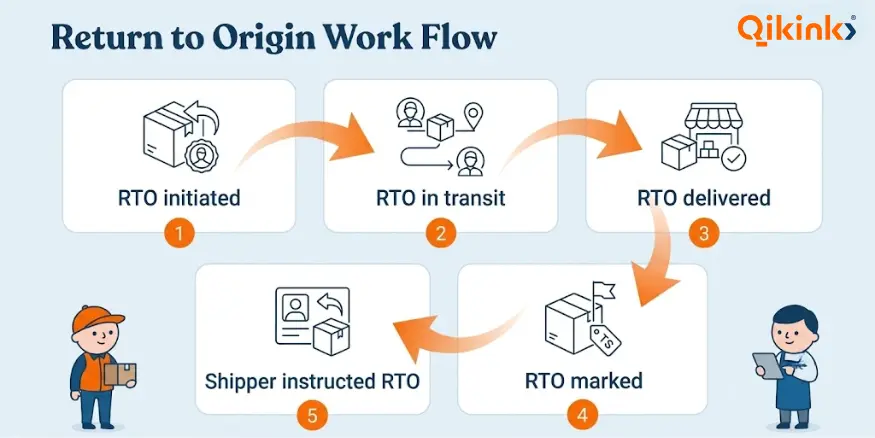
An RTO usually follows a failed delivery attempt. The courier may raise a non-delivery report, after which the seller or customer may be able to request another attempt. If the shipment is returned, its tracking status typically progresses through RTO initiated, RTO in transit and RTO delivered. The exact sequence and wording vary by courier.
| Status | What it means | What happens next |
|---|---|---|
| RTO initiated | The courier has decided to return the parcel. | The parcel is sent back, and the status changes to RTO in transit. |
| RTO in transit | The parcel is moving between courier hubs towards the origin address. | The parcel reaches the origin address, and the status changes to RTO delivered. |
| RTO delivered | The returning parcel has reached the origin address. | The seller or warehouse can inspect the parcel and update stock. |
| RTO marked | The tracking system has flagged the shipment for return. Some platforms label it “Marked As Return”. | The shipment enters the return journey, and later statuses show its progress. |
| Shipper instructed to RTO the shipment | The sender has asked the courier to return the parcel instead of continuing delivery attempts. The exact label varies by platform. | The courier processes the return and routes the parcel to the origin address. |
Once a shipment has moved to RTO, couriers may no longer accept a request for another delivery attempt.
Return to Origin Rate in India: Qikink Order Data
Source: Qikink order data, 1 Jan to 31 Aug 2026; 4,16,887 shipped orders. Last updated 12 October 2026.
How is the RTO Rate Measured?
RTO % equals RTO orders divided by shipped orders. RTO orders are orders that reached “RTO initiated” status at any point. Shipped orders include orders dispatched during the period that were either delivered or returned to origin. Orders still in transit when the data was collected are excluded.
The data comes from domestic orders fulfilled through Qikink for fashion-focused sellers and brands across apparel, accessories and home decor. These figures reflect Qikink’s order data, not the RTO rate of the entire Indian eCommerce market. Individual stores may have different rates depending on their customers, locations, payment options and fulfilment practices.
RTO Rate by Payment Mode (COD vs Prepaid)
RTO Rate by Payment Mode
COD orders had a 30.1% RTO rate, compared with 1.5% for prepaid orders.
Share of shipped orders returned to origin. Qikink domestic order data, 1 January to 31 August 2026.
View data table
| Payment mode | Shipped orders | Share of shipped orders | RTO orders | RTO rate |
|---|---|---|---|---|
| COD | 159,039 | 38.1% | 47,864 | 30.1% |
| Prepaid | 257,848 | 61.9% | 3,904 | 1.5% |
| All orders | 416,887 | 100% | 51,768 | 12.4% |
COD made up 38.1% of shipped orders but 92.5% of all RTO orders. COD orders were returned roughly 20 times as often as prepaid orders, so the share of COD orders has a large effect on a seller’s overall RTO rate.
Published RTO benchmarks vary by source and methodology. Shipway’s FY25 data reported an RTO rate of nearly 26% for non-prepaid orders, compared with under 2% for prepaid orders. These figures are from Shipway’s data and are not directly comparable with Qikink’s order data.
RTO Rate by T-Shirts
RTO Rate by T-Shirts
Raglan T-shirts had the highest RTO rate at 19.8%, while Oversized T-shirts had the lowest at 9.7%.
RTO rate, COD share and shipped orders by T-shirts.
View data table
| Product | Shipped orders | COD share | RTO rate |
|---|---|---|---|
| Oversized T-Shirt | 46,998 | 32.9% | 9.7% |
| Round Neck T-Shirt | 1,58,490 | 39.3% | 12.5% |
| Terry Oversized Tee | 16,939 | 43.1% | 14.3% |
| Raglan T-Shirt | 21,418 | 51.3% | 19.8% |
Raglan T-shirts had the highest RTO rate at 19.8%, followed by Terry Oversized Tees at 14.3%. Oversized T-shirts had the lowest RTO rate at 9.7%, while Round Neck T-shirts had the highest shipped orders (1,58,490) with an RTO rate of 12.5%. Raglan T-shirts had the highest COD share at 51.3%, followed by Terry Oversized Tees at 43.1%.
RTO Rate by State
RTO Rate by State
RTO rates range from 8.5% in Karnataka to 24.7% across the combined North-East states.
Share of shipped orders returned to origin. Qikink domestic order data, 1 January to 31 August 2026.
View data table
| State / region | Shipped orders | COD share of orders | RTO rate |
|---|---|---|---|
| Karnataka | 52,595 | 25.8% | 8.5% |
| Maharashtra | 85,676 | 31.9% | 8.7% |
| Delhi | 33,546 | 38.7% | 9.4% |
| Haryana | 22,873 | 34.7% | 9.8% |
| Tamil Nadu | 26,063 | 31.1% | 10.4% |
| Gujarat | 19,431 | 42.3% | 11.5% |
| West Bengal | 20,232 | 43.2% | 12.5% |
| Kerala | 12,417 | 32.6% | 12.6% |
| Telangana | 23,230 | 36.0% | 13.3% |
| Uttar Pradesh | 30,899 | 42.9% | 14.0% |
| Punjab | 12,208 | 52.1% | 17.6% |
| Rajasthan | 11,550 | 47.7% | 18.7% |
| All other states & UTs (combined) | 50,079 | 49.2% | 19.5% |
| North-East (8 states combined) | 16,088 | 62.1% | 24.7% |
The eight North-Eastern states combined had the highest RTO rate at 24.7%, followed among individual states by Rajasthan (18.7%) and Punjab (17.6%). Karnataka (8.5%) and Maharashtra (8.7%) had the lowest rates. COD accounted for 62.1% of orders in the North-East group and 25.8% in Karnataka.
Cite this data: Qikink, RTO data 1 Jan to 31 Aug 2026, qikink.com/blog/what-is-return-to-origin-how-it-affects-online-businesses/
Why Does Return to Origin Happen?
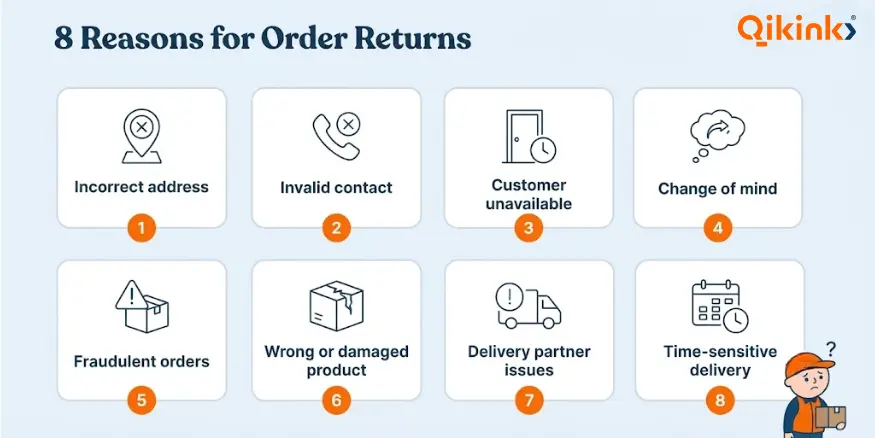
RTO happens when a courier cannot complete delivery, and the parcel is returned to its origin. Common causes include incorrect order details, customer unavailability or refusal, and problems with the product or delivery process.
1. Incorrect or incomplete delivery address:
A missing door number, wrong PIN code or misspelt street name can stop the courier from finding the address. Delivery attempts then fail.
2. Invalid contact information:
A wrong or unreachable phone number stops the delivery agent from confirming the address or delivery time with the customer.
3. Customer unavailability:
If nobody is at the address to receive the parcel, delivery attempts fail, and the courier may return it to the origin.
4. Change of mind:
A customer may refuse a parcel after finding a better offer, ordering the same item elsewhere or reconsidering the purchase. With cash on delivery, the customer has not paid at checkout, which can make refusal easier. In Qikink’s 2026 order data, COD orders accounted for 92.5% of all RTO orders.
5. Fraudulent orders:
Some orders are placed with false details or with no intention of accepting delivery, and they end as RTO. Because COD does not require payment at checkout, sellers may have less evidence of purchase intent before dispatch.
6. Wrong or damaged product:
A wrong size, wrong colour or damage can lead the customer to refuse the parcel at the door. This cause comes from the product or its fulfilment, not from the customer.
7. Delivery partner issues:
A courier may mark a parcel as undelivered because of a communication error or an operational mistake, even when the customer is available. Customers sometimes report that an attempt was logged without a visit to the address, and such cases are checked against the courier’s tracking records.
8. Event or time-sensitive delivery:
Orders meant for a festival, gift or event lose their value if they arrive late, and the customer may refuse them. Examples include seasonal products and gifts ordered for a specific event.
eCommerce Shipping: Complete Guide!
Learn the processes, shipping modes, courier selection, packaging, and tips
How Shipping in eCommerce Works →
How RTO Affects Online Businesses?
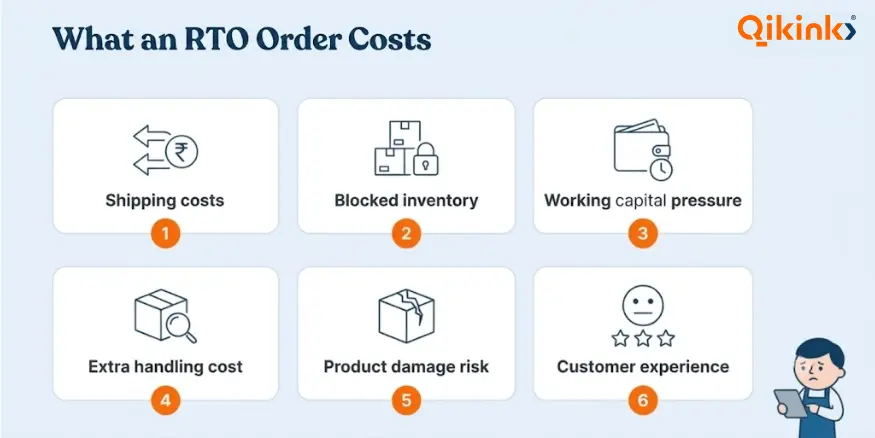
RTO affects an online business through shipping costs, blocked stock and lost sales, and the effect grows with the share of orders that are returned.
- Forward and return shipping costs: Depending on the courier and fulfilment arrangement, a seller may incur both forward and return shipping costs for an RTO order without completing the sale.
- Blocked inventory: Stock in the return cycle cannot be sold until it is received, inspected and restocked. Apparel sellers need to track sizes and colours, while home decor sellers may need to inspect fragile items for transit damage before reselling them.
- Higher working capital pressure: The money spent on the product stays locked until it is resold, which strains cash flow.
- Extra handling cost: Returned parcels need inspection, repackaging and stock updates, which add labour and packaging costs.
- Product damage risk: A parcel that travels twice and is handled more often can be damaged, and a damaged item may not be resold.
- Customer experience: A failed delivery can leave the customer dissatisfied, which can weaken repeat purchases and brand reputation.
GoKwik estimates that an RTO on a ₹1,000 COD order can cost a brand about ₹200 to ₹250, counting forward shipping, reverse logistics and operational costs. The actual cost varies with courier rates, product costs and the seller’s fulfilment arrangement.
How to Reduce RTO in eCommerce?
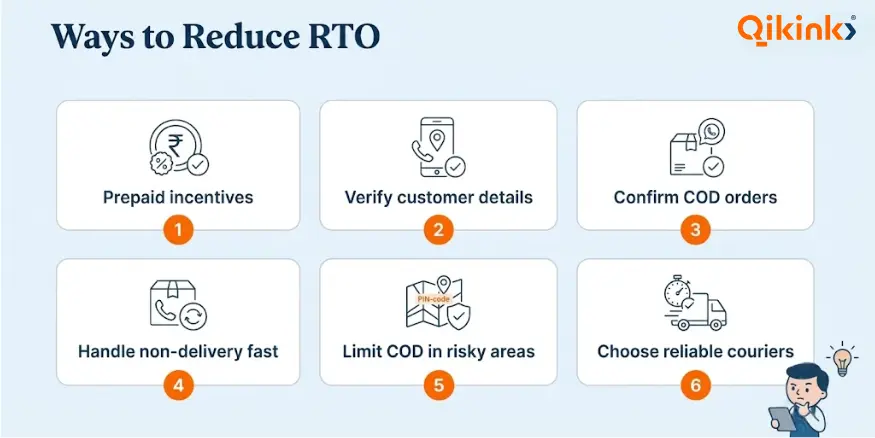
To reduce RTO in eCommerce, sellers can address the causes they control through payment options, address checks, order confirmation, failed-delivery follow-up, courier selection and accurate product information.
1. Offer prepaid incentives
Prepaid orders are paid before dispatch, so payment is not left to the moment of delivery. A small discount or cashback for paying online, shown at checkout, encourages prepaid payment. Some stores offer partial COD, where the customer pays a small amount online and the rest on delivery.
2. Verify address and phone details at checkout
Checkout can require a complete phone number, a valid PIN code and a landmark. These checks help prevent avoidable delivery failures caused by incomplete details, although they cannot confirm that an address is deliverable.
3. Confirm COD orders before dispatch
An SMS, WhatsApp message or call asking the customer to confirm the order helps screen out accidental and low-intent orders. It is a screening step, not a guarantee. Tracking updates after dispatch keep the customer aware of the delivery date.
4. Act quickly on non-delivery reports
When a courier raises an NDR (non-delivery report), the seller can correct the address, confirm the customer’s availability or request another attempt before the parcel is returned. For Qikink COD orders, check pending Delivery Exception orders regularly and take action before 3:00 AM, as instructed in Qikink’s Automatic NDR Flow documentation.
5. Limit COD in high-return areas
Tracking RTO by state, PIN code and repeat customer shows where returns concentrate. Based on their own data, sellers can choose to require prepaid payment or extra confirmation for those areas or customers.
6. Choose couriers by delivery performance
Review delivery success rates and transit times when selecting courier partners, since delays can increase the risk of refusal, particularly for time-sensitive orders. Checking that the courier serves the customer’s PIN code before dispatch also avoids failed deliveries to areas it does not cover.
7. Give accurate product information
Clear descriptions, photos and size guides reduce refusals caused by a gap between the product and what the customer expected, which matters most for apparel, where size and colour mismatches are a common reason for refusal.
What Online Sellers Should Watch?
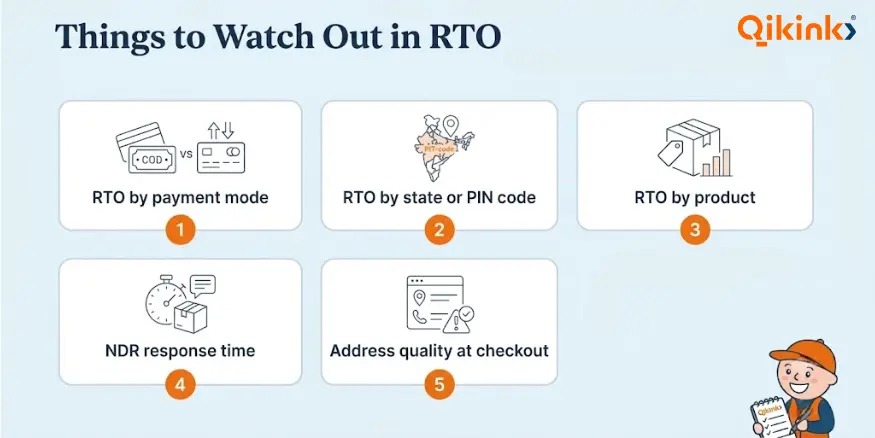
Sellers can monitor five measures to identify where RTO occurs and where changes to order handling may help. For payment mode, state or PIN code, and T-shirt category, the RTO rate is the number of RTO orders divided by the number of shipped orders in that group.
- RTO rate by payment mode: Compare COD and prepaid rates. A large gap shows the difference in RTO rates between the two, although the comparison alone does not establish the cause.
- RTO rate by state or PIN code: This identifies locations with higher RTO rates, so those areas can be handled with extra confirmation or prepaid payment. A location with many orders can have many RTOs but a low rate, so compare rates, not counts.
- RTO rate by product category: This shows which products have higher RTO rates, helping sellers review product descriptions, sizing information and COD settings. The rate alone does not show why those orders were returned.
- NDR response time: This is the time a seller takes to reply to a failed-delivery report. Slow replies leave less time to correct an address or arrange another attempt.
- Address quality at checkout: This is the number of orders that need an address or phone correction after the order is placed. Frequent corrections point to weak checkout validation.
What are the Challenges in a COD Order?
Prevent returns, improve prepaid order conversions and increase profit margin
Cash On Delivery Problems →
How does Qikink manage Return to Origin?

Qikink is a dropshipping platform in India that fulfils orders for online sellers. Qikink does not charge sellers an RTO fee for undelivered COD or prepaid orders. Returned parcels go to Qikink’s warehouse and appear in the returns management system on the seller dashboard.
Qikink stores returned products for 100 days from the date they are marked as returned. Sellers can reship them to the same or a different address during this period. Storage costs ₹20 plus 18% GST per product for the 100 days, and shipping is charged separately.
For COD orders, Qikink’s Automatic NDR Flow sends the customer a WhatsApp message under the seller’s brand name after a failed first attempt, with options to redeliver or cancel. If the customer does not respond within 24 hours, the order appears under Delivery Exception in the seller dashboard, where the seller can request a reattempt or cancel the shipment. If neither acts within 72 hours, the shipment moves to RTO.
Frequently Asked Questions
1. How to Reduce RTO in an eCommerce Store?
2. What Are the Common Reasons for RTO?
3. What Is the Difference Between RTO and NDR?
4. Who Pays the Shipping Charge on an RTO Order in India?
5. What Does Returned to Origin at Shipper’s Request Mean?
6. What Are the Costs Associated With an RTO Order?
7. Can a Prepaid Order Also Become an RTO?
Final Thoughts
RTO happens when a shipment fails to reach the customer and is sent back to its origin. Tracking statuses show where the parcel is, and the RTO rate by payment mode, state and T-shirts shows where a seller can act. Prepaid options, address checks, order confirmation and a quick reply to each NDR address the causes sellers control.
Online sellers looking for a fulfilment partner that supports COD without RTO fees can consider Qikink’s dropshipping service. Qikink does not charge an RTO fee for undelivered COD or prepaid orders.
Join Today for Free →Read More
- How to Sell Products Online in India: Complete Guide
- Reverse Dropshipping: Meaning and How It Works
- B2B Dropshipping In India: Guide on How to Start
- Top Best Payment Gateways in India for eCommerce
Share the Article


